Australian real estate outlook 2027: Near-term caution, long-term opportunity

Key takeaways
- Higher interest rates and economic uncertainty are making commercial tenants more cautious, while retail spending has remained resilient.
- We expect steady improvement in office markets over the next 12 months as supply moderates.
- Upward pressure on capitalisation rates will likely drag on near-term returns, but any fall in prices could create buying opportunities for patient investors. High-quality assets in core locations are likely to prove the most resilient.
Australia’s real estate market is under pressure from rising interest rates and an uncertain economic outlook. Yet many segments continue to offer value, and a slowdown in supply can be constructive for long-term investors and portfolios built around durable cashflows and resilient demand.
November 2026's interest rate decision pushed Australia’s cash rate to the highest since 2008 – and further tightening cannot be ruled out. Unlike the period following the 2008 Global Financial Crisis, when Australian real estate investors who entered the market were rewarded across all types of assets and locations, this cycle will produce both winners and losers. Institutional investors with the required operational capability will be able to unlock value. While IFM Investors’ senior leadership has been through softening cycles before, with the platform benefiting from a strong operational capability, these are uncharted waters for less seasoned owners and investors.
In a higher-rate environment, coupled with persistent inflation and slower growth, tenants who might otherwise have sought new premises will be more cautious about moving, particularly in the office and industrial segments, to avoid relocation costs. However, the bifurcation of the office market will continue, with tenants willing to move gravitating towards high-quality buildings close to public amenities. This occurs against a backdrop of a significant slowing in office development, and the industrial sector is set to follow that trend.
Ongoing efforts to cool the economy warrant a cautious outlook. That said, we anticipate higher capitalisation rates – and the resulting pressure on asset prices – to create long-term buying opportunities, and we will continue to seek returns from high-quality real estate assets across multiple segments.
Despite recent commentary around the impact of AI on white-collar careers, we do not predict an immediate impact on office demand.
Does buying beat developing office projects?
In the office market, the strength of tenant demand gives us confidence going into 2027. Demand has held firm in Brisbane and Sydney, with Melbourne showing signs of recovery despite its central business district continuing to have the highest office vacancy rate among comparable markets. Canberra, meanwhile, has struggled, with new supply meeting muted interest.1
Despite recent commentary around the impact of AI on white-collar careers, we do not predict an immediate impact on office demand. AI-linked staffing changes should be taken seriously, but not viewed in isolation.2 Many recent employment decisions – often linked to AI-led efficiencies in press coverage – instead reflect the economic cycle and market and margin pressure. In the medium term, some roles are likely to be reduced, others redefined. New functions will emerge, offering opportunities for upskilling, as businesses learn how to use the technology effectively. In light of these developments, a place will remain within the community for high-quality office sites that attract workers through their amenity.
Looking at the year ahead, the challenge facing the sector now is one of feasibility. Investors able to deploy capital into the office sector in 2027 will need to ask whether new office developments stack up. On the evidence, it appears some will struggle.
Across state capitals, even the strongest markets are unable to charge levels required to cover the cost of construction. Sydney, the office market where the gap is smallest, was reporting market rents 18% below economic rents – a rift that widened to a chasm when looking at Perth, where the gap was 39%.3
Graph 1: Market vs economic rent forecasts for Sydney and Melbourne
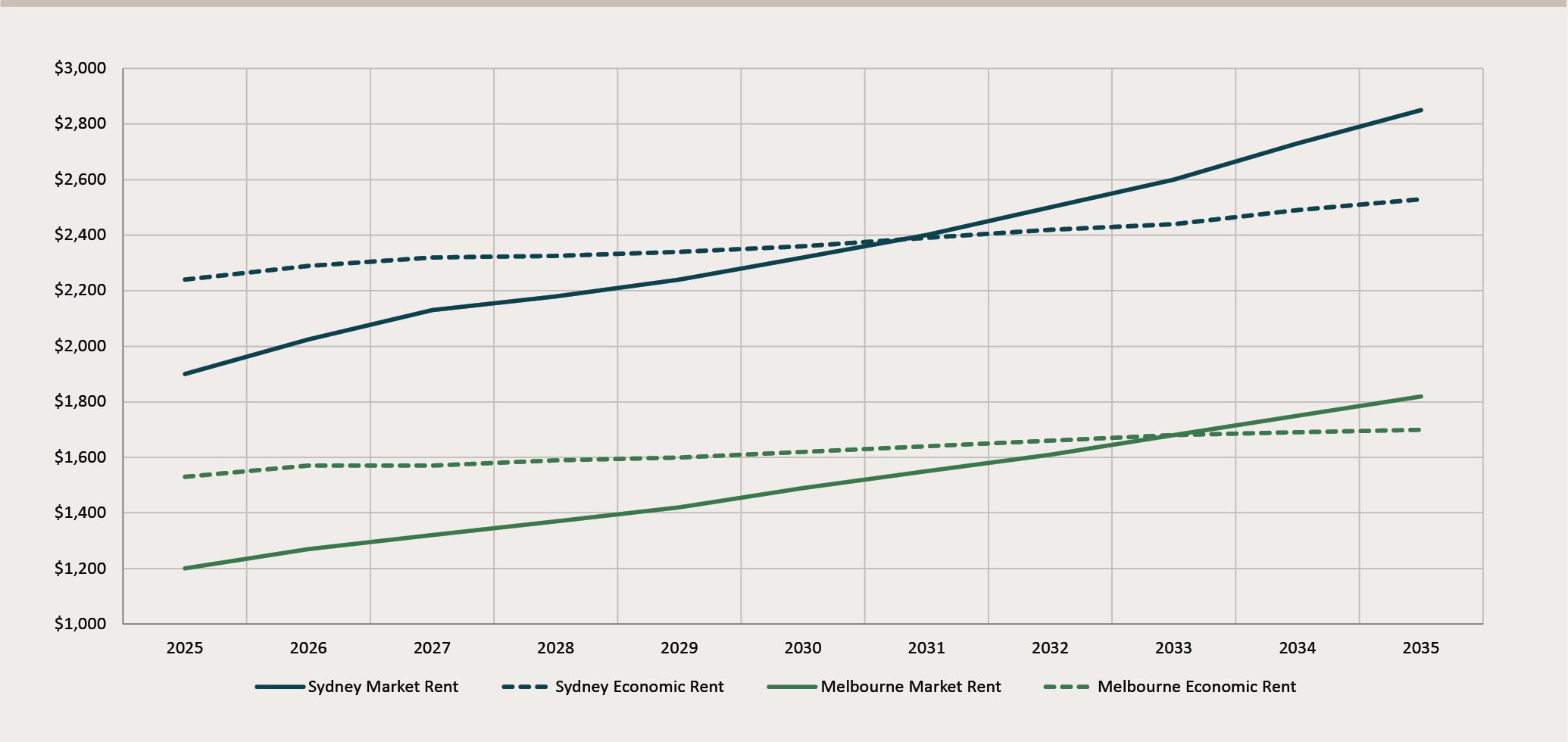
Source: Cushman & Wakefield
Faced with harsh economic realities, some owners of existing A-grade office stock will begin 2027 holding valuations higher in the expectation that capitalisation rates will compress. This means patient and agile investors with a strong balance sheet will still be able to grow their office holdings. This is despite forecasts of only 200,000 square metres of new floor space completing in both 2027 and 2028, across Australia’s five largest cities – compared to close to 600,000 square metres completed in Sydney alone during 2024.4 With construction costs rising, CBRE projects the next five years to be the lowest for new office supply since the 1990s.5
The slowdown in new developments combined with falling vacancy will ultimately shift negotiating power in favour of landlords, and we expect rental income to hold up well as a flight to quality continues.
Stagnating per capita spending requires resilience
Across other sectors, durable cashflows and pricing power take on increased importance in the current environment.
In industrial real estate, vacancy rates have moved higher in Sydney, Melbourne and Adelaide, albeit from lows not often seen in the market.6 Nonetheless, we see room for improvement over the coming year. Warehouses and logistics, in particular, are likely to benefit from long-term demand as geopolitical risks drive Australian businesses to move more of their supply chains and inventory closer to home.
Retail, meanwhile, remains broadly resilient – as we noted in our 2026 outlook. Household spending was up 6.8% year-on-year in August 2026, according to the Australian Bureau of Statistics. This supported our positioning, although there are signs that high energy prices and interest rate increases are starting to have a cooling effect on discretionary spending.7 According to Deloitte Access Economics8, this is forecast to slow to 0.7% in 2026-27, down from 1.9% the previous financial year. Additionally, much of recent retail growth has been nominal, and once inflation is stripped out, the figures for per capita spending paint a more subdued picture – illustrating how much of Australia’s recent success has been aided by population growth.
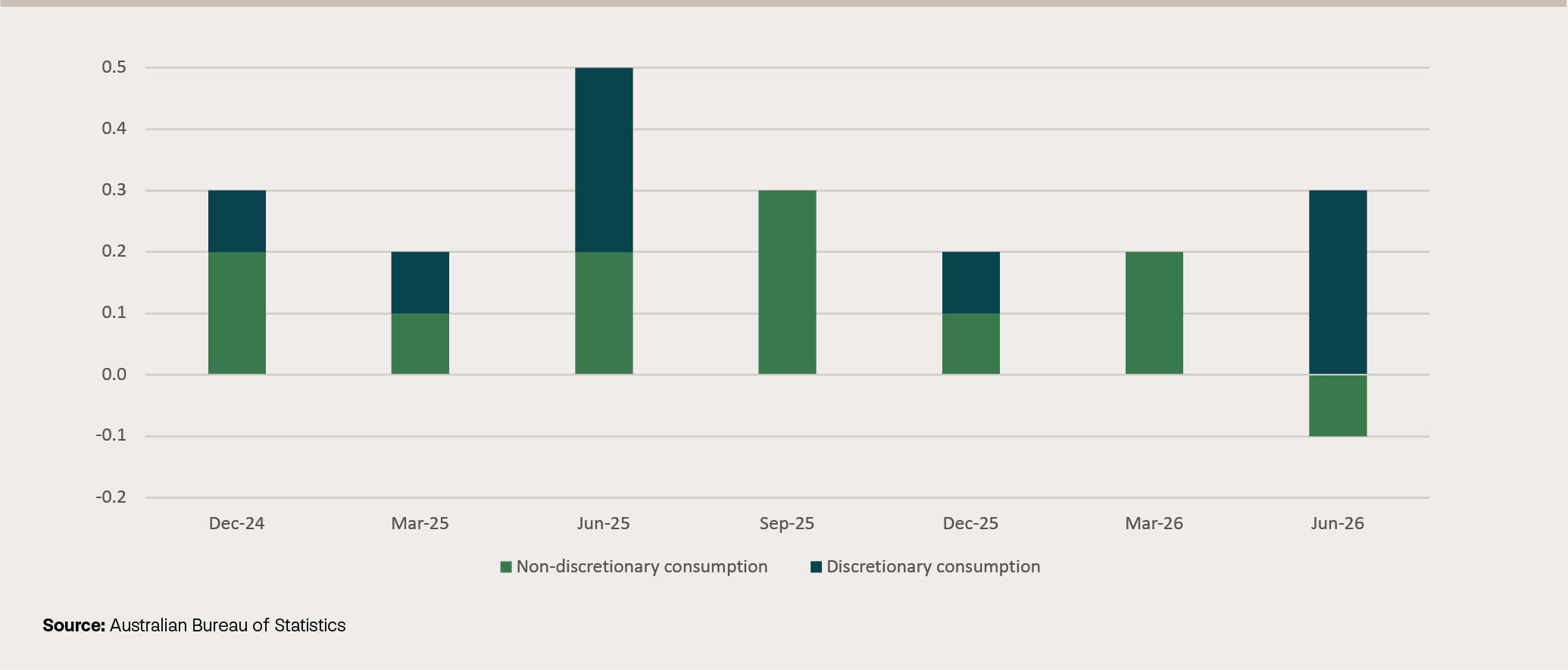
Graph 2: Discretionary and non-discretionary consumption contributions to quarterly growth in GDP
Source: Australian Bureau of Statistics
Local demand for grocery and convenience, provides a solid foundation for neighbourhood and regional retail sites going into 2027. Developments anchored by grocery stores and other non-discretionary spending will likely be more protected as household spending is pinched, with the June 2026 quarter decline in non-discretionary spending visible in Graph 2 largely attributable to lower fuel costs resulting from the reduction in fuel excise duty. CBD locations may benefit as foot traffic builds back towards pre-pandemic levels. Major national brands continue to seek out sites they expect to perform strongly beyond the current cycle.
A market facing headwinds
The economic backdrop means the next 12 months are set to be more challenging overall for Australian real estate. Recent rate increases are likely to have the intended effect of reducing consumer spending, with knock-on impacts for the wider real estate market.
Investors with core strategies are likely to be well positioned for this cycle. Those with a strong focus on proven assets in markets with lower vacancy rates and real pricing power may be able to protect against inflation.
Healthy outlook for healthcare, life sciences and education
Australia’s ageing population and growing university sector will continue to generate opportunities in the healthcare, life sciences and education sectors. While recent reforms to the aged care system placed renewed emphasis on in-home support, this only slightly reduces the growing demand for retirement living options.
Healthcare precincts will also grow in importance. By offering an ageing population the ability to have their medical needs met in one place, they have the potential to improve healthcare outcomes. The University of NSW’s Health Translation Hub, an asset within IFM Investors’ real estate portfolio, illustrates how the sector might evolve. It brings acute healthcare services under the same roof as researchers and the next generation of healthcare professionals.
Where alternative real estate can outperform in 2027
Some alternative segments of the real estate market are well placed to outperform in the current cycle.
The rapid growth in data centres – sitting at the intersection of the real estate and infrastructure markets – will likely lead to increased competition for land suitable for industrial real estate. However, we do not anticipate data centres and industrial projects to crowd each other out over the longer term, given Australia still has ample potential industrial land and development sites. Developers are more likely to compete over whether banked land is used for one or the other, allowing rapid development to meet growing demand in both sectors. In the short term, developers in Australia will need to address the challenge of their social licence if they wish to succeed. This is most apparent where developments are proposed within residential neighbourhoods, often requiring significant upgrades to existing power infrastructure and measures to address local concerns about noise.
An emerging risk for the education and student accommodation sectors centres on a potential reduction in Australia’s migration intake and its impact on attracting international students, as political parties debate the level of acceptable immigration.
Beyond the near-term cycle, the investment case for Australian real estate remains supported by constrained new supply, structural demand across several sectors and opportunities created by repricing. For investors, current market conditions may create attractive entry points into high-quality assets positioned to benefit as the cycle turns.
[1] Property Council of Australia (2026), Melbourne office market stabilising, but nation’s highest vacancy underscores work ahead on better policy and tax settings; Brisbane bucks the trend as CBD office vacancy plunges; Sydney CBD vacancy falls as premium demand drives office recovery; Canberra office vacancy jumps as new supply lands, but Civic remains the critical challenge.
[2] Bradley Speers, Maximus Girgis (2026), The impact of AI on the office sector
[3] Cushman & Wakefield (2026), The cost to build: Rising economic rents are constraining new office supply, p. 5
[4] Ibid., p. 4
[5] CBRE (2026), Why 2026 is the year of the office for investors
[6] CBRE (2026) Australia’s national industrial & logistics vacancy remains steady at 3.2%
[7] Australian Bureau of Statistics (2026), Household spending unchanged in August
[8] Deloitte Access Economics (2026), Deloitte Access Economics Retail Forecasts

Scott Mosely
Scott is IFM Investors’ Head of Real Estate, overseeing a portfolio of office, industrial, retail and social infrastructure, as well as the health and education assets.

Private Markets Macro Outlook 2027: AI, energy and a less predictable world
Much of what happens in 2027 will come down to two things: how fast AI investment keeps growing, and how often energy supply is disrupted. Neither is easy to forecast, which makes resilience in portfolio construction more important than any single call.