2027 global economic outlook: Economic resilience amid structural change

Key takeaways
- Economic and investment outcomes are increasingly diverging across countries, sectors and asset classes as geopolitical fragmentation, industrial policy, defence spending and rising state intervention reshape economies in different ways.
- Investment linked to AI is creating new sources of demand for energy, infrastructure and industrial capacity.
- The most valuable assets in 2027 may be those that enable economic transformation while retaining the capacity to withstand supply shocks, demand shocks and a structurally more demanding cost-of-capital environment.
The global economy enters 2027 having proved more resilient than many anticipated. Yet resilience should not be mistaken for stability. Economic and investment outcomes are increasingly diverging across countries, sectors and asset classes as geopolitical fragmentation, industrial policy, defence spending and rising state intervention reshape economies in different ways.
At the same time, investment linked to AI is creating new sources of demand for energy, infrastructure and industrial capacity. For investors, the defining feature of 2027 might be less about whether growth is stronger or weaker, and more about the growing dispersion of outcomes across markets and assets.
Geopolitical risk, populism and the shift from efficiency to sovereign resilience
For much of the post-Cold War period, economic policy and corporate strategy were organised around efficiency. Governments supported trade integration, fiscal restraint and market liberalisation, while companies built globally distributed supply chains designed to minimise costs and inventories. That model delivered substantial gains, but also left large parts of the economy exposed to the risk of supply chain shocks.
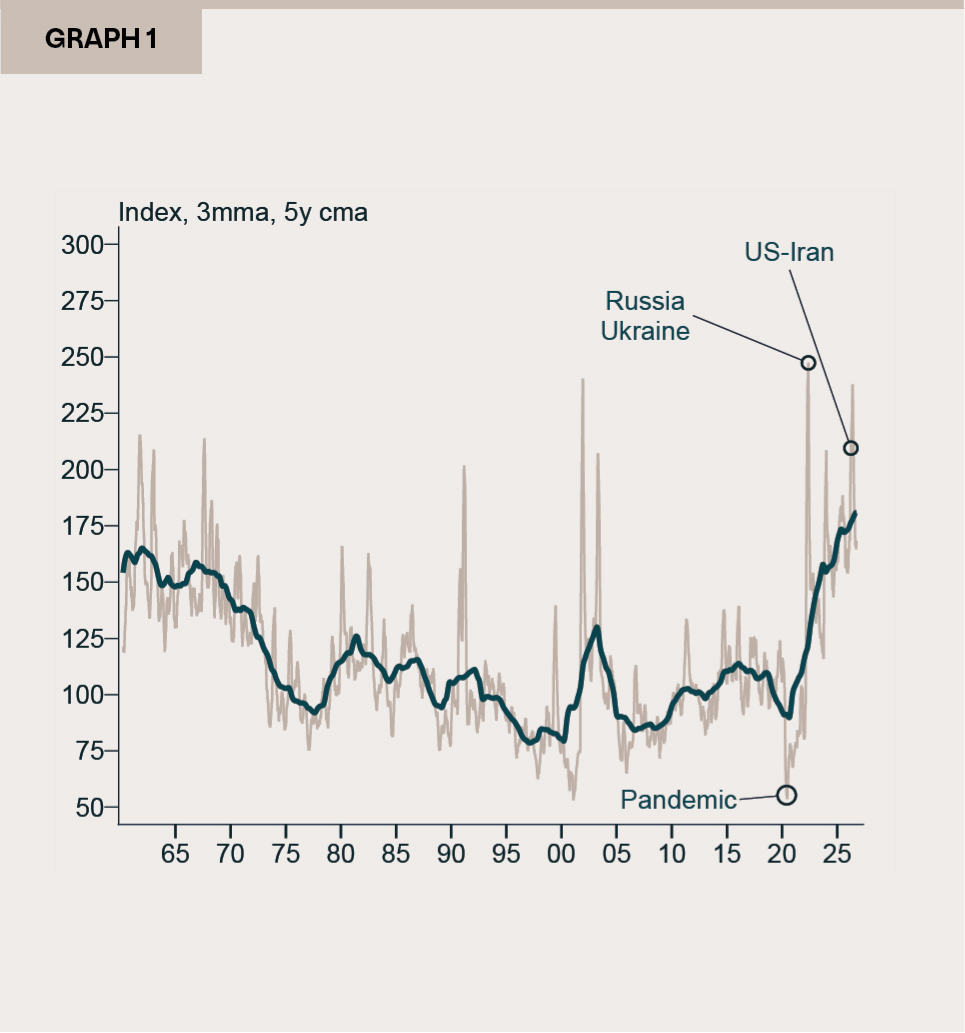
Geopolitical events are no longer brief, isolated sources of market volatility. Strategic competition, energy-security concerns and growing trade and technology restrictions are becoming structural influences on inflation, exacerbated by the barrel price of oil repeatedly approaching or exceeding US$110 during 2026. Protectionism and domestic self-sufficiency may improve sovereign resilience, but risk weakening productivity and long-run economic potential.
Graph 1: Geopolitical risk index, 1960 to present
Source: IFM Investors, Matteo Iacoviello
Geopolitical risk may also increasingly be defined by the rise of populism, particularly in economies that have traditionally been pillars of the global order. The next 12 months will see elections held in a number of European countries where populist parties are increasingly competitive – notably Spain, France and Italy – while recent successes enjoyed by Germany’s far-right Alternative für Deutschland are unsettling an already weakened federal coalition. Populist governments may favour visible fiscal measures over productivity-enhancing reform, while placing greater pressure on central banks and other institutions responsible for policy credibility, undermining wider economic confidence.
Governments and businesses are left reassessing domestic industrial capacity and access to what are now regarded as politically sensitive technologies. Redundancy, once viewed simply as a cost, is increasingly understood as insurance and strategic capability.
The macroeconomic effects are likely to be stagflationary at the margin. Trade fragmentation, duplicated capacity and disrupted energy or commodity flows can raise inflation while reducing productivity and potential growth. Fiscal support, defence spending and industrial subsidies may cushion activity, but can also increase public borrowing and limit central banks’ scope to ease. Many fiscally constrained governments face mounting pressure to lift defence spending towards NATO’s 3.5% GDP target – 5% including defence-related infrastructure – while already in deficit.
These mildly stagflationary dynamics should support investor interest in essential infrastructure, specialised real estate, adaptable businesses and flexible financing. Assets with durable revenues, credible inflation pass-through and manageable refinancing exposure should be best placed.
Global growth in 2027 is likely to remain below trend but resilient to material downside risks, with limited scope for a strong upswing.
AI is the next global investment cycle
Artificial intelligence is the most compelling source of long-term upside in the 2027 global economic outlook, but it should initially be understood as an investment cycle rather than simply a technology theme. Adoption at scale requires data centres, electricity generation and transmission, semiconductors, communications infrastructure, cooling, water and storage – placing private markets near the centre of a cycle needing to balance finite labour with limited, in-demand equipment.
The economic upside will depend on how effectively firms adopt and use AI. Any potential upside will further depend on the extent to which task-level efficiencies translate into economy-wide productivity. Firms will retrain workers and re-engineer workflows, but it will take time for any potential gains to become sustained output growth and improved productivity.
In the near term, the infrastructure build-out should support investment and growth. It will also significantly increase electricity demand and intensify competition for already scarce resources – capital, construction materials and workers – with ambiguous effects on inflation and upward pressure on rates. If adoption disappoints, a retrenchment in capital expenditure, valuations and hiring could become a material demand shock. Investor uncertainty around whether AI developers’ revenues would match their substantial investment continues to be expressed in equity market volatility and spread widening in debt markets.
The opportunity increasingly sits adjacent to the theme
The strongest risk-adjusted opportunities may lie not in the headline theme itself, but in the assets that enable it. Data centres require electricity and transmission; renewable generation needs storage and grid capacity; supply-chain resilience depends on ports, logistics and transport; and defence capability requires manufacturing capacity, secure communications and critical inputs.
These connections will increasingly blur traditional asset-class boundaries. A data centre can simultaneously be categorised as a digital asset and a property development – while the sector’s growth will see a structural increase in energy demand. Advanced manufacturing and logistics systems similarly combine land, power, water, transport and communications.
Adjacent assets can share the structural tailwinds of the headline theme while benefiting from the barriers to entry created, including long lead times and demand for a limited number of experts. Portfolios may benefit from both the investment trend and owning the constraints to its expansion across the wider private markets spectrum – spanning infrastructure, real estate, private equity and private credit.
Inflation shocks may be less extreme, but more frequent
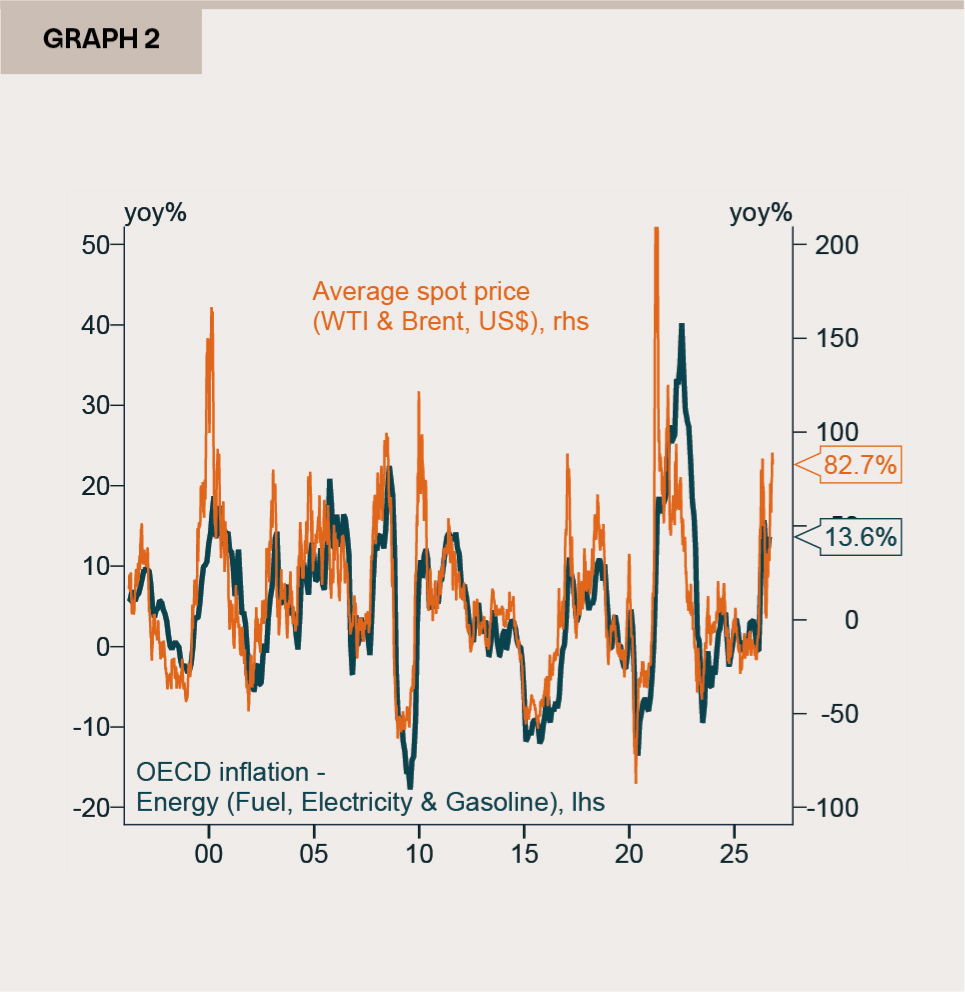
The pre-pandemic environment built around globalisation, with abundant labour and persistent disinflation, is giving way to more frequent cost pressures associated with geopolitical disruption, leading to more assertive industrial policy. The conflicts in Ukraine and the Middle East are leading to increased defence spending and further fuelling the energy transition. The pandemic, tariff tensions and conflicts illustrate how supply shocks can raise inflation while weakening potential output. Future shocks need not match the extremes experienced earlier in the decade to sustain uncertainty around monetary policy and risk-free rates. This view is supported by the steady revision upwards of both private and public sector forecasts of inflation for 2026 and 2027. This comes from existing domestic pressures, technology tailwinds turning to headwinds and the continued impact from oil and energy supply shocks.
Graph 2: Energy price inflation and oil prices
Source: IFM Investors, OECD, International Energy Agency
The result is a less favourable growth-inflation trade-off. Repeated cost shocks can compress real incomes and margins while leaving inflation above target, limiting central banks’ ability to support weaker activity. Even when policy rates fall, inflation uncertainty could keep risk premia and long-term yields above the levels of the previous decade.
For private assets, inflation protection cannot be assessed by labels alone. Infrastructure may offer explicit or implicit inflation linkage, but its quality depends on regulation and the extent of permissible cost pass-through. Meanwhile, real estate outcomes depend on a range of conditions, including lease structures, supply conditions and whether rents adjust faster than operating and financing costs. Private credit can benefit from floating-rate income, but only while borrowers can service the higher interest burden.
Modest but dispersed growth, rising bond yields and the importance of the next shock
Global growth in 2027 is likely to remain below trend but resilient to material downside risks, with limited scope for a strong upswing. Outcomes will vary more by country, depending on exposure to energy shocks and the other risks above.
The US is best placed to capture the near-term effects of the AI investment cycle because of its capital markets, technology ecosystem and digital infrastructure. Countries most exposed to the AI opportunity could see larger productivity gains if adoption succeeds, but also face greater downside risk.
This reinforces the wider theme of modest but increasingly dispersed growth. Geopolitical fragmentation and populism may support activity in sectors benefiting from industrial policy, defence spending and supply-chain reconfiguration, but could weaken aggregate productivity and potential growth. AI and investment in enabling infrastructure may provide a counterweight by supporting capital expenditure and eventually expanding productive capacity.
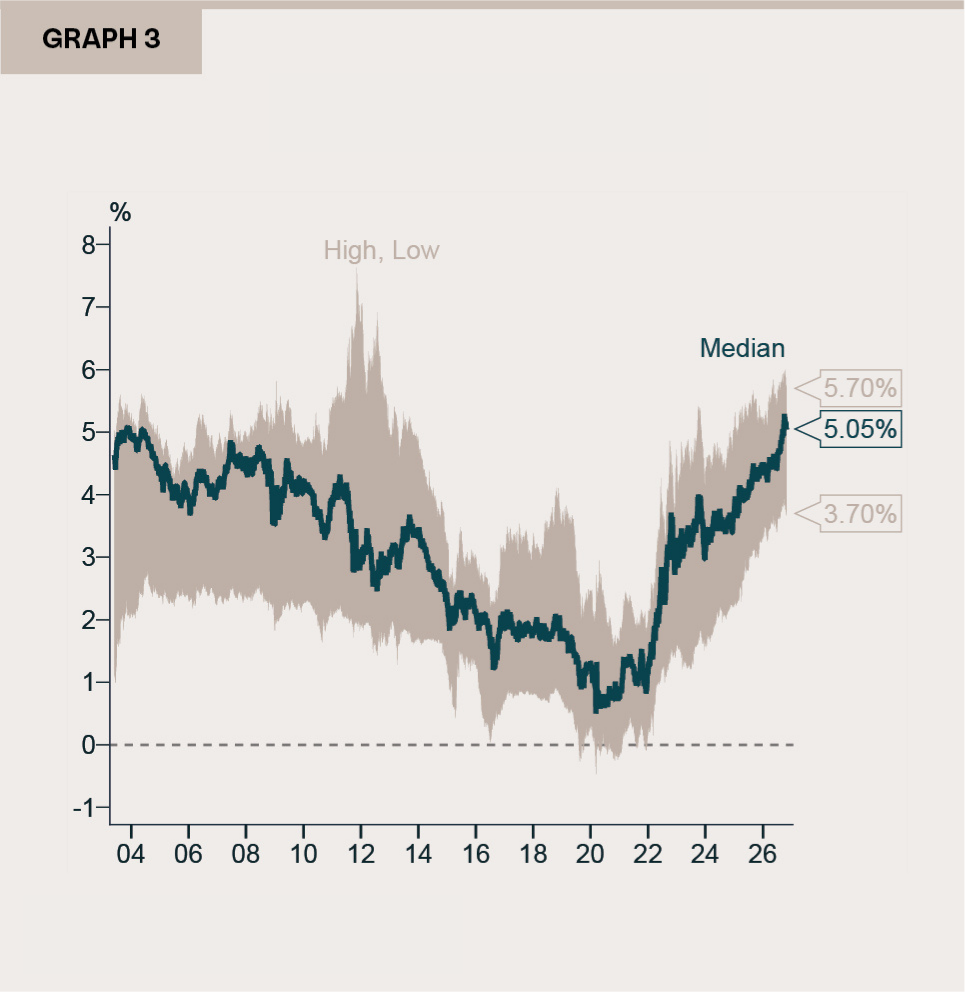
A further concern is the rise in long-end government bond yields. Persistent inflation uncertainty is part of the explanation, but the impact of rising borrowing costs on deficits and fiscal sustainability should not be underestimated. Public borrowing for defence, industrial policy, ageing populations, strategic autonomy and the energy transition is competing with substantial private financing requirements associated with AI and infrastructure investment.
Graph 3: G7 30-year bond yields
Source: IFM Investors, Bloomberg, IMF
Higher long-term yields matter even if central banks were to cease increasing policy rates – which cannot be guaranteed in 2027, as many G7 economies, notably the US, seek to reduce inflation.
The valuation implications are equally important due to the link between sovereign yields and discount rates across public and private markets. Real estate and infrastructure are exposed through both discount rates and refinancing costs, although contractual revenues and fixed-term financing offer some protection. Private credit may benefit from higher contractual income, but would face increased risks where borrowers face more difficult refinancing or declining collateral values. Changes in risk-free rates are a whole-of-portfolio issue, not just a fixed-income concern.
Is a demand-led downturn likely in 2027?
Recent history suggests the next economic shock is at least as likely to originate from supply as from demand. The pandemic has given way to conflict-led energy and trade disruption, demonstrating how constraints on any one area of the production cycle can raise inflation while weakening activity.
The distinction matters for both policy and portfolios. Demand shocks generally push growth and inflation in the same direction, allowing monetary policy to address both objectives. Adverse supply shocks weaken activity while raising prices, forcing central banks to choose between supporting growth and containing inflation. Monetary policy can manage demand, but it cannot directly replace disrupted energy supplies, unavailable workers or lost productive capacity.
Prolonged geopolitical tensions, increased protectionism or an energy interruption would operate mainly through supply, raising costs, weakening potential growth and delaying rate cuts. Other scenarios, including a confidence shock or financial-market correction, would be more conventionally demand driven. AI could generate either outcome: successful adoption could expand productive capacity and support non-inflationary growth, while excessive investment followed by disappointment could produce a correction in capital expenditure, employment and asset valuations.
Within private markets, asset resilience must mean the capacity to perform across supply and demand shocks and a wider range of interest-rate outcomes.
For private market investors, the opportunity lies where fragmentation, AI and persistent cost pressures intersect: power, transmission, storage, digital infrastructure, logistics and specialised property, alongside adaptable businesses and carefully structured credit. The most valuable assets may be those that enable economic transformation while retaining the capacity to withstand supply shocks, demand shocks and a structurally more demanding cost-of-capital environment.

Alex Joiner
Alex is Chief Economist at IFM Investors. He is responsible for the firm’s economic, financial market and geopolitical risk analysis that is key in IFM’s investment process. In this capacity he engages with IFM’s domestic and global clients on macro-investment trends and themes.

Private Markets Macro Outlook 2027: AI, energy and a less predictable world
Much of what happens in 2027 will come down to two things: how fast AI investment keeps growing, and how often energy supply is disrupted. Neither is easy to forecast, which makes resilience in portfolio construction more important than any single call.