Key takeaways
- Infrastructure debt may offer a broader opportunity set than many investors assume, spanning investments across the credit spectrum.
- Duration and structure can be tailored to different portfolio objectives such as liability matching, flexibility and interest-rate risk management.
- Complexity may create potential value when supported by specialist underwriting and active management.
For investors seeking diversified income, downside protection and differentiated private credit exposure, infrastructure debt may offer a compelling way to finance the assets that keep economies moving.
Investors have historically turned to infrastructure as a resilient private markets asset class. Many institutional investors focus on the equity side of the capital structure to generate yield with potential upside but often overlook the debt side. We believe infrastructure debt plays a core role in a private debt asset allocation but misconceptions about the asset class mask its true appeal. In the current market environment, when investors are looking for income, resilience and differentiated sources of return, these misconceptions risk obscuring the role infrastructure debt can play in a diversified portfolio. By dispelling three common myths around yield, duration, and complexity, we can better understand breadth of the opportunity set.
Myth one: Infrastructure debt is low-yielding
As Chart 1 shows, infrastructure can offer a range of risk profiles and corresponding yields available across the credit spectrum. For many liability matching investors seeking yield enhancement relative to liquid fixed income, investment-grade debt provides an opportunity, with BBB spreads typically in the 150-275 bps range. There are also higher-yielding opportunities in the sub-investment grade (IG) space that offer spreads in the 400-600bps range, aligning with a risk/return optimisation strategy typically seen in private credit allocations.
Across the credit spectrum, we believe investors may benefit from improved resilience from asset centric business models and predictable revenues typical of the infrastructure asset class. We expect that spreads in infrastructure debt move with wider credit conditions; however, we have found this spread opportunity to be relatively stable over multiple market cycles.
We believe investors should be cautious when approaching the mezzanine part of the capital stack of an infrastructure business. We have observed that investors can start to lose the benefits of resilient businesses when too many protections are given up. As a result, investments can begin to resemble equity risk with limited upside and lack of control.
Chart 1: Typical risk and return characteristics of infrastructure debt
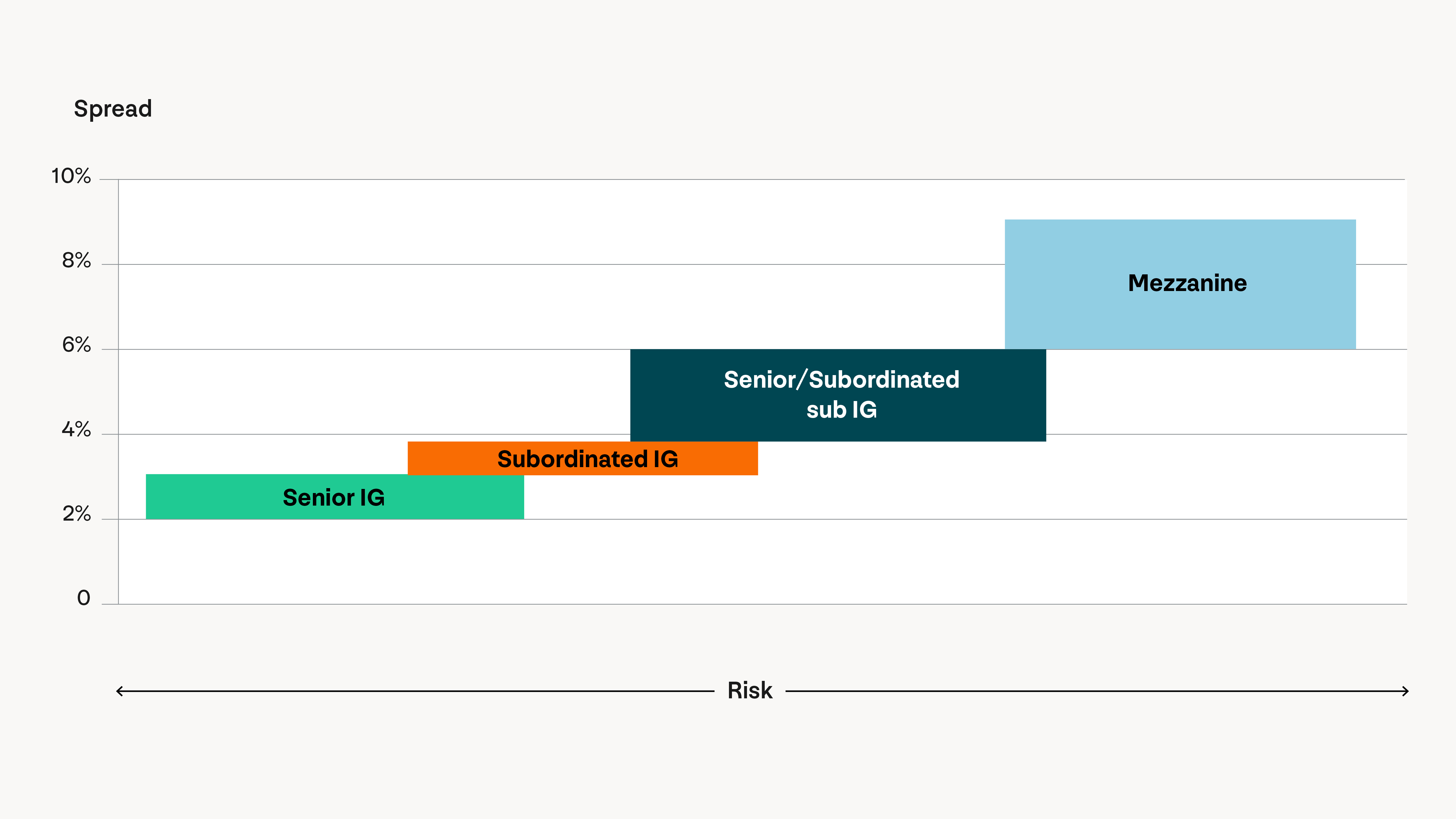
Source: Dealogic, ProjectWare, IFM proprietary data – as of 31 March 2026. Credit spreads are indicative of current market conditions and are subject to change at IFM’s discretion.
Myth two: All infrastructure debt is long duration
Many large-cap, core infrastructure businesses – like regulated utilities and contracted renewables – can often secure long-term debt financing, with tenors typically spanning 10 to 30 years. These long-dated investments remain an ideal match for investors with long-dated liabilities. Chart 2 illustrates how infrastructure businesses across various sectors, sizes, and business models can support different debt profiles, including shorter-dated and floating-rate debt. Within the sub-IG market, many investments are floating-rate with a weighted average life (WAL) between 4-8 years. Together, these characteristics can help investors insulate their portfolios from inflation and potential changes in interest rates. Features like amortization profiles, cash sweeps, and step-up coupons can also help manage refinancing risk.
Chart 2: Maturity/WAL profiles of select floating-rate sub-IG investments executed by IFM
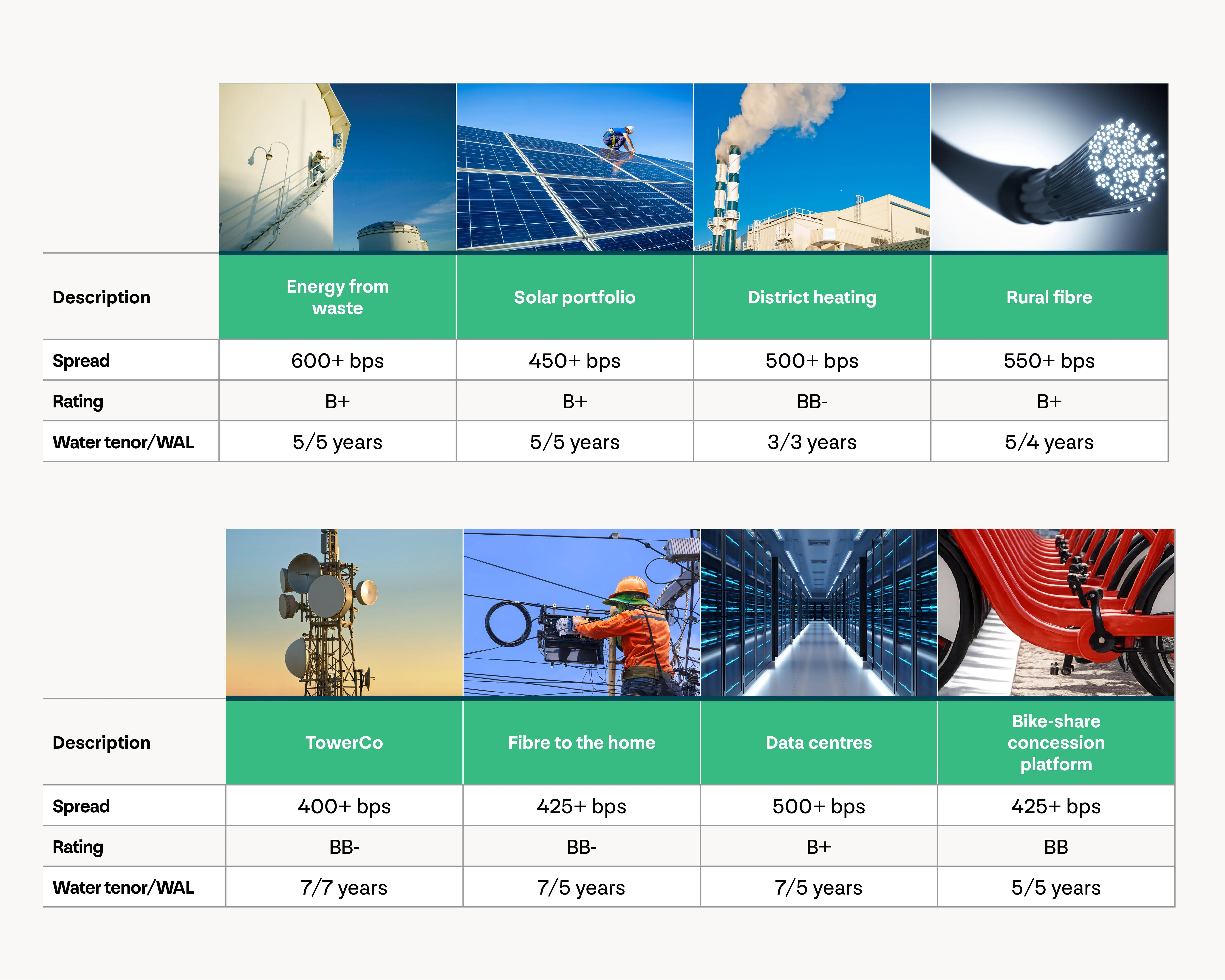
Source: IFM Investors. Notes: Investments were selected as recently executed sub-IG investments in one of IFM’s unconstrained sub-IG focused infrastructure debt portfolios.
The above case studies discuss certain portfolio companies in which funds managed by IFM Investors has made investments. This information is solely provided as an illustration of the types of investments considered by the prior funds and does not purport to be a complete list of all such investments. Not all of the investments made by prior funds and mandates have been successful as the case studies discussed herein. There is no guarantee that IFM Investors will be able to procure investments with the same or similar investment parameters.
Myth three: Infrastructure debt deals are complex and operationally challenging to manage
This myth is only partially true, but for specialist investors, this complexity can be a source of robust risk-adjusted relative value compared to other forms of private debt. We believe infrastructure debt does require specialty underwriting, but we see a premium available in the market as a result. Infrastructure businesses can be operationally complex, requiring a detailed understanding of a business from multiple perspectives including engineering, global supply chains, energy markets, contracting, and regulation before determining where to invest.
Throughout our 25+ year history of investing in infrastructure debt, we have not shied away from this complexity. This experience has helped us develop deep knowledge of the nuances involved in investing across highly specialised sectors, such as waste-to-energy and fibre. It also means we have a long history of tracking the evolution and growth of infrastructure sectors to understand key trends and identify emerging risks. For instance, we have been selective in our approach to investing in data centres, focusing on strategic assets with diversified and strong tenant contracts. We have also seen the importance of understanding technology and management experience in non-traditional renewables sectors like waste-to-energy.
We have observed that part of infrastructure debt’s complexity and resilience comes from the highly structured nature of each loan. This includes covenants and security over valuable assets and shares within the business. Compliance with these features must be closely monitored. When challenges arise, a specialist team must be equipped and ready to work with company management with the goal of achieving mutually beneficial outcomes that protect capital.
For these reasons, we have built a sizable team of infrastructure debt investment specialists globally. In our view, this approach makes us well suited to originate through vast local networks and deliver on investments we believe present the best relative value. We also have a dedicated team of asset management specialists to assist in monitoring and managing our existing portfolio investments. This team will take the lead on any restructuring or workout scenarios when necessary.
Infrastructure debt’s core role in portfolio construction
We believe that infrastructure debt can potentially play a central role in portfolio construction for private debt allocations. The diversity and breadth of the asset class make infrastructure debt suitable for a variety of applications including both liability matching and risk-adjusted relative value optimisation. From a senior position to equity, investors can access scheduled income, flexible duration profiles, structural protections designed to preserve capital, and exposure to the essential infrastructure themes shaping the future economy.
From our perspective, the myths around infrastructure debt - that it is necessarily low-yielding, long-duration, or too complex to access - miss the real opportunity. Complexity can be a source of value when specialist platforms underwrite investments and appropriately manage risks. For investors seeking diversified income, downside protection and differentiated private credit exposure, infrastructure debt may offer a compelling way to finance the assets that keep economies moving. It can also help investors target robust risk-adjusted returns through the cycle.

Jacob Otto
Jake is Director, Head of Product Specialists for the EMEA region, where he leads a team that provides specialised support for both our infrastructure equity and debt client and prospective-client relationships.

James Balcombe
James is a Vice President, Debt Product Specialist within IFM Investors’ Global Client Solutions team. He partners closely with clients and prospective clients across EMEA, providing specialist support on IFM's infrastructure debt capabilities.
Related articles

Manchesterism in action: the rise and rise of Manchester Airports Group



Three reasons infrastructure debt complements corporate direct lending


Off the record, on the road: Our CSO’s latest private markets insights