Three reasons infrastructure debt complements corporate direct lending

Overview
As private debt markets have grown and evolved, infrastructure debt has remained a distinct part of the market, offering potential diversification through real asset exposure and resilient credit profiles.
Alongside corporate direct lending, infrastructure debt can contribute differentiated sources of risk and return within a private debt allocation. This piece explores three reasons why we believe infrastructure debt complements corporate direct lending in today’s market.
Key Takeaways
Takeaway 1: Infrastructure debt offers access to a large and growing financing opportunity
The search for yield has fueled the rapid growth of corporate direct lending, which reached nearly US$2 trillion1 in assets under management (AUM) at the end of 2025. Once a niche alternative, private lending has become a significant source of corporate financing, rivaling traditional lending segments, including the roughly US$2 trillion global leveraged loan2 and US$3 trillion global high yield3 markets.
Institutional lending in infrastructure has grown to US$170 billion1 in AUM through 2025, which supports a wider market opportunity of approximately US$505 billion of annual borrowing by infrastructure companies, making it an increasingly important source of financing for essential infrastructure assets globally.
We see a growing opportunity for institutional investors to lend to infrastructure businesses driven by several powerful structural tailwinds. Rising energy demand, the continued build-out of digital and AI-related infrastructure, and increasing investment in infrastructure to support national security and economic growth are all driving significant long-term capital requirements.
We believe these trends are creating a sizeable and durable opportunity for investors to diversify private debt exposure beyond corporate lending, and gain exposure to important real asset segments of the global economy.
A global opportunity set: US$505BN of annual loan inssuance over the past 5 years
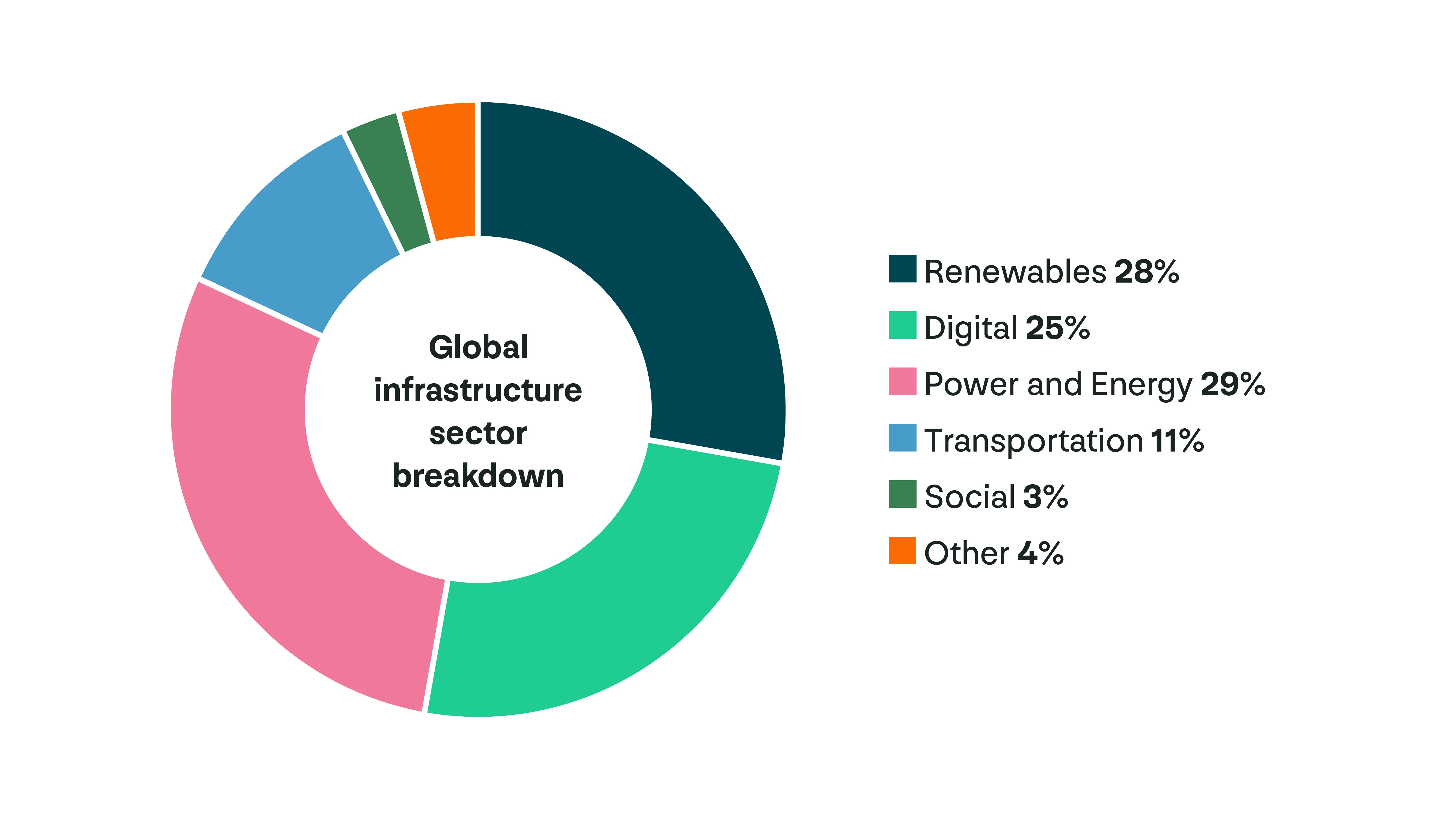
As of 30 June 2026. Source: Infralogic
Takeaway 2: Infrastructure debt is a specialized asset class that can help preserve relative value
Essential infrastructure underpins modern economies. These businesses are capital intensive, with assets built to operate over decades rather than years. The long-lived nature of these assets is often accompanied by complex regulatory, operational and contractual frameworks.
Underwriting infrastructure debt therefore requires specialist expertise across fields such as regulation, construction, engineering requirements and counterparty strength. These characteristics can complement risk factors found in more cyclical corporate direct lending.
We have observed that complexity and a narrower lender base have helped preserve the risk-adjusted relative value in infrastructure debt over time. Investment grade infrastructure debt has typically offered spreads of 175-275 bps, with spreads often widening further during more challenging credit environments. Sub-investment grade infrastructure debt spreads of 400-600bps are broadly comparable with many corporate direct lending opportunities, where spreads have often ranged around 450-700 bps.
Spreads by region and rating
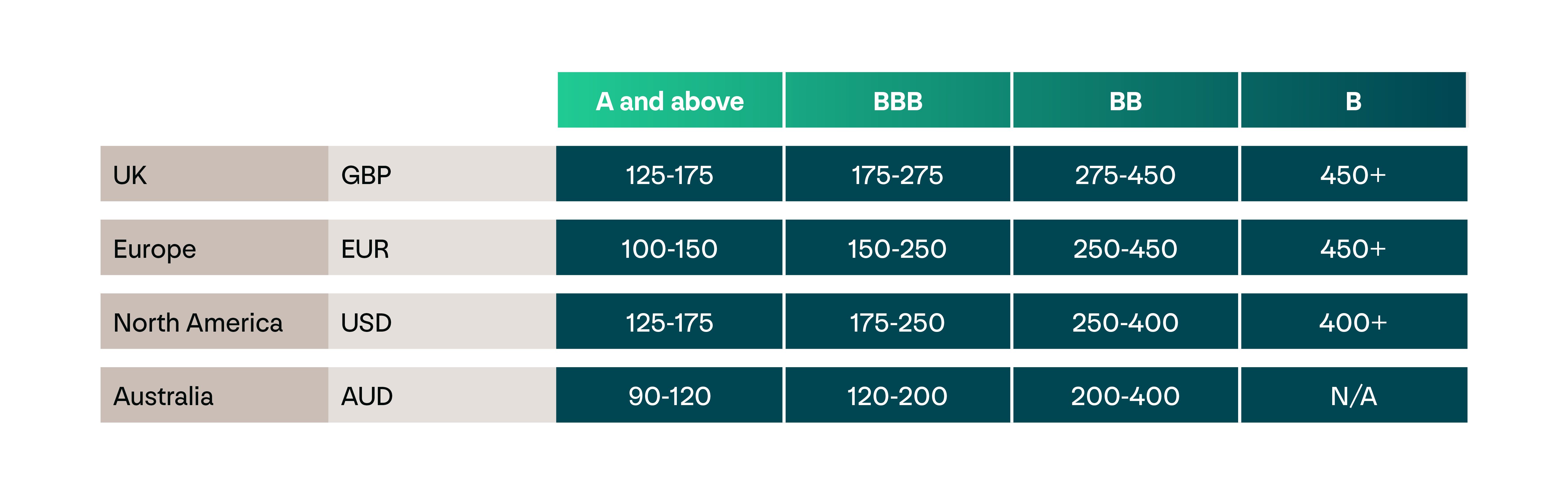
Source: Dealogic, ProjectWare, IFM Proprietary Data - as of 30 June 2026. Credit spreads are indicative of current market conditions and are subject to change at IFM's discretion
Takeaway 3: Different strengths, complementary roles
We see attractive opportunities across corporate direct lending and infrastructure debt that can be highly complementary to each other. Corporate direct lending provides exposure to a broader range of businesses whose performance is more closely linked to company earnings and the economic cycle. Infrastructure businesses provide resilience. Inelastic demand for infrastructure and often contracted cashflows means that future revenues can be well understood. In addition, the long-life strategic asset base of infrastructure can help buoy recovery values and protect in downside scenarios.
We believe the expansion of private debt allocations is a long-term trend, making diversification within those allocations increasingly important. Against this backdrop, infrastructure debt stands out for its combination of attractive relative value and differentiated risk exposures.
Distinct profiles between infrastructure debt and corporate direct lending
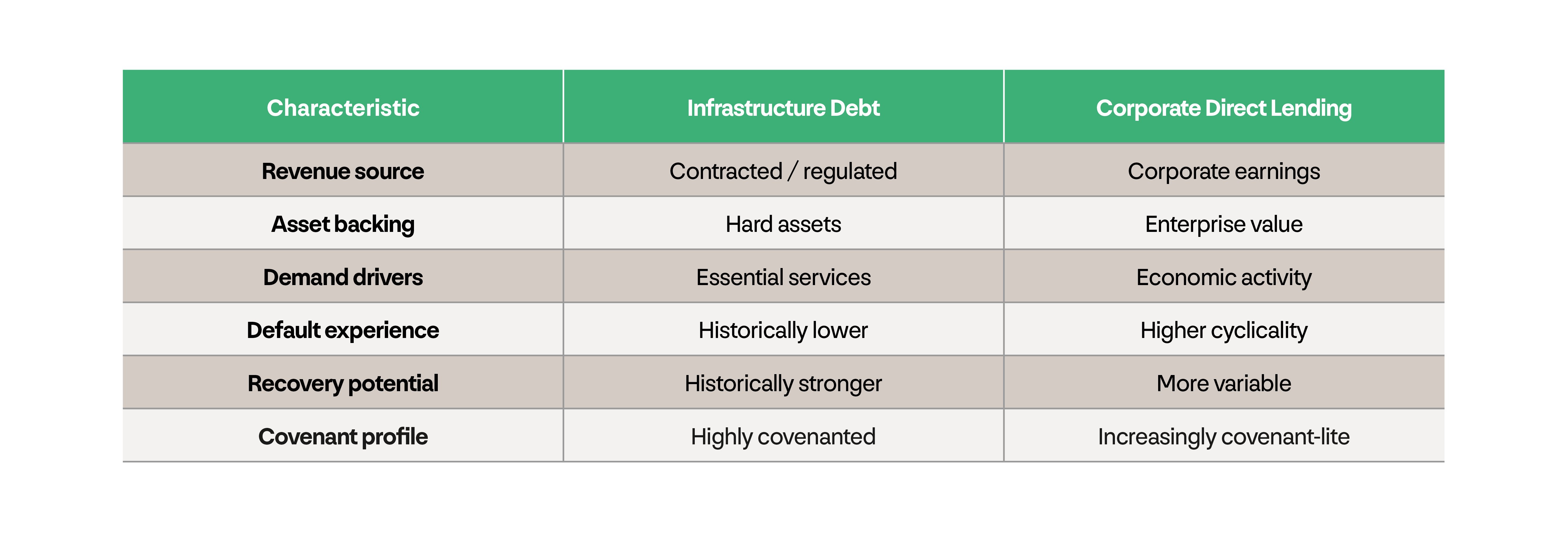
Source: IFM Investors
[1] Preqin Private credit AUM 31 December 2025, 1.9 trillion.
[2] Morningstar Global Leveraged Loan Index
[3] Bloomberg Global High Yield Index

Chris Purcell
Chris is responsible for the origination and execution of infrastructure debt transactions. He has over 18 years' global experience in finance with a focus on project finance, infrastructure debt and securitisation.

James Balcombe
James is a Vice President, Debt Product Specialist within IFM Investors’ Global Client Solutions team. He partners closely with clients and prospective clients across EMEA, providing specialist support on IFM's infrastructure debt capabilities.
Related articles

Dispelling the myths of infrastructure debt


Off the record, on the road: Our CSO’s latest private markets insights


The mid-market advantage in infrastructure investing