The end of a turbulent year, but not the turbulence
Global markets ended 2025 on firmer footing than expected in what was a turbulent year. Tariff shocks faded, but trade tensions and policy uncertainty loom for 2026. Advanced economies face modest growth, loose fiscal stances, and idiosyncratic monetary easing. Equity market gains need to broaden out to be sustained, while fixed income offers limited upside; real assets remain a defensive play.
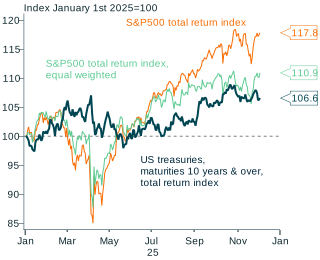
Graph 1: US equities and long-duration Treasuries
Source: IFM Investors, Bloomberg, Macrobond
Global economic state of play
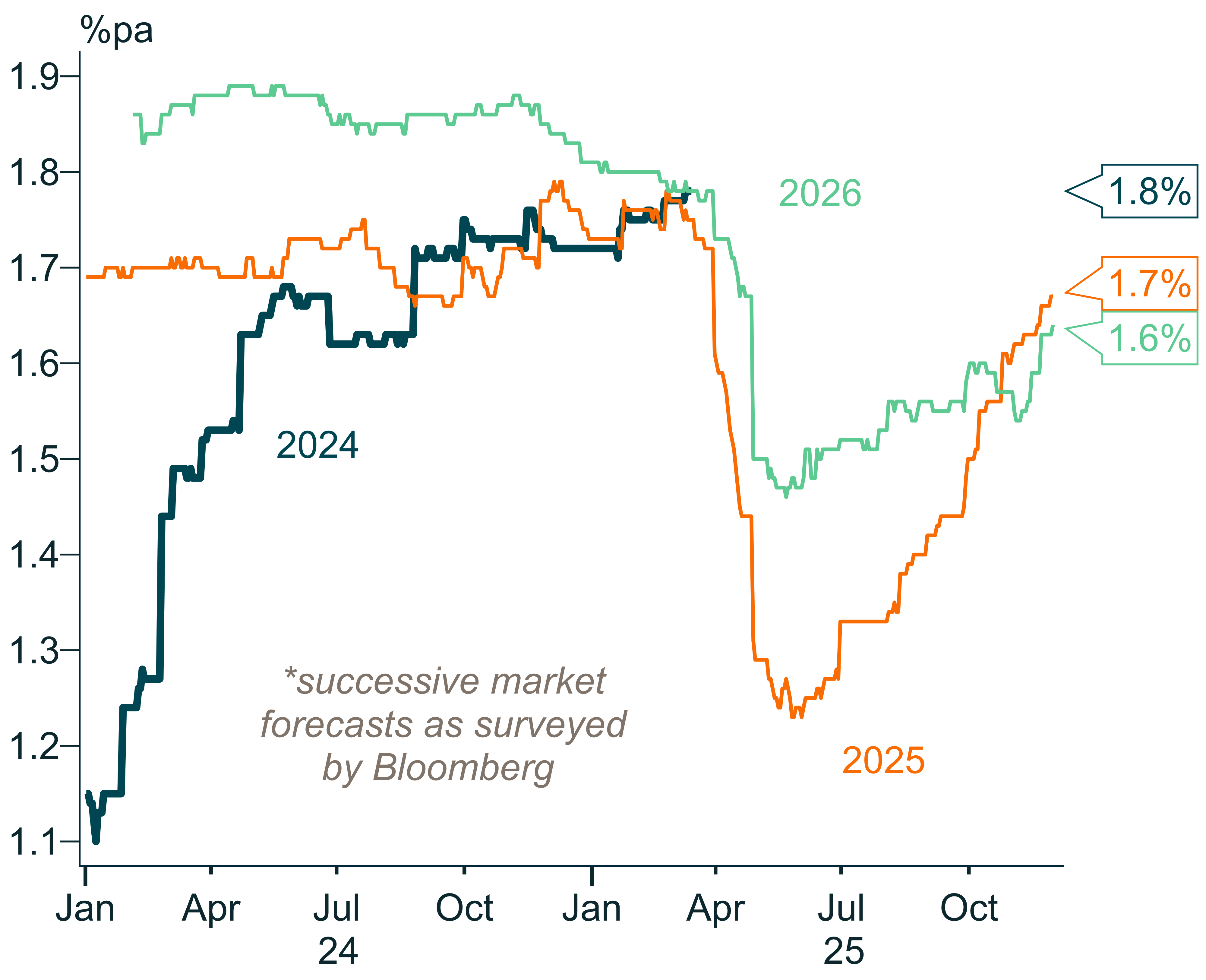
As 2025 draws to a close it appears that the global economy, and advanced economies in particular, have entered a period of relative stability – a somewhat surprising one given the tumultuous year it has been. The shock to confidence, economies and markets from tariff announcements has largely passed. Even though trade tensions have not, with further volatility in this space is likely to be a theme of 2026. Indeed, the relatively benign economic forecasts for advanced economies for 2026 (see Graph 02) risk being a placeholder for more volatility to come. And this comes as a risk to equity markets in particular, that have swung from being as much as 15% lower, (taking the US as an example), in the wake of ‘Liberation Day’ to as much as close to 18% higher. The sell-off in recent weeks has also been brief, even though the drivers behind it - Fed uncertainty, compounded by US government shutdown, concerns over AI-hype and a pull-back in broader sentiment – were valid, particularly as we approach an uncertain 2026. European markets (notably smaller ones) and selected emerging markets (as we noted last quarter) are also returning very well. Australian equity market gains being relatively modest by comparison. Fixed income also had a turning point mid-year underpinned by a choppy rally of US long duration government bonds, moving up the credit curve gained investors some return pick up as spreads remained tight despite economic risks.
Graph 2: Developed market real GDP forecasts
Source: IFM Investors, Bloomberg, Macrobond
Despite global policy rates falling through the year global long duration (over 10 years) bonds underperformed the rally across the rest of the curve. The 10s30s yield curve across G7 countries steepened driven by an increase in 30-year bond yields and, at the time of writing was at 4.2% - a rate not seen since 2011. This comes as scepticism around fiscal discipline remains a thematic and investors seek a greater term premium to fund government largesse. Fiscal accommodation and large deficits seem likely to persist through 2026. Discontent with many advanced economy governments and the rumbles populism make it a difficult path to tighten fiscal policy; the UK may be a notable test case through the year. Pressures also stem from the need to increase defence spending across many jurisdictions. The cessation of the Russia-Ukraine conflict is a key geopolitical risk; however, such an outcome would not remove this need.
In a world where fiscal policy remains relatively loose then the room or need for further monetary easing remains modest. The Fed may find itself easing more than most of its peer central banks even though the outlook for US inflation remains on the high side. And central banks like that in Europe may ease more modestly even though its inflation rate allows it to go further. Central bank responses across advanced economies will be far more idiosyncratic in 2026. Outside of Japan, where modest hikes are expected, the trend will be to ease and hold. This is as policymakers feel for r*, hoping for stabilised labour markets and grappling with a weaker disinflationary pulse and accommodative fiscal stances.
The Fed may find itself easing more than most of its peer central banks even though the outlook for US inflation remains on the high side.
Recession risks across advanced economies are not high going into 2026 given the absence of any specific disruptive shock on the horizon, even though we’d assess geopolitical uncertainty remains high. Indeed, economic growth for 2026 is expected to be much as it was in 2025, at trend, at best. Eurozone growth is expected to slow from 2025’s pace, despite a pickup in the larger economies, notably Germany. There’s little improvement expected in the UK or Japan. While no material improvement is expected in growth in the US its rate of growth is likely to be well above most advanced economy peers. Fiscal and financial condition tailwinds, the AI-investment super-cycle and what has been solid productivity growth should all underpin this differentiation. The consumer recovery will be supported by these themes, though many note the risk of a K-shaped growth dynamic across income quintiles.
Despite this expectation on the economy there are risks in both directions. We are but a year into the new Administration’s term, mid-terms are on the horizon (a low Presidential approval ratings suggest a fiscal incentive could be announced), US-China trade tensions are unresolved nor are legal challenges to the broader tariff complex. And a watchful eye will be kept on the Fed as Chair Powell comes to the end of his term and on other potential changes that could occur. This is with a view to not only the potential for easier monetary policy but also the erosion of trust in a key institution.
A key thematic for economies and equity markets is AI. The investment in the real assets and its adoption to broaden-out productivity dividends. We will likely need to see the latter to give confidence to the former, that is a clearer path to how AI investment is monetised. This is important for the US equity market as, at the time of writing, the 12.3% price return year to date can be decomposed into 6.9ppts from AI companies and 5.4ppts from the rest of the index. For equity market returns in the US to again be solid in 2026 we’d expect economic performance will need to underpin earnings in non-AI sectors, especially if AI-hype takes a breather. We are not convinced that the thematic emerging market bid has materially further to run but potential policy volatility out of the US may again underpin the ‘anywhere-but-the-US’ trade that has supported other developed economy bourses through 2025. On fixed income, given the outlook, yields are again only expected to grind lower and in the context of a benign economic outlook the recent widening of credit spreads may narrow slightly but material outperformance of core fixed income seems unlikely. Real assets, in particular unlisted infrastructure, look attractive as a hedge against uncertainty that we think is likely to come in some form over the course of next year.
For a more detailed economic update on Australia, the US, Europe and the UK and Asia, read ‘The end of a turbulent year, but not the turbulence’ .
Meet the authors

Alex Joiner
Alex Joiner is Chief Economist at IFM Investors. He is responsible for the firm’s economic, financial market and geopolitical risk analysis that is key in IFM’s investment process. In this capacity he engages with IFM’s domestic and global clients on macro-investment trends and themes.

Frans van den Bogaerde
Frans supports the Chief Economist with the firm’s economic, financial market, and policy analysis and forecasting. He holds a Bachelor of Commerce (Finance & Economics) with Honours in Finance (First Class) from the University of Melbourne.

Chris Skondreas
Chris supports the Chief Economist with the firm's economic, financial market, and policy analysis and forecasting. He holds a Bachelor of Commerce (Economics and Finance) from Monash University.
Related articles

Private credit under pressure, but opportunities still exist





Where investment decisions can fall short – and why


Beyond data centres: Could fibre optic networks bridge the AI divide?