Key takeaways
-
Competition in the development financing market, fuelled by the return of bank lenders and an increase in capital availability to non-bank lenders, has seen both banks and non-bank lenders increase their exposure to development risk through higher leverage and lower presales cover.
-
While the resulting risk may have been acceptable at a time of ever-increasing residential property prices, recent rate rises and changes to federal policies have curtailed demand, slowing developers’ ability to either pre-sell housing, or sell completed developments.
-
An outcome of a low-presales period is the increased importance of residual stock loans as a source of exit liquidity for development financing. Questions around the required risk premium and depth of the residual stock loan market remain.
-
Some Australian real estate developers are likely to experience distress as construction costs continue to rise and the housing market cools – passing increased risk onto underlying lenders where loans were not adequately de-risked.
The availability of capital to non-bank lenders has led lenders to take on more asset-based risk rather than pursuing exit strategies on which lenders would have traditionally focused.
The recent steep rise in sovereign bond yields creates significant challenges for governments financing ever-increasing debt levels, as well as further pressure for the private credit market – with real estate debt particularly impacted.
Property investors are contending with the impact on discount rates, asset valuations and the continuing impact of inflation on construction costs. What began as pandemic-led supply chain disruptions dovetailed into cost increases triggered by the conflict in Ukraine, with further cost pressures arising from this year’s conflict in the Middle East.
These changes come after years of strong inflows into the commercial real estate (CRE) debt market, fuelled by non-bank lending. While a relatively new entrant to the debt market, non-bank lenders have, over the past decade, established themselves as a significant source of residential development financing, with inflows markedly increasing from 2021 onwards. The proliferation of private debt liquidity and resulting competition for deals, has seen lenders take on increasing levels of risk. Crucially, where banks often diversify their CRE loan books across sectors – residential, office, retail, industrial and others – non-bank lenders are traditionally more exposed to residential development risk, with some having around 70-80% of a loan book exposed to the sector.
Increasing competition, increasing risk
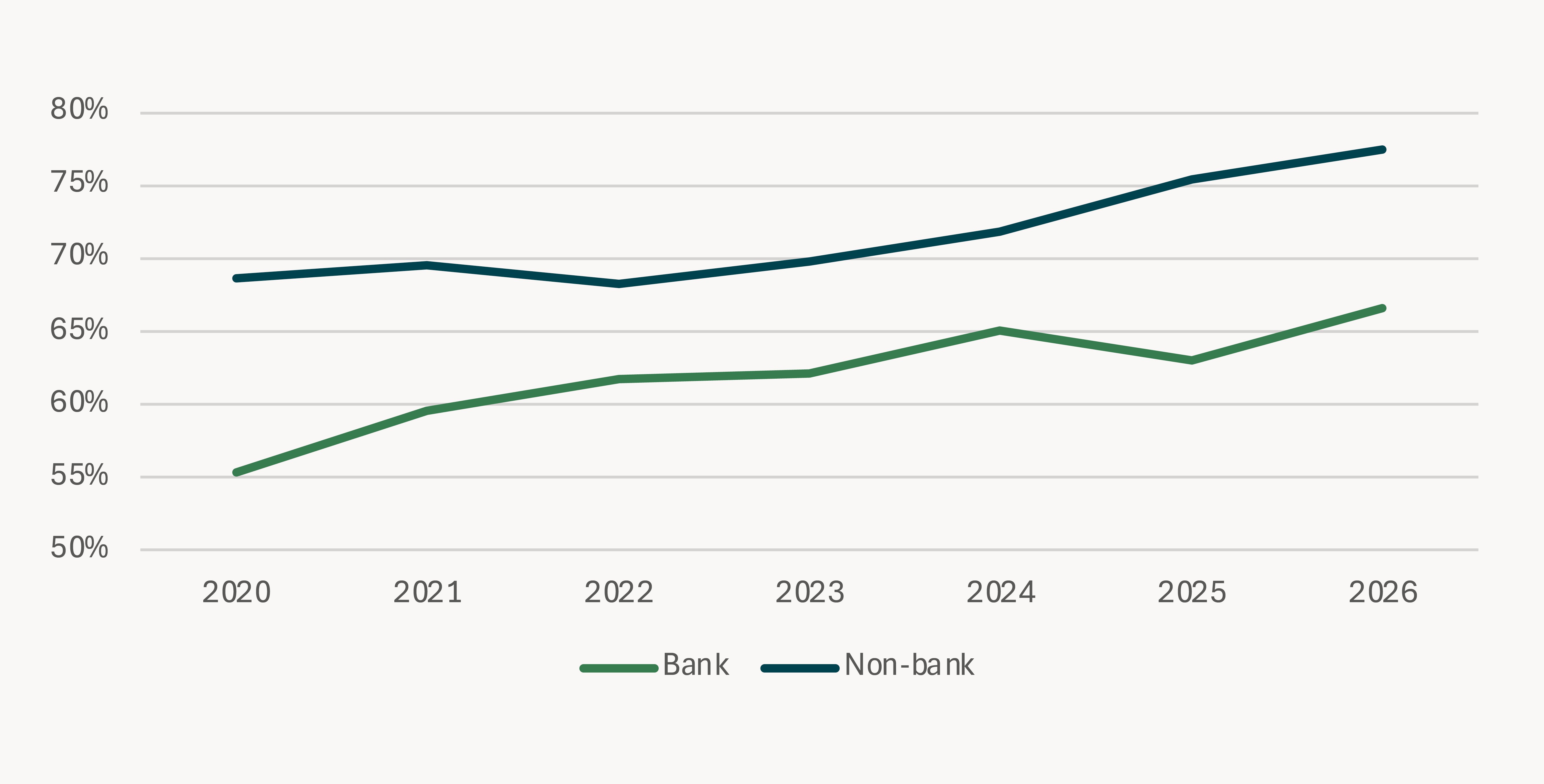
Banks retreated from the CRE market in the years prior to the pandemic and have only re-entered the market in the past few years. During the same period, non-bank lenders experienced increased private credit inflows - increasing competition and driving up loan-to-value (LTV) ratios. By 2026, the average bank LTV ratio had risen to around 66% – an increase of more than 10 percentage points since 2020 and just shy of non-banks’ 68% LTV ratio only five years prior (Chart 1). Non-bank lenders have traditionally competed with banks by providing developers with unitranche facilities that combine equivalent senior bank debt and mezzanine debt into a single loan. This unitranche, or stretch senior loan, explains the 10-15 percentage point gap between the bank and non-bank lenders’ LTV in Chart 1. Consequently, as bank LTV ratio increase over time, the LTV ratio for non-bank lenders increased from the 70% to 77% LTV in order for non-bank lenders to remain competitive.
Chart 1: Bank and non-bank lenders loan-to-value ratios
Source: Ashurst Perkins Coie Australia Real Estate Finance Market Update 2026
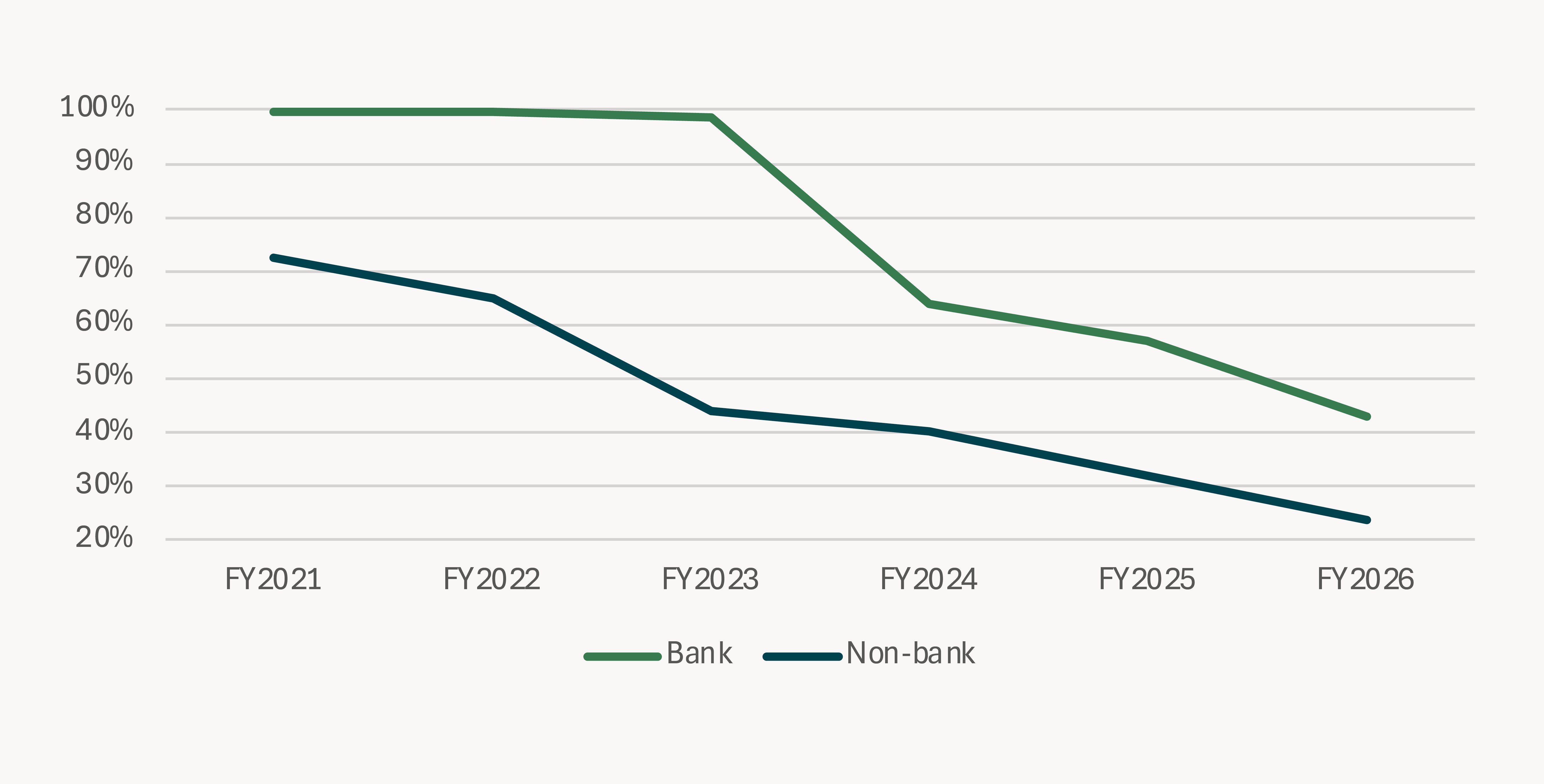
Alongside banks’ higher LTV ratios comes an increase in the offtake risk associated with residential projects. As recently as the 2022 financial year, banks were only lending where full presale cover was provided by developers, de-risking the project almost entirely. However, faced with growing competition, banks lowered their presale requirements, aggressively shifting into territory previously catered to by non-bank lenders. As was the case with the change in LTV ratios, the two sectors maintained a similar spread, with the non-bank sector lowering presale requirements by more than half – from around 72% in 2020-21 to 23% over the course of 2025-26. Meanwhile, between the 2022-23 and 2025-26 financial years, bank presale coverage declined from near-total coverage of 98.5% to 43%.
Chart 2: Non-banks maintaining a gap against banks on presale debt coverage requirements
Source: Ashurst Perkins Coie Australia Real Estate Finance Market Update 2026
As a result, when evaluating the creditworthiness of any one developer, the task has evolved. While lenders were previously able to significantly de-risk by insisting on presale protection, they now must assess where a project’s local property market may stand in 18 months to two years, and whether a developer will be able to sell the completed project quickly and for the desired price and profit margin. The post-pandemic boom in residential prices offered developers and lenders some assurance that they would meet their business cases. However, sustained inflation, less benign policies and four rate rises over the course of 2026, have placed significant pressure on local developers and non-bank lenders’ underwriting assumptions.
Developers and lenders are now faced with the additional challenge of rising construction costs. When evaluating any real estate loan, it is important to examine whether a builder has fully accounted for this potential escalation rate when pricing a construction contract. In the case of Brisbane, the escalation rate for a construction deal is forecast at 7% a year, equivalent to more than half the profit margin of a typical build contract. Persistent pressure on labour, materials and subcontractor pricing matters in two ways. First, it can create a funding gap if the development contingency is inadequate. Second, it can weaken the builder precisely when the project needs continued performance. A fixed-price contract is not a substitute for a solvent builder with enough margin and liquidity to honour it.
It’s crucial that these significant cost increases are accounted for when underwriting any transactions. Questions that any lender – whether bank or non-bank lender – should ask include: Can the builder sustain the escalation? Has the construction contract priced a realistic per square metre rate for that local geographic area? And will the escalation leave the builder with a margin they deem acceptable to continue with the project and what are the consequential impacts on their overall workbook? A prudent lender needs to ask such questions against a higher LTV and lower presales lending matrix.
Lower presales increase reliance on residual stock finance
The natural outcome of a reduction in presales coverage to activate construction debt is that it leaves more stock to be sold after completion. Traditionally in a high-presales-coverage market, the unsold stock is the equity or profit for a developer. However, a low presales environment means that developers now must leverage up the unsold stock as a means to refinance out the incumbent construction debt by taking what is referred to as a residual stock loan. Residual stock loan amortisation depends on assumptions about monthly sales volumes, sale prices and holding costs. If actual performance falls short, the loan may need to be extended or amended, slowing cash flow and eroding the developer’s remaining profit.
IFM Investors observed a significant pipeline of residual stock loans in the last 12 months, mostly from those that had received development financing in FY2024. Extrapolating from the even lower presales environment for FY2025 and FY2026, IFM expects the residual stock market to grow in the near term as a result. If purchaser headwinds persist, lenders must ask themselves: how liquid is the residual stock loan market as an exit option for development financing? What is an appropriate risk premium for a residual stock loan?
Property private credit: when growth outpaces alignment
Australia’s private credit expansion has met a genuine financing need in parts of the market that require out-of-the-box bank lending solutions and where banks have become more selective. However, recent developer distress, valuation adjustments and restrictions on fund withdrawals have sharpened scrutiny of underwriting, governance and the alignment between managers and investors. These developments warrant examination without assuming that all managers share the same weaknesses.
In our view, three features help explain the proliferation of property debt businesses.
First, origination can be relatively scalable. Established intermediary networks and repeatable loan and security structures can support portfolio growth. But repeatable documentation does not make development risk standardised. Assessing sponsor equity, construction costs, completion funding and repayment capacity requires specialist resources. Competitive pressure becomes dangerous when deployment targets take precedence over those disciplines.
Second, tangible security is a compelling fundraising proposition. Property is familiar, and mortgage security can reassure investors. Yet security establishes a claim on an asset; it does not guarantee recovery of principal. An unfinished development may require substantial further expenditure before it can be exited. Lending ratios based on assumed completion values therefore need to be considered alongside current values, remaining costs and stressed recovery scenarios.
Third, fee structures can make loan activity more immediately rewarding to managers than durable investment outcomes. ASIC has identified arrangements in which managers retain some or all borrower-paid origination fees (either upfront fees or establishment fees), alongside other remuneration. Its research also highlights the incentive for shorter loans and repeated refinancing to generate these additional fees. Where remuneration is earned upfront while investors retain the subsequent credit risk, incentives can diverge. Limited disclosure makes that divergence harder to assess.
Development lending also requires care when interpreting returns. Capital is typically drawn progressively, so a headline annualised loan return does not describe the actual earnings on an investor’s entire allocation. Where subscribed capital awaits deployment in lower-yielding assets, net investor returns may be materially lower. Fees and credit losses can widen the gap. Finally, performance fees require particular scrutiny where they crystallise on individual transactions or unrealised income before the portfolio’s eventual losses are known.
A stronger private credit market requires disclosure of all manager remuneration, independent valuation and credit oversight, limits on connected-borrower exposure, and liquidity terms consistent with the underlying loans. Performance rewards should reflect net investor outcomes, with appropriate loss carry forwards or clawbacks.
The test is whether a business model rewards sound lending is through repayment and recovery – not simply capital raising and loan origination.
Asset-backed assessment
In short, the development financing market has been taking on more risk, backed largely by a belief that asset values will remain strong and even continue the growth trajectory seen since the pandemic. The availability of capital to non-bank lenders has led lenders to take on more asset-based risk rather than pursuing exit strategies on which lenders would have traditionally focused.
While some lenders and developers may face challenges in a more competitive market, investors can minimise risk by avoiding monoline strategies focused entirely on development financing. Where development financing may feature as part of a diversified credit portfolio, careful assessment of a developer’s ability to withstand a downturn in property prices or higher construction costs can help investors avoid the risks associated with more aggressive lending practices.

Hiran Wanigasekera
Hiran is an Executive Director and Co-Head of IFM Investors' APAC Diversified Credit capability. He responsible for joint management of key credit portfolios, credit product strategies and managing the day-to-day running of debt portfolios. Hiran has worked across a wide range of credit sectors and industries including bank lending, corporate credit and structured investments.

Related articles

Manchesterism in action: the rise and rise of Manchester Airports Group



Three reasons infrastructure debt complements corporate direct lending



Dispelling the myths of infrastructure debt