Key takeaways
-
The mid-market remains an active area for infrastructure investing, offering investors access to a broader and potentially less crowded opportunity set.
-
Mid-market infrastructure can improve risk-adjusted returns and portfolio efficiency, enabling investors to construct portfolios that balance defensive characteristics with growth potential.
-
Allocating to mid-market infrastructure can enhance portfolio diversification by providing exposure to assets with differentiated risk-return characteristics across the infrastructure spectrum.
Private infrastructure fundraising surpassed the high watermark years of 2021-22 and reached nearly US$300 billion in 20251. This record milestone reflects robust institutional investor confidence and increasing allocations to infrastructure as an asset class. We believe that private infrastructure has become an integral part of institutional investors’ portfolios, offering a steady demand profile, inflation hedge, sustainable growth, and low correlation to traditional asset classes.
Well-aligned opportunity set: An expanding market
While large-cap infrastructure has attracted increased institutional capital, the mid-market remains central to deal activity. The chart below illustrates that over the last five years, infrastructure deals less than US$1 billion accounted for just under half of the market in transaction value and approximately 89% of deals, underscoring the depth and liquidity of the segment. For global investors seeking diversification and higher return potential while retaining the defensive characteristics of infrastructure, the mid-market offers an attractive and growing opportunity set.
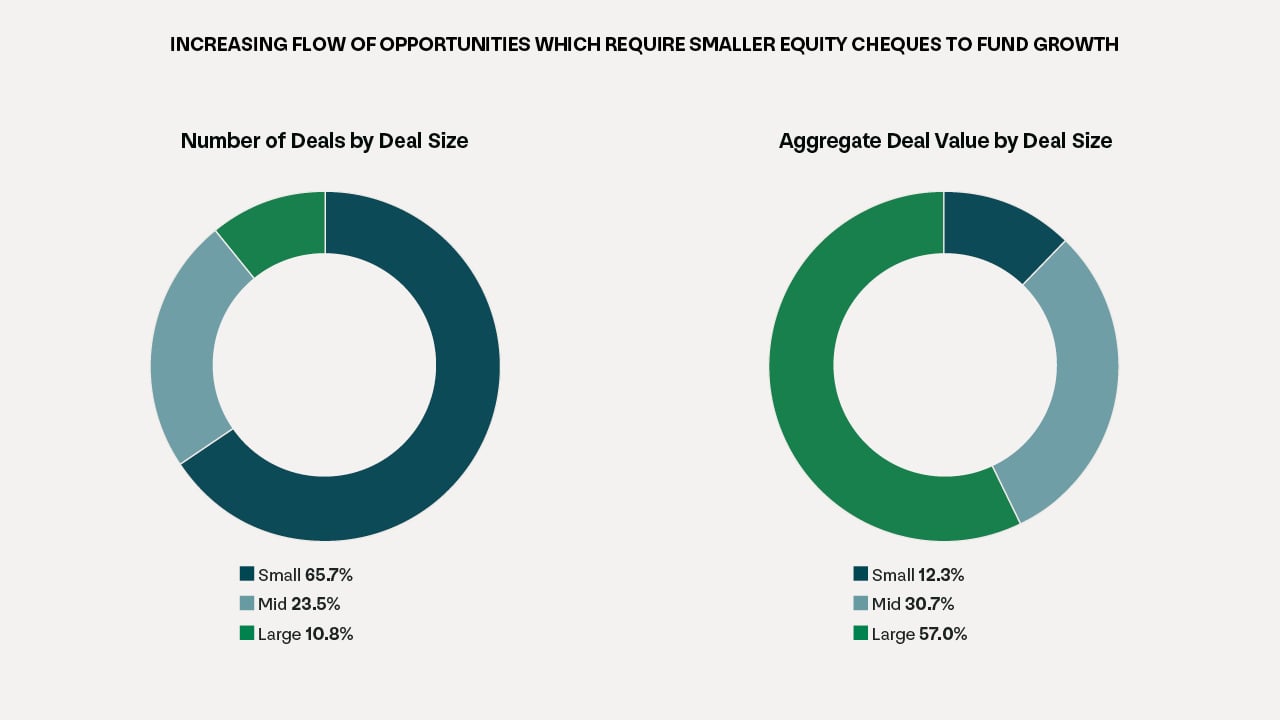
Source: Preqin infrastructure deals (2021 – 2025), with the deal size representing the total transaction value including leverage. Small: less than US$250 million; Mid: less than US$1billion but greater than US$250 million; Large: greater than US$1 billion.
Preqin’s fund search data indicates that investor intentions are shifting further toward smaller commitments2, highlighting growing interest in mid-market strategies. At the same time, the increasing size of infrastructure funds has created attractive pricing in the mid-market. As many infrastructure managers originally focused on the mid-market have migrated into the large-cap space as their fund sizes have grown, the mid and lower market have become comparatively underserved.
Enhancing long-term portfolios through stronger risk-adjusted returns
Generally mid-market infrastructure has consistently demonstrated higher risk-adjusted performance relative to the broader infrastructure market across multiple time horizons. These findings indicate that mid-market infrastructure can offer a more attractive risk-return profile with stronger capital preservation, which we believe makes it a compelling option for long-term infrastructure investment portfolios.
Improving mid-market exposure to improve portfolio efficiency
Mid-market also provides access to a broader set of infrastructure strategies, extending beyond core into other infrastructure sub-strategies and adjacencies. We believe these strategies complement traditional core infrastructure, enabling investors to construct portfolios that aim to balance defensive characteristics with growth potential. The following analysis in the chart below indicates that incorporating unlisted core infrastructure into a traditional equity/fixed income portfolio can shift the efficient frontier upward and to the left, enhancing returns while reducing overall risk. Adding 5% allocation to unlisted value add infrastructure increased the Sharpe ratio by 0.11, further enhancing the portfolio’s risk-adjusted returns and reinforcing the benefits of diversification within the infrastructure asset class.
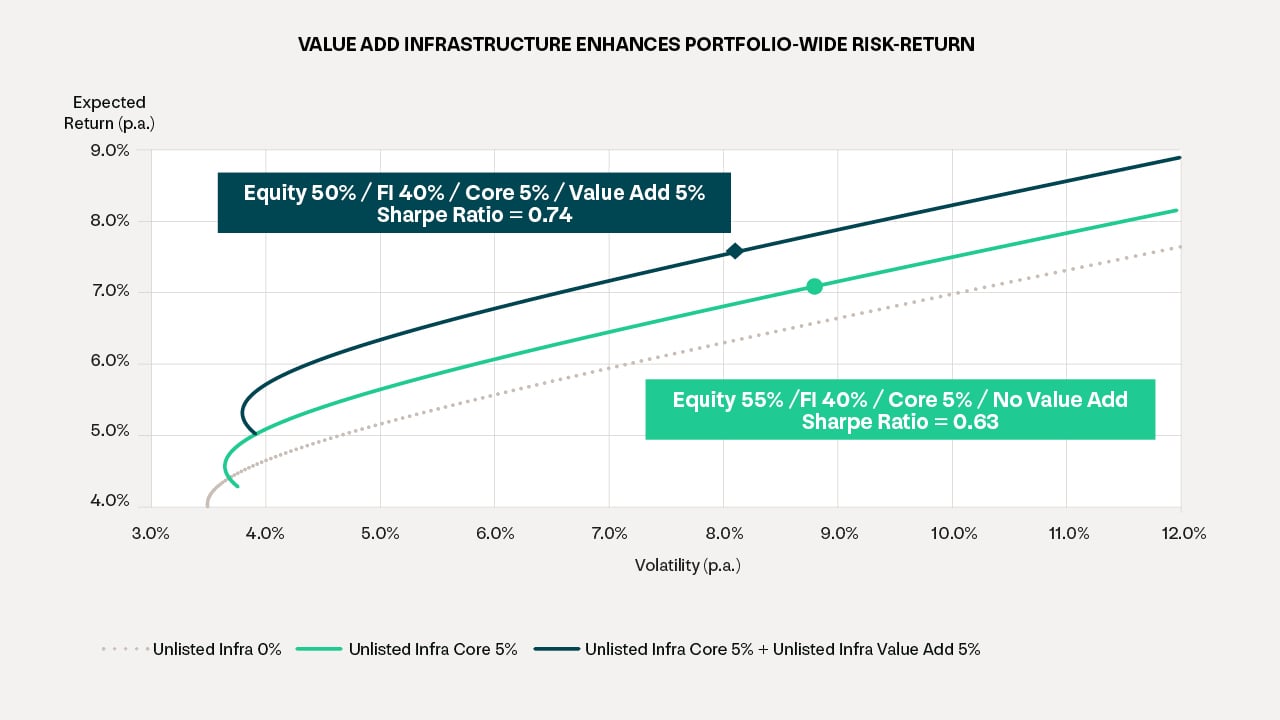
Notes: The chart reflects the risk-return profile of the portfolio based upon the performance from June 2001 to December 2025, with different allocations in listed equity (MSCI World 100% Hedged to USD Net TR USD), fixed income (Bloomberg Global-Aggregate Total Return Index Value Hedged USD), unlisted infrastructure core (SIPA Global unlisted infrastructure core, EW LCU) and unlisted infrastructure value add (SIPA Global unlisted infrastructure value add, EW LCU). The Sharpe Ratio is calculated using the performance in excess of the risk-free rate of returns (1.5% p.a.) for each portfolio divided by the standard deviation of the performance.
Combining infrastructure sub-strategies to improve diversification
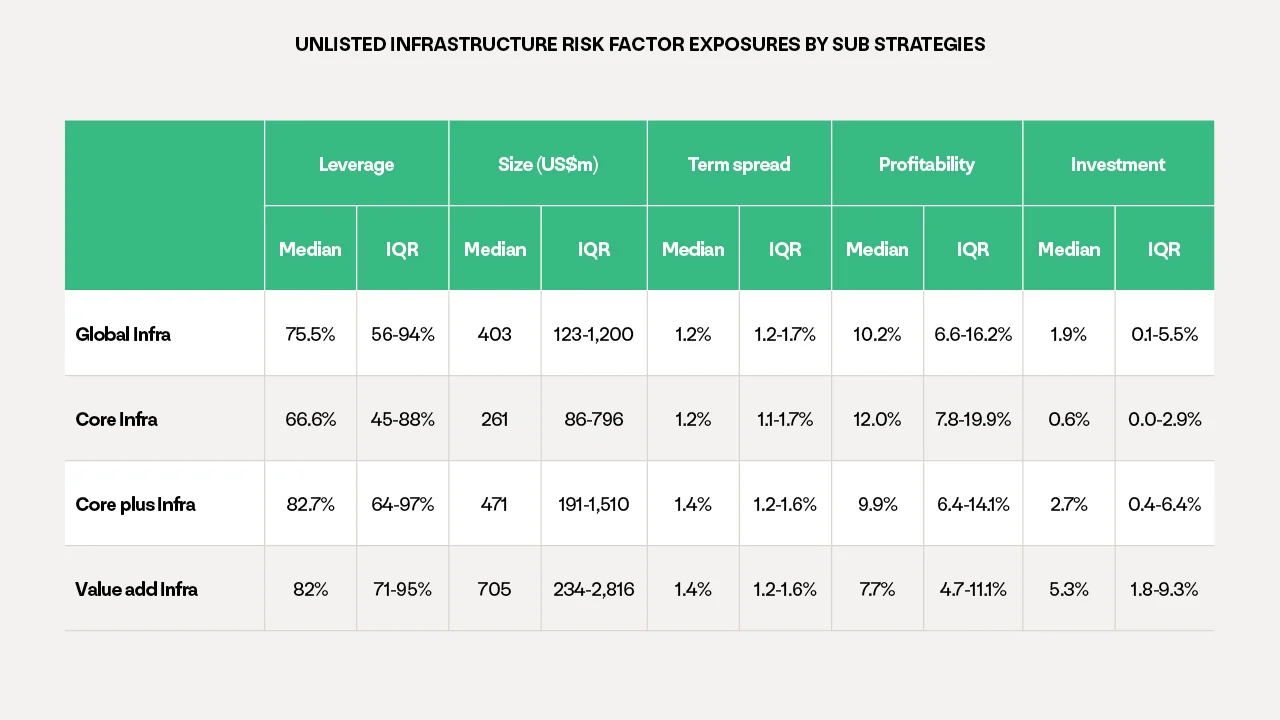
Source: Scientific Infra & Private Assets (SIPA) as of 31 January 2026. Leverage: total liabilities over total assets; size: total assets; term spread: 20-year public bond yield minus 3-month public bond yield; profitability: return on assets before tax; investment: capex over total assets. The categorisation of core, core plus and value add adopted by SIPA is based on risk/return profiles of unlisted infra companies within the infraMetrics database. Companies with expected returns below the median are classified as core; those above the median but below the 75th percentile are core plus; and those above the 75th percentile are value add.
While infrastructure sub-strategies - such as core, core plus, and value add - share certain common characteristics, their distinct value drivers offer complementary exposures. Access to opportunities across the infrastructure risk spectrum may allow investors to combine these differentiated return drivers within a single portfolio, potentially strengthening diversification and improving risk-adjusted returns. As shown in the table above, core plus and value add infrastructure generally show lower immediate profitability than core infrastructure, but increased ability to generate higher returns through value creation initiatives.
Mid-market strategies also enable access to emerging infrastructure sub-sectors that typically begin at a relatively smaller scale but rely heavily on active near-term value creation levers, including technological upgrades, operational optimisation, and strategic repositioning. These opportunities may be attractive for investors seeking differentiated sources of alpha within their infrastructure allocations. By targeting these niche segments, mid-market strategies enable investors to complement traditional core infrastructure holdings with assets that combine defensive characteristics with higher return potential.
Positioned for resilience across market cycles
From our observations, heightened uncertainty amid elevated geopolitical risks and widening divergence in the growth outlook across major economies currently characterise the global economic landscape. In this context, mid-market infrastructure strategies focused on asset centricity with positive infrastructure adjacency and supported by clear value creation pathways naturally lend themseleves to potentially resilient performances through cycles.
The projected acceleration of infrasturcture investments, with global assets under management expected to approach US$3 trillion by 20303, further underscores the relevance of this resilience. Mid-market has accounted for a large share of transaction volume and deal activity in recent years, highlighting the depth of the opportunity set. For investors seeking to enhance portfolio diversification and improve risk-adjusted returns while retaining the defensive characteristics of infrastructure, mid-market can offer a compelling way to access this opportunity.
[1] Source: Infrastructure Investor Fundraising Report Full Year 2025
[2} Source: Preqin Global Report Infrastructure in 2026
[3] Source: Preqin Private Markets in 2030

Abbie Sui
Abbie is a senior member of the Infrastructure Portfolio Management Team, responsible for a broad set of portfolio construction, risk management and fund analysis outcomes across all of IFM Investors’ infrastructure products as well as asset management of Adelaide Airport.

Aaron McGovern
Aaron is responsible for the origination of infrastructure investments and ongoing management of assets. Aaron has worked on transactions in the Americas, Europe and Australia in the transport, energy and utilities sectors. Aaron is currently a board member of Aleatica and Impala Terminals.
Related articles

Infrastructure outsourcing: Unlocking returns via scaled leasing



Power demand back to growth. But is the grid ready?


Discovering growth and return opportunities across the power sector: Unlocking scalable growth in power infrastructure