Geopolitical risks rising
Geopolitical risks have intensified sharply in early 2026, driven largely by a more interventionist US policy stance. This has unsettled global markets and pushed investors toward tactical rebalancing, favouring non‑US developed markets. Despite uncertainty, risk appetite remains intact for now, though sentiment is increasingly shaped by escalating geopolitical pressures.
Global state of play
The thematics that we highlighted in our fourth quarter 2025 missive have begun to play out, somewhat more dramatically than we expected, in early 2026. The relative calm that characterised the second half of 2025 has been shattered by a number of geopolitical events, with most resulting from a more interventionist policy stance taken by the United States. Some of these were foreseeable and others were not; some are domestic, some are global; and some were kinetic events while others economic. Globally, these included: the US intervention in Venezuela; tensions with NATO over Greenland; failed Russia-Ukraine peace talks; the expiration of the New START Treaty and now renewed tensions in the Middle East focussed on Iran. Domestically, the judicial attacks on the US Federal Reserve (Fed), Fed Chair transition and now the Supreme Court ruling tariffs illegal have also garnered market attention and have created uncertainty in the global economy.
It is no wonder that global investors continue to have geopolitical risks among their key concerns for the current year – though perhaps unusually, that focus is overwhelmingly on what the US might do next. Accommodative monetary and fiscal policy remains in place across much of the developed world with, if anything, more to come, supporting investor sentiment despite all the uncertainty. There is appetite to deploy capital into growth assets, notably equities, but the trade is to non-US developed markets and to some extent emerging markets to diversify away from perceived risks.
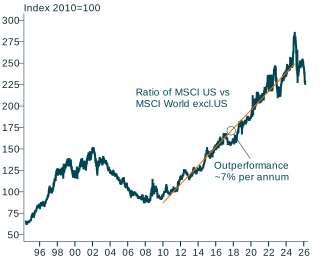
Graph 1: US versus World excl. US equities
Source: IFM Investors, MSCI, Bloomberg, via Macrobond
The trade to non-US developed and some emerging markets has been in place since the election of the current US administration and has intensified through the second half of 2025 and into 2026. By contrast, US equities traded sideways in late 2025 and have moved materially lower in 2026 to date. While geopolitical or US policy risks are at the heart of this shift, this rebalancing from investors is also opportune. US equity market outperformance for over a decade has averaged 7% per annum between 2010 to 2025 (GRAPH 01), and has left many portfolios overweight US assets. This allocation has not been a bad place to be given performance and leverage into the AI-tech-Magnificent 7 upswing, but with increased caution in the AI space combined with valuation pressures on a historical and relative basis (with other developed markets) and a broad ‘de-dollarisation’ theme, investor enthusiasm for US exposure has been somewhat eroded. This is further compounded by the weakness in the US dollar, which is broadly expected to continue, and acts as a further potential deterrent to global investors.
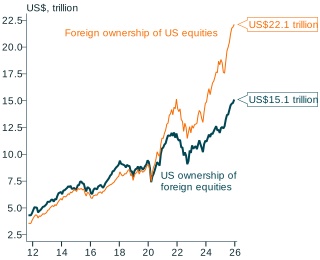
For now, we view this shift in investor appetite as a tactical rebalancing rather than outright divestment, a view seemingly confirmed by data from the US Treasury showing foreign holdings of US equities have never been higher, standing at US$22.1 trillion in December last year, although much of this increase is from higher valuations as US equities have outperformed. There is no geographic theme here, holdings are at record levels for European, Asian and Latin American investors alike and we can also include Canada and Australia. There’s no evidence of aggressive divestment, but there is evidence of the marginal dollar going to non-US markets in preference to the US, demonstrated by strong flows into developed market ETFs and aided by the recent performance of these markets themselves. The performance has caught the eye of domestic US investors who have increased their own exposure to foreign equities by around 25% since the start of 2025.
Graph 2: Investor equity market holdings
Source: IFM Investors, US Treasury, via Macrobond
For foreign investors, some of the rebalancing has occurred via translating holdings to domestic currencies. The weaker Australian dollar is an example of this, where holdings of US equities is at a record high in US$ but in A$ terms is around 2.5% lower, as at December, than the A$1.19 trillion recorded in November. The marked rise in the Australian dollar in 2026 to date will only reinforce this.
Impact on Australian superannuation investors
For Australian superannuation investors these dynamics will likely shift the geographic composition of listed equities exposures on a tactical basis, but arguably not the overall allocation. For ‘balanced’ portfolios, listed equity market exposure is on average around 55%, with international equities at 32% and Australian equities at 23% (according to APRA data). Near-term international equity allocation may edge lower due the higher Australian dollar and the domestic allocation move higher. We’d expect the former, given the economic outlook, to pick up again characterised by a non-US rebalancing to other developed markets (cognisant this will be done with a mind to the sector benchmark that remains heavily skewed to US markets). Supporting this will be a limit to how much portfolio allocation to Australian equities investors are comfortable with. They are already overweight on a historical basis and own around 22% of current market capitalisation. How far this non-US rebalancing will run is an open question. We remain relatively constructive on the US given its recent and expected nominal growth, productivity outperformance and leverage into transitional thematics like AI and tech adoption. For now, we see it as a material tactical rebalancing rather than a strategic shift away from the US in equities or across other asset classes.
Should the current performance of listed non-US developed market equities continue overall allocations may rise which may be beneficial to increasing private market exposures, most notably infrastructure, by relieving the ‘denominator effect’. We say this are the pressure on longer duration core fixed income yields to stay elevated or even move higher remains as it has for some time (noting the edging lower in 2026 to date). This is now particularly true of Australian fixed income with the Reserve Bank of Australia (RBA) taking a different course on policy due to persistently elevated inflation (implying the spread between US and Australia bond yields remains positive for the foreseeable future). Further, the correlation between listed equities and fixed income becoming increasingly positive suggests that investors could seek to bolster the defensive attributes of their portfolios - while also being mindful for the need for inflation protection. We see the potential for achieving this with unlisted infrastructure in particular given its low correlation and reliant cash flows. And the ability to diversify portfolios from the geopolitical risks that are likely to characterise the investment environment for some time to come.
For a more detailed economic update on Australia, the US, Europe and the UK and Asia, read the Economic Update for the first quarter of 2026 ‘Geopolitical risks rising’.
Meet the authors

Alex Joiner
Alex Joiner is Chief Economist at IFM Investors. He is responsible for the firm’s economic, financial market and geopolitical risk analysis that is key in IFM’s investment process. In this capacity he engages with IFM’s domestic and global clients on macro-investment trends and themes.

Frans van den Bogaerde
Frans supports the Chief Economist with the firm’s economic, financial market, and policy analysis and forecasting. He holds a Bachelor of Commerce (Finance & Economics) with Honours in Finance (First Class) from the University of Melbourne.

Chris Skondreas
Chris supports the Chief Economist with the firm's economic, financial market, and policy analysis and forecasting. He holds a Bachelor of Commerce (Economics and Finance) from Monash University.
Related articles

Beyond data centres: Could fibre optic networks bridge the AI divide?



Infrastructure: The times they are a-changin’


Partnering to invest in existing UK infrastructure