Infrastructure equity for insurers: Capital efficiency, diversification, resilience

Key takeaways
For insurers, we believe allocating to infrastructure equity offers three key benefits:
-
Improved diversification at a time when traditional equity-bond dynamics are challenged, with the added benefit of downside protection
-
Improved capital efficiency through lower Solvency II / Solvency UK charges on qualifying investments
-
More flexibility and control when using an open-ended fund structure, as investors can adjust their allocation over time and avoid blind pool risk
This piece was co-written by Anil Shenoy, FFA (Head of Insurance, UK & Ireland, IFM Investors) and Chris Pritchard, FIA (Principal and Co-head of Insurance Investment, Barnett Waddingham).
Infrastructure equity: What’s the opportunity for insurers1?
What do we mean by ‘infrastructure equity2?’
As an asset class, infrastructure equity is far from homogeneous. ‘Core’ strategies invest in the assets that underpin everyday life – from transport networks and utilities to renewable power.
Caption: This animation shows that core infrastructure assets are generally capital-intensive, long-lived, and essential to society, while also typically enjoying resilient demand across market cycles, a durable competitive advantage, and high barriers to entry.
But infrastructure equity can also span higher-return strategies in areas that may be less regulated or more market-driven, such as emerging digital platforms. These ‘core plus’ strategies are higher up the risk curve.
How is infrastructure equity classified under Solvency UK/Solvency II?
Since the introduction of Solvency II in January 2016, several amendments have been made to the capital treatment of equities.
In June 2017, an amendment reduced the capital charge applied to two categories of infrastructure equity:
-
Qualifying Infrastructure Equities (QIE)
-
Qualifying Infrastructure Corporate Equities (QICE)
Instead of being treated as generic Type 1 or Type 2 equities – with a capital charge of 39% and 49% respectively – qualifying infrastructure could now benefit from lower charges of 30% (QIE) and 36% (QICE).
Certain criteria must be met for infrastructure equity to be classified as either a QIE or a QICE investment – for example, both the infrastructure asset and the operating entity must be located in the European Economic Area (EEA) or the Organisation for Economic Co-operation and Development (OECD). But for insurers able to access qualifying strategies, this treatment can significantly enhance the capital efficiency of allocating to infrastructure equity.
What are the potential benefits for insurers?
At the core end of the spectrum in particular, infrastructure assets often operate under regulated or contractual frameworks, generating predictable and often inflation-linked revenues.
|
For insurers, core infrastructure can: |
More generally, core infrastrucutre has: |
|
Provide a potential hedge against inflation |
Historically helped mitigate downside risk |
|
Potentially deliver returns with less volatility and downside protection |
Provided portfolio diversification4 |
|
Support liability matching |
|
|
Deliver steady yields |
|
To return once more to Solvency II, the lower capital charge applied to infrastructure equity also represents an opportunity, insofar as it may enhance an insurer’s investment portfolio from the perspective of overall return on capital. For 2025, Barnett Waddingham’s long-term capital market assumptions for Type 1 equities ranged from 7.5-8.5% per annum5. By comparison, an infrastructure equity fund focused on core infrastructure might be expected to deliver returns of 8-12% per annum6. In other words, the expected return per unit of solvency capital is higher for infrastructure equity than for traditional listed equities.
|
Expected returns per annum |
|
|
Forecast for Type 1 equities |
7.5 - 8.5% |
|
Forecast for core infrastucture equity fund |
8 - 12% |
Source: IFM Investors and Barnett Waddingham.
We believe this – and the benefits listed earlier in this section – make infrastructure equity an attractive investment, complementary to global equities. At a time when global indices look increasingly concentrated towards US mega-cap stocks, infrastructure equity may provide valuable diversification.
Portfolio construction: How should insurers incorporate infrastructure equity?
What might allocating to infrastructure equity look like in practice?
Below, we consider the case for including infrastructure equity in a Property and Casualty (P&C) insurer’s portfolio, as well as a large UK with-profits fund.
Example P&C insurer portfolio
Many P&C insurers have exposure to illiquid assets, such as private credit or property. In this context, allocating to infrastructure equity could provide an additional source of returns and diversification, potentially without compromising on risk, capital metrics, or liquidity constraints.
In Chart 1, we demonstrate this with two portfolios: the first excludes infrastructure equity, the second includes a 7.5% allocation.
Chart 1 - Including infrastructure equity in a P&C insurer portfolio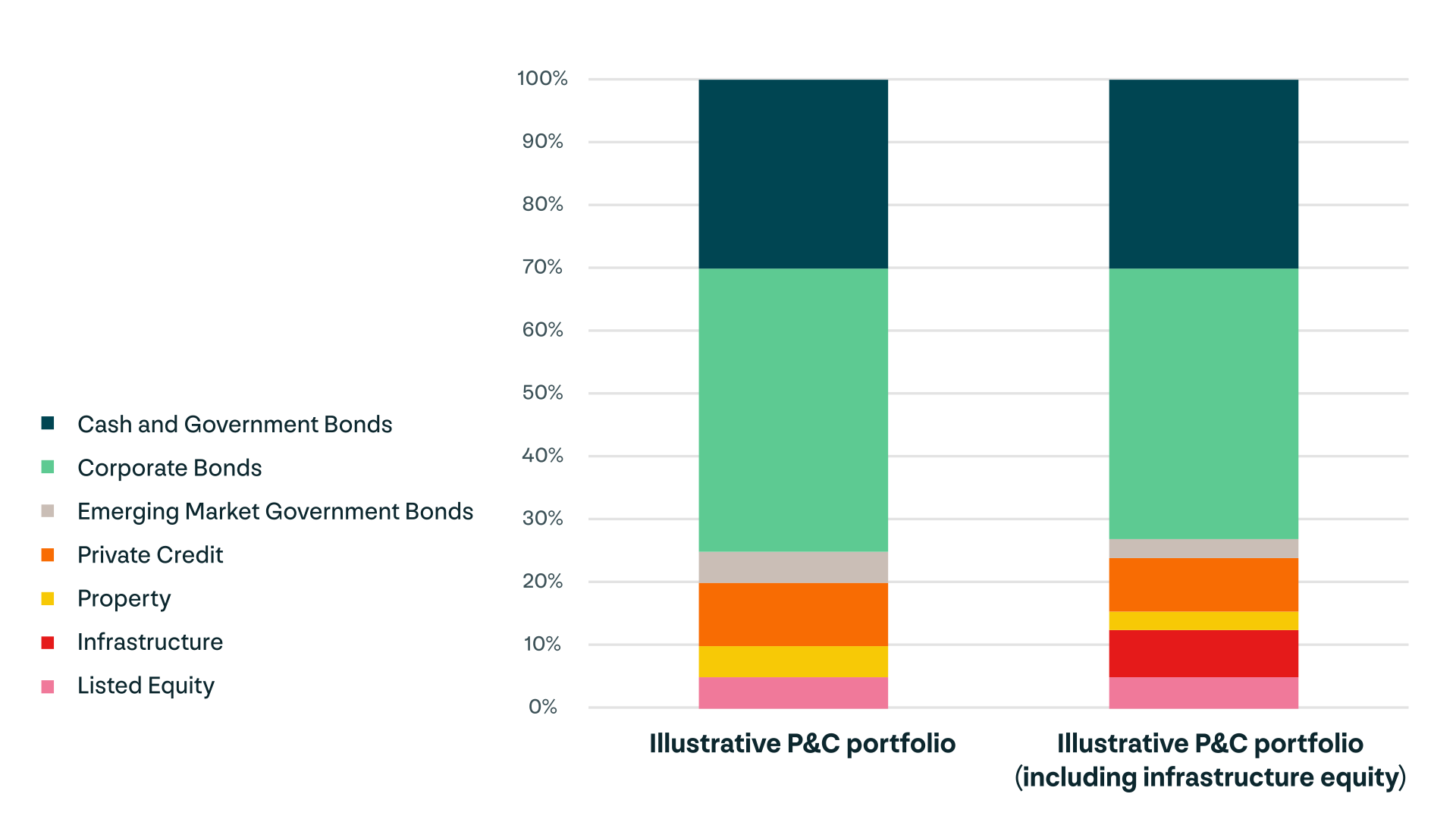
Source: Barnett Waddingham. For illustrative purposes only.
Example with-profits fund portfolio
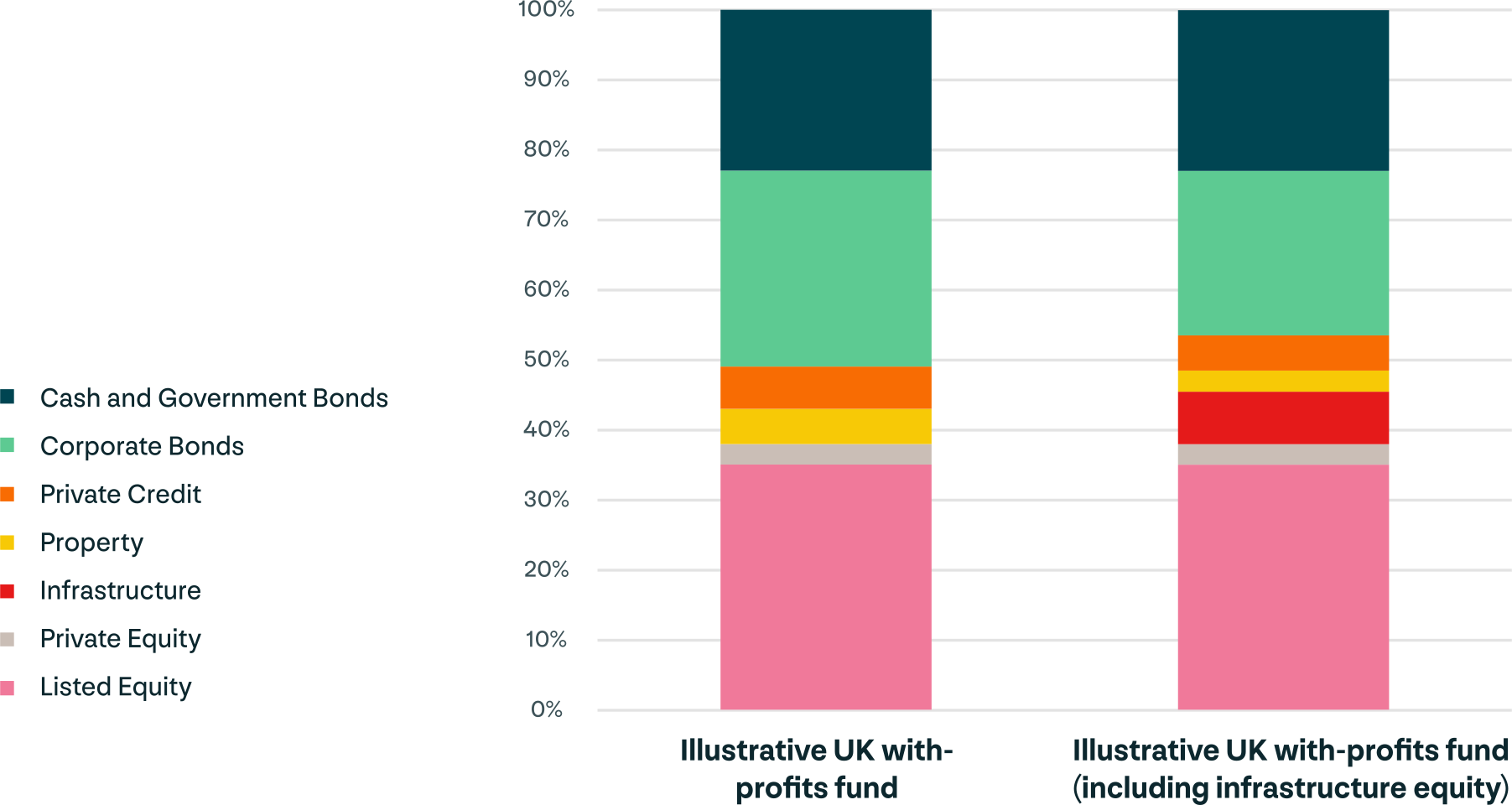
Similarly, with-profits funds are increasingly considering alternative asset classes to enhance policyholder outcomes. Chart 2 shows two portfolios for a typical medium-sized with-profits fund: the first excludes infrastructure equity, the second makes a 7.5% allocation.
As with the P&C portfolio, allocating to infrastructure equity provides a new source of returns; it also potentially reduces risk and capital metrics.
Chart 2 – Including infrastructure equity in a with-profits fund portfolio
Source: Barnett Waddingham. For illustrative purposes only.
Does investing via a closed- or open-ended fund make a difference?
Investors can access infrastructure equity through both open-ended and closed-ended fund structures. Whichever option an investor chooses, selecting the right manager is crucial.
Close-ended funds
Open-ended funds
For insurers, we believe investing in infrastructure equity via an open-ended fund has the potential to enhance portfolio resilience, improve capital efficiency, and provide the flexibility to scale allocations long term.
Conclusion: What’s next for infrastructure equity?
In this article, we’ve outlined why we believe now is the right time to invest in infrastructure equity, but looking further ahead, the asset class looks set to benefit from a number of global megatrends8. From decarbonisation and electrification to digital connectivity and circular-economy solutions, these trends point to a sustained opportunity, reinforcing infrastructure equity’s role as a strategic, forward-looking allocation for insurers.
This piece was developed in partnership with Barnett Waddingham.

Footnotes:
1 Investments in infrastructure are subject to various risks including regulatory risk and market risk, which are outlined in further detail on the “Important Disclosures” page. Prior to making an investment in any infrastructure strategy, investors should refer to the offering documents for a complete discussion of risks.
2 This article refers to private markets infrastructure (i.e. investments in infrastructure assets that are made through private (non-listed) ownership structures).
3 Type 1 equity is comprised of non-OECD listed equities, unlisted equities, private equity, commodities, and all other assets where look through is unavailable. Type 2 equity constitutes equities listed in a regulated EEA or OECD market.
4 Given there has historically been little correlation between infrastructure equity and more traditional asset classes, like equities/bonds
5 Source: Barnett Wadingham. Expected market returns are provided gross.
6 Source: IFM Investors. Expected market returns are provided gross.
7 Although the secondary market is expanding.
8 Megatrends: building a sustainable investment portfolio - Briefings | Barnett Waddingham
Important Disclosures
The following disclosure applies to this material and any information provided regarding the information contained in this material. By accepting this material, you agree to be bound by the following terms and conditions. The material does not constitute an offer, invitation, solicitation, or recommendation in relation to the subscription, purchase, or sale of securities in any jurisdiction and neither this material nor anything in it will form the basis of any contract or commitment. IFM Investors (defined as IFM Investors Pty Ltd and its affiliates) will have no liability, contingent or otherwise, to any user of this material or to third-parties, or any responsibility whatsoever, for the correctness, quality, accuracy, timeliness, pricing, reliability, performance, or completeness of the information in this material. In no event will IFM Investors be liable for any special, indirect, incidental, or consequential damages which may be incurred or experienced on account of a reader using or relying on the information in this material even if it has been advised of the possibility of such damages.
Certain statements in this material may constitute “forward looking statements” or “forecasts”. Words such as “expects,” “anticipates,” “plans,” “believes,” “scheduled,” “estimates” and variations of these words and similar expressions are intended to identify forward-looking statements, which include but are not limited to projections of earnings, performance, and cash flows. These statements involve subjective judgement and analysis and reflect IFM Investors’ expectations and are subject to significant uncertainties, risks, and contingencies outside the control of IFM Investors which may cause actual results to vary materially from those expressed or implied by these forward-looking statements. All forward-looking statements speak only as of the date of this material or, in the case of any document incorporated by reference, the date of that document. All subsequent written and oral forward-looking statements attributable to IFM Investors or any person acting on its behalf are qualified by the cautionary statements in this section. Readers are cautioned not to rely on such forward-looking statements. The achievement of any or all goals of any investment that may be described in this material is not guaranteed.
Past performance does not guarantee future results. The value of investments and the income derived from investments will fluctuate and can go down as well as up. A loss of principal may occur.
This material may contain information provided by third parties for general reference or interest. While such third-party sources are believed to be reliable, IFM Investors does not assume any responsibility for the accuracy or completeness of such information.
This material does not constitute investment, legal, accounting, regulatory, taxation or other advice and it does not consider your investment objectives or legal, accounting, regulatory, taxation or financial situation or particular needs. You are solely responsible for forming your own opinions and conclusions on such matters and for making your own independent assessment of the information in this material. Tax treatment depends on your individual circumstances and may be subject to change in the future.
An infrastructure investment is subject to certain risks including but not limited to: the burdens of ownership of infrastructure; local, national and international economic conditions; the supply and demand for services from and access to infrastructure; the financial condition of users and suppliers of infrastructure assets; changes in interest rates and the availability of funds which may render the purchase, sale or refinancing of infrastructure assets difficult or impractical; changes in environmental and planning laws and regulations, and other governmental rules; environmental claims arising in respect of infrastructure acquired with undisclosed or unknown environmental problems or as to which inadequate reserves have been established; changes in energy prices; changes in fiscal and monetary policies; negative economic developments that depress travel; uninsured casualties; force majeure acts, terrorist events, under insured or uninsurable losses; and other factors beyond reasonable control. IFM-07NOV2025-4955226
Related articles

Private credit under pressure, but opportunities still exist





Where investment decisions can fall short – and why


Beyond data centres: Could fibre optic networks bridge the AI divide?