Key takeaways
-
Equity markets Surprisingly buoyant despite elevated geopolitical and macro risks.
-
Fixed income Long-end yields grinding higher as inflation and policy risks are repriced.
-
Real assets Infrastructure remains attractive for resilience, inflation linkage and diversification.
Risk repriced, but not resolved
Global markets are navigating an increasingly uneasy mix of geopolitical risk and shifting macro fundamentals. The escalation in the Middle East has reintroduced a stagflationary impulse via higher energy prices, yet risk appetite has remained resilient. Equities have pushed to new highs even as long‑end bond yields have climbed to multi‑decade levels, reflecting inflation, fiscal and policy uncertainty.
Markets climb the wall of worry
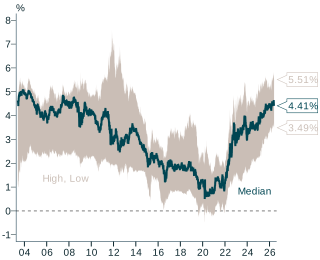
Global markets have spent the second quarter of the year trying to reconcile an increasingly uncomfortable macro and geopolitical mix. The renewed escalation in the Middle East has lifted energy prices, disrupted confidence and reintroduced yet another stagflationary impulse into the global outlook. Yet risk appetite has remained surprisingly resilient. Equity markets have continued to push higher, particularly in the US with the S&P500 pushing through record highs, despite the deterioration in the geopolitical backdrop. At the same time long-end bond yields across advanced economies (GRAPH 01) have also moved higher, collectively hitting levels not seen in nearly 20 years as investors reassess inflation, fiscal and central bank risks.
Graph 01: G7 30-year bond yield
Source: IFM Investors, Bloomberg, via Macrobond
The impact of the Middle East conflict has broadened. While initially regionally contained, the fallout is now a truly global macro event transmitted primarily through energy markets – although the shock is broader than simply one affecting the price of oil. Higher fuel prices flow through to transport, food and fertiliser costs; shipping and insurance premia rise as trade routes are disrupted; and confidence is undermined by the persistent uncertainty around escalation. Risk markets are seemingly pricing in much of the good news flow, while discounting the bad that often comes shortly thereafter. The scenario we’re seeing is not yet a 1970s-style stagflation shock, but it has reintroduced a familiar and uncomfortable trade-off for policymakers and investors: weaker real income growth on one side and renewed inflation pressure on the other.
The reintroduction of this trade-off matters because the global economy begun the quarter with the disinflation narrative still broadly intact. Central banks were expected to ease policy gradually as inflation returned closer to target and growth cooled. That confidence has been challenged. The market pricing of central bank moves has reversed through the quarter. Previous expectations of rate cuts, particularly by the US Federal Reserve (Fed), have been scaled back and, in some jurisdictions, replaced by renewed concern that policy may need to stay restrictive for longer. For central banks, the complication is clear. A supply-side energy shock weakens growth, but it also risks lifting inflation expectations if it proves persistent. That makes the policy reaction function less straightforward and leaves markets more sensitive to each inflation print, labour market release and central bank communication. While the US is at the centre of the geopolitical shock, the impact on an economy largely able to meet its own energy needs is more limited than other advanced economies. Those more energy dependent, such as the UK, Europe, through to Asian nations and including Australia, face risks from both price and lack of volume.
The impact of the Middle East conflict has broadened. While initially regionally contained, the fallout is now a truly global macro event transmitted primarily through energy markets – although the shock is broader than simply one affecting the price of oil.
The quarter has also been defined by the volatility of the newsflow. Signs of optimism that a ceasefire might be agreed, largely emanating from the US Administration, have repeatedly been followed by reports suggesting that any agreement remains incomplete, and is fragile or contested. This has created a market environment driven less by a single durable narrative and more by a rapid repricing of probabilities. Risk assets have rallied on headlines suggesting de-escalation, only to give back gains when those hopes have faded. Rates and commodities have been similarly reactive. The result is not just higher volatility, but a more fragile form of investor confidence.
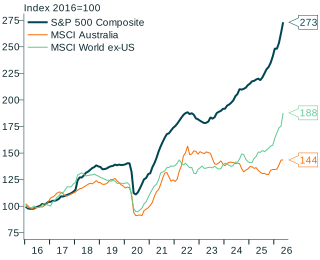
What has been striking, however, is the strength of equity markets in the face of these risks. In a more orthodox macro environment, rising energy prices, declining expectations for central bank easing and higher long-end bond yields would be expected to weigh more heavily on valuations. Instead, equities have remained well supported. Part of this reflects the resilience of nominal growth and corporate earnings in the US (GRAPH 02), while it also reflects a renewed enthusiasm around AI-related capital expenditure and the broader investment cycle in technology, energy infrastructure and defence. It also seemingly reflects a market that has become increasingly willing to look through geopolitical shocks where the damage to earnings is not yet visible. For investors this resilience should not be dismissed, but neither should it be extrapolated too confidently given the uncertainty that clouds the outlook. Equity markets are effectively assuming that the inflationary impulse from the Middle East conflict will be contained, that central banks will not be forced back into a more aggressive tightening bias, and that earnings growth will remain sufficiently robust to absorb higher discount rates. Those assumptions may prove correct, but the margin for error has narrowed. The more long-end yields rise, the more equity valuations must rely on earnings delivery rather than multiple expansion.
Graph 02: Earnings per share
Source: IFM Investors, IBES, via Macrobond
Fixed income markets have been less sanguine. Long-end government bond yields in advanced economies have continued to grind higher, reflecting the combined pressure of inflation risk, fiscal supply, term premia and uncertainty around central bank reaction functions. This is one of the defining market signals of the quarter. In highly-indebted Japan, for example, 30-year yields are at record highs, currently 3.8%, amid fiscal pressures and weaker demand from institutions. And we have seen how market sentiment can shift towards these trends and impart volatility across markets. A defensive investor, concerned about the economic outlook, is finding that view comes at a cost, as duration positions see yields drift higher and equity markets rise.
For institutional investors, the portfolio construction implications are important. The case for maintaining exposure to growth assets has not disappeared; indeed, the persistence of equity momentum suggests that investors remain reluctant to move too defensively while nominal growth and earnings remain intact. But the combination of stagflation risk, elevated long-end yields and headline-driven volatility argues for more deliberate diversification. Portfolios need assets that can withstand a wider range of inflation and growth outcomes, rather than relying solely on the traditional equity-bond balance.
Real assets remain central to this discussion. Infrastructure in particular continues to offer attractive characteristics in the current environment: resilient cash flows, potential inflation linkage, lower correlation to listed markets and exposure to long-term structural investment themes. In a world where geopolitical risk is persistent, inflation shocks are more frequent and government bond markets are no longer providing the same defensive ballast, the role of infrastructure as a portfolio stabiliser remains compelling.
Australia: Cracks start to show?
The Reserve Bank of Australia (RBA) has raised the cash rate 25bp in March and May since our last quarterly economic update, marking a return to its previous cycle high of 4.35%. This makes the Bank a clear outlier among major developed-market central banks – all of which elected to hold rates steady in May. We stress that starting points matter, where prior to the Middle East conflict the Australian economy was arguably growing beyond potential – with subdued productivity growth a binding constraint – characterised by resurgent domestically-generated inflation.
The May press release was cautiously hawkish, noting that higher fuel prices were “already adding to inflation” and consequently there were “early signs that many firms experiencing cost pressures [were] looking to increase prices”. This was reinforced by the more policy-relevant trimmed mean inflation printing at 3.5%yoy in Q1 — confirming that underlying inflation remained uncomfortably elevated even before the full pass-through of conflict-related cost pressures. A subsequent speech by the Bank's Chief Economist leaned further in the same direction, drawing on recent RBA research showing that Australian firms pass on cost increases fully and more rapidly when inflation expectations are drifting higher and capacity is constrained. The paper's prescribed policy response in such environments is ‘front-loaded tightening’ – a framework that explains the three consecutive hikes delivered across as many meetings since the onset of the conflict.
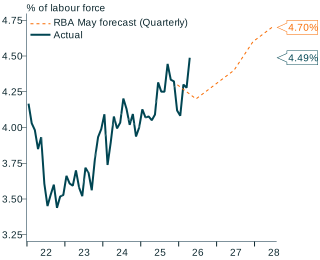
That said, the statement did acknowledge the conflict's potential to weigh on domestic activity and characterised the 75 basis points of tightening delivered in 2026 as providing sufficient headroom to respond to incoming data. Indeed, the deterioration in leading indicator data was already apparent in the lead-up to the May meeting, but cracks are now beginning to appear in the hard data for the first time since the onset of the conflict and the RBA’s policy pivot in February. Employment fell by 19,000 in April, a significant downside surprise, while the unemployment rate jumped 20bp to 4.5% - materially above the bank’s forecasts. Should the labour market continue to deviate from the RBA's base case (GRAPH 03), it may effectively cap further rate hikes. The bank has sought to make preserving labour market gains a key facet of its interventions, but this may be tested should inflation accelerate in the near term. Further, we see the risk that AI is already impacting the labour market to slow employment growth and this could present upside risk to the unemployment rate should labour supply remain strong.
Graph 03: Unemployment rate
Source: IFM Investors, RBA, ABS via Macrobond
The Australian federal government’s 2026-27 Budget continued in setting an expansionary fiscal policy. While there was a $44.9bn improvement in the bottom line over the forward estimates, $36.6bn came from parameter variations (including a stronger-than-expected economy and higher commodity prices) and a further $8.2bn came from policy decisions (mainly future spending reform to the National Disability Insurance Scheme). Deficits are expected over the forward estimates, with no return to surplus – which we regard as a conscious choice after budget surpluses were recorded in FY23 & FY24. Changes to the capital gains tax framework and a shake-up of negative gearing were the most contentious reforms, designed to address intergenerational equity in the property market. This will likely add, at the margin, to a property market already slowing under the weight of tighter monetary policy. Compounded by rising costs in the sector, property investment is a clear downside risk to economic growth in the near term. On productivity, the Budget offers a modest package of measures. While welcome, the measures were not enough to get the government to upgrade its productivity forecasts.
Real GDP grew 0.3%qoq and 2.5%yoy – ahead of RBA expectations and further indication growth is above potential. Of course, the result predates the deterioration in the outlook owing to higher energy prices and the full impact of rate hikes. The headline understates domestic activity with domestic demand surging 3.5%yoy – primarily due to business investment tied to datacentre installations. This was offset by a related rise in data processing equipment imports and a net trade drag. Meanwhile, household consumption accelerated, dwelling investment growth slowed and public demand edged higher. We see the result as the calm before the storm, with leading indicator data and the latest employment read suggesting the slowdown necessary to close the output gap is underway.
For a more detailed economic update on Australia, the US, Europe and the UK and Asia, read the Economic Update for the second quarter of 2026 ‘Risk repriced, but not resolved’.

Alex Joiner
Alex Joiner is Chief Economist at IFM Investors. He is responsible for the firm’s economic, financial market and geopolitical risk analysis that is key in IFM’s investment process. In this capacity he engages with IFM’s domestic and global clients on macro-investment trends and themes.

Frans van den Bogaerde
Frans supports the Chief Economist with the firm’s economic, financial market, and policy analysis and forecasting. He holds a Bachelor of Commerce (Finance & Economics) with Honours in Finance (First Class) from the University of Melbourne.

Chris Skondreas
Chris supports the Chief Economist with the firm's economic, financial market, and policy analysis and forecasting. He holds a Bachelor of Commerce (Economics and Finance) from Monash University.
Related articles

Manchesterism in action: the rise and rise of Manchester Airports Group



Three reasons infrastructure debt complements corporate direct lending



Dispelling the myths of infrastructure debt