
Why energy security depends on infrastructure

Key takeaways
-
Energy security increasingly depends on the infrastructure connecting supply with demand.
-
Flexible midstream infrastructure can help maintain energy flows when global supply routes are disrupted.
-
Strategic positioning and adaptability can determine the long-term value of energy infrastructure.
Secure energy increasingly relies on the infrastructure that connects supply with demand. Recent tensions in the Middle East have once again put energy security in the spotlight. They have also reinforced a simple point: producing energy is only part of the equation. Energy must also be transported, stored and distributed reliably, particularly when supply routes are under pressure.
This is not solely a response to geopolitical events. Rising electricity demand, AI-driven power consumption, decarbonization and greater uncertainty are increasing the value of resilient energy systems and the infrastructure that underpins them.
In an increasingly interconnected global energy system, the ability to maintain reliable supply during periods of disruption is paramount.
Midstream infrastructure plays a critical role in connecting energy supply with demand. Pipelines, terminals, storage facilities and export infrastructure enable energy to move between regions and respond to changing market conditions. Their strategic value can become especially visible during periods of instability.
Liquefied natural gas (LNG) serves as a useful example. Natural gas provides roughly a quarter of the world's primary energy, and as Europe adapts to significant shifts in energy supply, it has become increasingly reliant on LNG imports from the United States. This highlights the important role U.S. export infrastructure plays in global energy security.
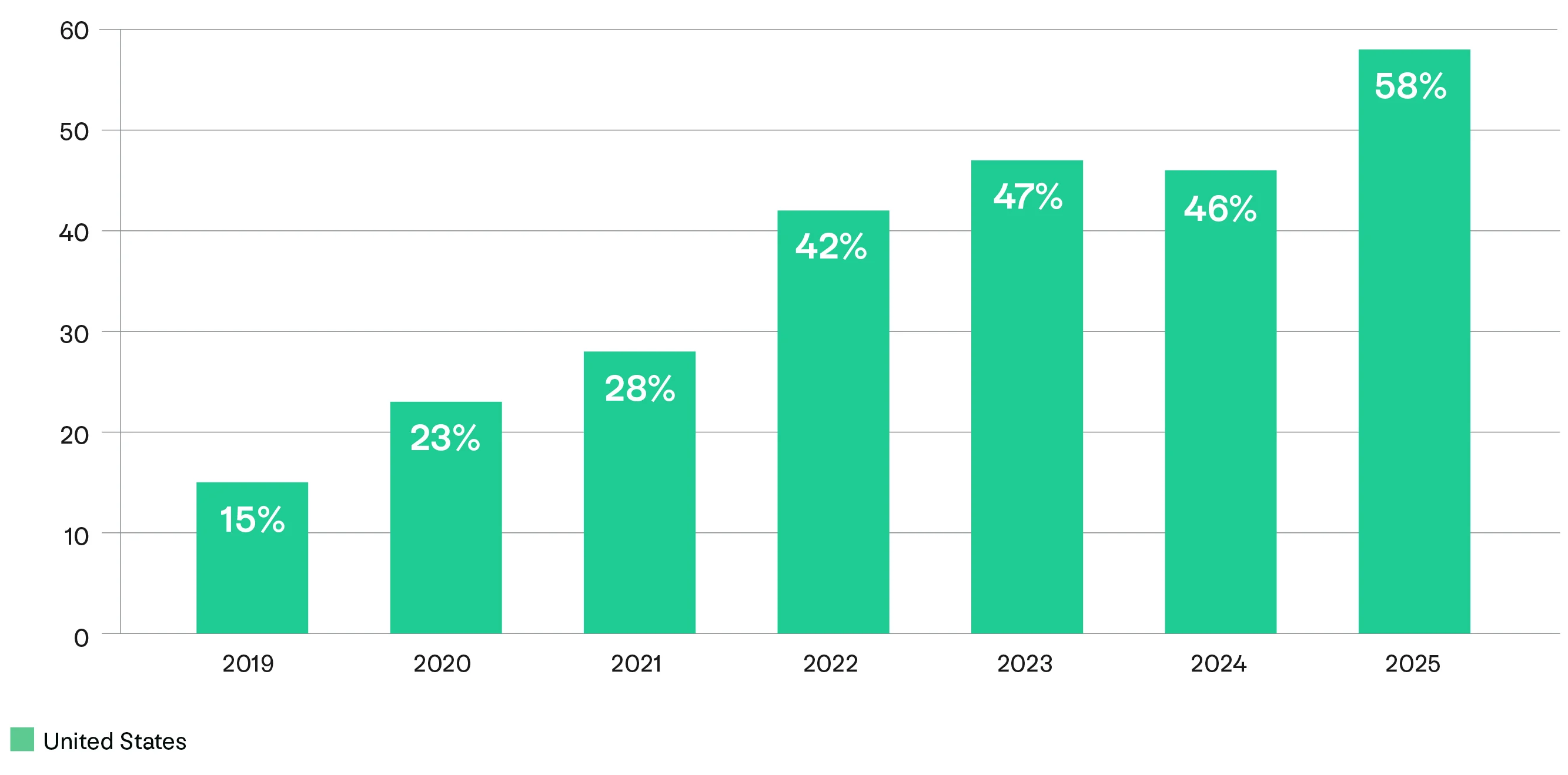
U.S. LNG plays a critical role in global energy security: The United States now supplies over half of Europe’s LNG
Chart 1: Percentage of Europe LNG supplied by United States
Source: GIIGNL Annual Report
However, not all midstream assets are affected equally. Outcomes depend on an asset's role within the energy system, its location within broader energy networks and its ability to adapt as market conditions evolve. Assets that connect supply with demand, maintain flexibility during disruptions and serve critical energy markets may become increasingly valuable as energy systems become more complex and connected.
Case study: Freeport LNG Train 2 – Supporting global energy security through U.S. energy export infrastructure
Freeport LNG demonstrates the important role that reliable and flexible U.S. export infrastructure can play in supporting global energy security. The Russia-Ukraine crisis and the more recent Iran conflict highlight the strategic importance of assets capable of serving global energy markets during periods of stress.
The U.S. is the world’s largest producer of natural gas and the leading exporter of LNG1. Located on the U.S. Gulf Coast, Freeport LNG accounts for approximately 17% of U.S. LNG export capacity currently in commercial operation today1. The destination flexibility in customer offtake contracts has helped U.S. LNG export cargoes balance global supply and demand during recent conflicts.
Since the Russia-Ukraine crisis, Europe has increasingly relied on U.S. LNG to replace Russian gas imports, with the U.S. share of European LNG imports rising from 28% in 2021 to approximately 60% today (see chart 1). Similarly, over the same period, the proportion of Freeport LNG cargoes delivered to Europe increased from 24% to 66% (remaining 16% Asia, 7% South America, and 11% MENA)2.
From there, the Iran conflict disrupted global LNG markets following damage to QatarEnergy’s Ras Laffan export facility and the effective closure of the Strait of Hormuz, a key shipping route that facilitated approximately 20%1 of global LNG supply prior to the conflict. These events underscore how operating U.S. LNG facilities, such as Freeport LNG, help maintain energy flows and supply reliability during significant disruptions.
[1] U.S. Energy Information Administration
[2] U.S. Department of Energy. Natural Gas Imports and Exports Monthly. Data available as of September 2026.
Tom Osborne, Executive Director of Infrastructure at IFM Investors, says energy security requires not only ownership of resources, but also the infrastructure needed to deliver them. “Energy security depends on the resilience and adaptability of critical infrastructure when supply routes, trade flows or demand patterns shift. In an increasingly interconnected global energy system, the ability to maintain reliable supply during periods of disruption is paramount.”
This implication extends well beyond today’s geopolitical tensions. As energy demand rises and supply chains become more interconnected, infrastructure is becoming a critical enabler of reliability and system resilience.
For long-term investors, this reinforces the importance of identifying strategically positioned infrastructure assets that can support energy security and adapt as markets, technologies and trade flows continue to evolve.
Important Disclosures
The following disclosure applies to this material and any information provided regarding the information contained in this material. By accepting this material, you agree to be bound by the following terms and conditions. The material does not constitute an offer, invitation, solicitation, or recommendation in relation to the subscription, purchase, or sale of securities in any jurisdiction and neither this material nor anything in it will form the basis of any contract or commitment. IFM Investors (defined as IFM Investors Pty Ltd and its affiliates) will have no liability, contingent or otherwise, to any user of this material or to third-parties, or any responsibility whatsoever, for the correctness, quality, accuracy, timeliness, pricing, reliability, performance, or completeness of the information in this material. In no event will IFM Investors be liable for any special, indirect, incidental, or consequential damages which may be incurred or experienced on account of a reader using or relying on the information in this material even if it has been advised of the possibility
of such damages.
Certain statements in this material may constitute “forward looking statements” or “forecasts”. Words such as “expects,” “anticipates,” “plans,” “believes,” “scheduled,” “estimates” and variations of these words and similar expressions are intended to identify forward-looking statements, which include but are not limited to projections of earnings, performance, and cash flows. These statements involve subjective judgement and analysis and reflect IFM Investors’ expectations and are subject to significant uncertainties, risks, and contingencies outside the control of IFM Investors which may cause actual results to vary materially from those expressed or implied by these forward-looking statements. All forward-looking statements speak only as of the date of this material or, in the case of any document incorporated by reference, the date of that document. All subsequent written and oral forwardlooking statements attributable to IFM Investors or any person acting on its behalf are qualified by the cautionary statements in this section. Readers are cautioned not to rely on such forward-looking statements. The achievement of any or all goals of any investment that may be described in this material is not guaranteed.
Past performance does not guarantee future results. The value of investments and the income derived from investments will fluctuate and can go down as well as up. A loss of principal may occur.
This material may contain information provided by third parties for general reference or interest. While such third-party sources are believed to be reliable, IFM Investors does not assume any responsibility for the accuracy or completeness of such information.
This material does not constitute investment, legal, accounting, regulatory, taxation or other advice and it does not consider your investment objectives or legal, accounting, regulatory, taxation or financial situation or particular needs. You are solely responsible for forming your own opinions and conclusions on such matters and for making your own independent assessment of the information in this material. Tax treatment depends on your individual circumstances and may be subject to change in the future.
Australia Disclosure
This material is provided to you on the basis that you warrant that you are a “wholesale client” or a “sophisticated investor” or a “professional investor” (each as defined in the Corporations Act 2001 (Cth)) to whom a product disclosure statement is not required to be given under Chapter 6D or Part 7.9 of the Corporations Act 2001 (Cth). IFM Investors Pty Ltd, ABN 67 107 247 727, AFS Licence No. 284404.
United Kingdom Disclosure
This material is provided to you on the basis that you warrant that you fall within one or more of the exemptions in the Financial Services and Markets Act 2000 (“FSMA”) [(Financial Promotion) Order 2005] [(Promotion of Collective Investment Schemes) (Exemptions) Order 2001, or are a Professional Client for the purposes of FCA rules] and as a consequence the restrictions on communication of “financial promotions” under FSMA and FCA rules do not apply to a communication made to you. IFM Investors (UK) Ltd shall have no liability, contingent or otherwise, to any user of this material or to third parties, or any responsibility whatsoever, for the correctness, quality, accuracy, timeliness, pricing, reliability, performance, or completeness of the information in this material.
Switzerland Disclosure
This Information is provided to you on the basis that you warrant you are (i) a professional client or an institutional client pursuant to the Swiss Federal Financial Services Act of 15 June 2018 (“FinSA”) and (ii) a qualified investor pursuant the Swiss Federal Act on Collective Investment Schemes of 23 June 2006 (“CISA”), for each of (i) and (ii) excluding high-net-worth individuals or private investment structures established for such high-net worth individuals (without professional treasury operations) that have opted out of customer protection under the FinSA and that have elected to be treated as professional clients and qualified investors under the FinSA and the CISA, respectively.
IFM-14OCTOBER2026-6012454
To explore the potential investment implications of growing demand for strategically positioned energy infrastructure, please contact our Global Client Solutions team.