Infrastructure debt outlook 2027: AI hyperscalers set to extend debt market dominance

Key takeaways
- AI hyperscalers’ financing needs are reshaping infrastructure debt markets in 2027, with power availability, counterparty strength and concentration risk key considerations for lenders.
- A pullback in US government support for renewables has changed the economics for certain projects and led investors to look again at carbon-based energy providers.
- A higher and more uncertain rate environment means a recalibration of both financing costs and construction budgets.
As institutional investors weigh their private markets allocations, infrastructure debt continues to make its case as a defensive, inflation-linked complement to public bond and equity holdings – even as the sector faces a more complicated political, regulatory and macroeconomic backdrop.
We expect sovereign resilience will be an increasingly important theme for the infrastructure debt market. There is a broad reassessment among governments and investors of the strength of supply chains, defence and national infrastructure, sharpened by geopolitical tensions.
Likewise, AI-related infrastructure will remain a core focus in 2027 and beyond, with hyperscalers ramping up construction of data centres and related infrastructure such as power stations.
A higher and more uncertain rate environment that reshapes financing structures will also be a feature of the new year. The US Federal Reserve raised rates in September 2026 to a target range of 3.75%–4.00%, its first hike since 2023. The European Central Bank and the Reserve Bank of Australia have moved in the same direction, raising their policy rates amid a rising inflationary environment, with analysts predicting further hikes.
The practical consequence of this for infrastructure lending is a recalibration of financing costs and construction budgets. Contingency provisions, pass-throughs and inflation escalators will take on renewed importance, helping reduce construction risk in the underlying transactions. This will leave the borrower to shoulder the risks rather than the lender. Alongside these will be a continued borrower preference for shorter-duration, floating-rate construction financing over locking in long-term permanent debt.
IFM Investors’ own spread data as of the first half of 2026 shows the shape of this repricing across markets. North American BBB-rated infrastructure debt has been priced in the 175–250 basis point range over base rates, with BB credits at 250–400 basis points and B-rated paper above 400. European spreads have run somewhat tighter, while Australia, supported by strong bank competition in a relatively concentrated market, has consistently offered some of the tightest spreads globally, even as rate expectations there have grown more cautious.
Data centre demand is also one of the principal drivers of rising US electricity consumption, presenting fresh financing opportunities for energy infrastructure including nuclear.
The outlook for North America
While most countries are prioritising sovereign resilience, we argue that the US and Europe are diverging in certain areas. On energy infrastructure priorities, US federal support is shifting away from a focus on renewable energy and towards onshoring, domestic manufacturing and supply chain resilience.
Despite a materially less supportive US federal policy backdrop, renewable energy remains the most active corner of the US power market because it can be built faster than the alternatives.
Utilities continue to issue long-term power purchase agreements, and with wind turbines and solar panels readily available, renewable projects can be brought online far more quickly than new gas-fired plants, which often face lead times of three to six years. Battery storage continues to benefit from favourable federal tax credit treatment.
Conventional power in North America has continued to attract investor interest even as overall new deal flow in the sector has been comparatively lower. Nevertheless, opportunities are likely to arise for deal refinancings, compensating for the relative lack of newer deals, which take longer to come to market and execute. Midstream and LNG assets have remained resilient, supported by structurally rising electricity demand.
Renewables in the US are still in play but are now more susceptible to regulatory risk and have less federal funding available. Since late 2025, the US government has ordered a suspension of several East Coast projects. These include Ørsted’s Revolution Wind off Rhode Island, which was roughly 80% complete at the time of the order, and Equinor’s Empire Wind off New York. Developers have challenged the orders in court and construction is resuming on some projects only after judicial review.
The pullback in federal support has hurt smaller renewable energy projects, underscoring the need for investors to focus on quality. For example, during this period IFM Investors financed a diversified 300 MW distributed solar platform spanning more than 200 assets across 19 US states. The transaction was structured with a roughly 30% equity capital cushion and revenues drawn predominantly from long-term power purchase agreements and net metering arrangements. It is the kind of scaled, contracted platform that is increasingly favoured over smaller, less capitalised developers.1
Transport modernisation is a growing part of next year's opportunity set, with an increase in rail M&A financing activity. But it remains the case that little in the 2027 outlook looms larger than the financing needs of the AI build-out.
Hyperscaler debt spending
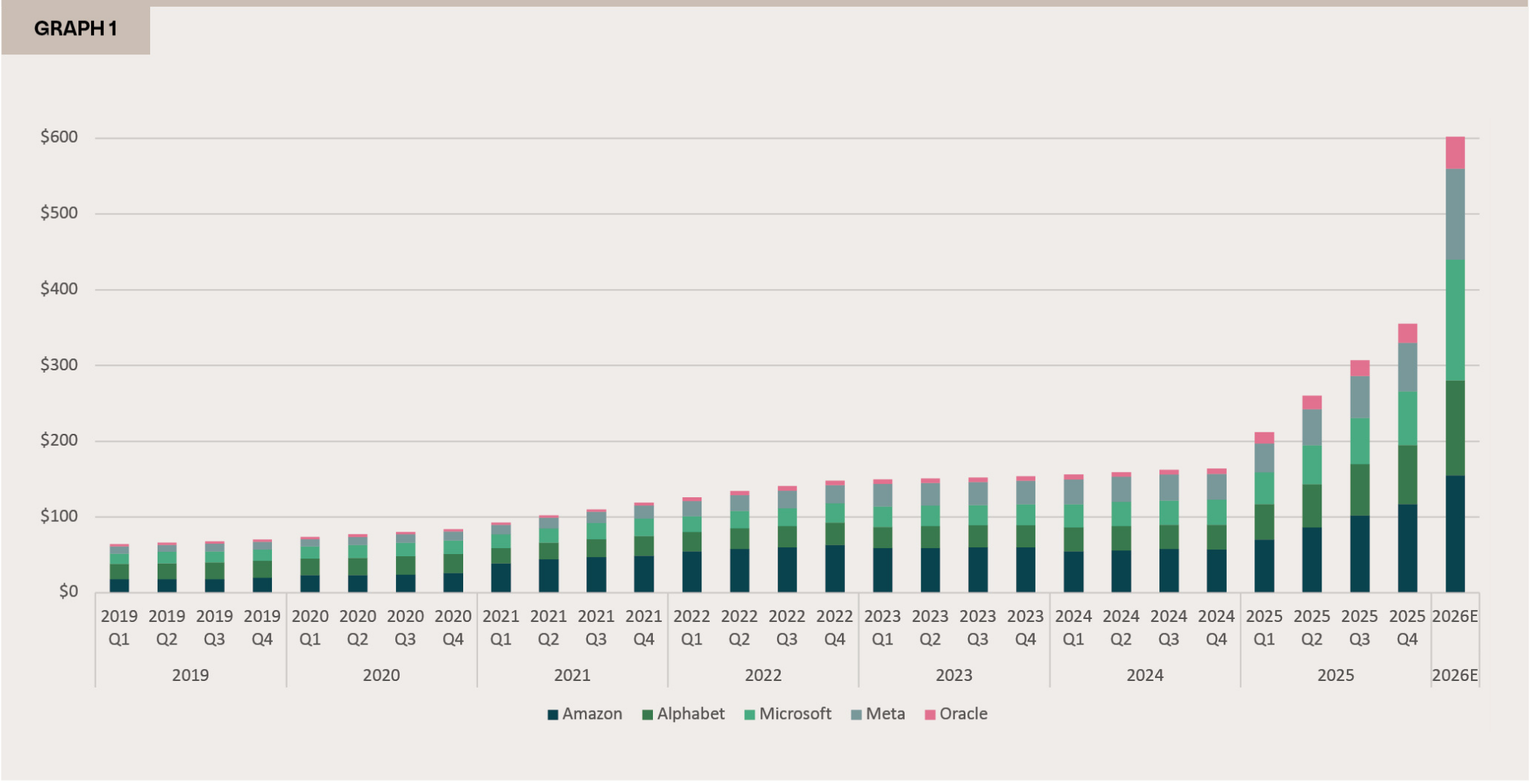
Hyperscaler capital expenditure across the sector as a whole will total around US$800 billion in 2026, with the five largest cloud platforms – Amazon, Alphabet, Microsoft, Oracle and Meta Platforms – forecast to spend US$1.2 trillion in 2027, according to Goldman Sachs.2
Already, just over a dozen large-cap AI-focused technology names account for more than US$1 trillion of outstanding interest-bearing debt, MUFG data shows.3 Looking ahead, MUFG forecasts that hyperscalers will finance around half of their global data centre spend from cashflow, with the remainder financed through private credit and other debt arrangements.
Graph 1: Top five hyperscalers set to spend US$602 billion in 2026
Source: MUFG
The growth drivers behind this appear compelling: to take just one metric, AI adoption is progressing faster than the adoption of personal computers or the internet at comparable stages when those were first developed. But we remind investors that they should remain cautious. When backing data centre capacity expansion, investors should focus on location, power availability, grid access and hyperscaler tenant quality. These factors now separate the most bankable assets from the rest.
In a move that underscores the importance of project selection, Oracle in September issued force majeure notices to the developer of a new data centre in New Mexico in an effort to protect itself from costs if the facility were to be delayed.4 The decision came at a time when some rating agencies, such as Fitch, were already re-evaluating the company’s debt, as credit default swap spreads approached two-decade highs.5 More widely, the news underscores the way in which technology firms are stretching themselves in the race to dominate AI.
We see a potential threat to growth from a recent phenomenon in the US of local communities and politicians pushing back against data centre developments amid concerns over water consumption, energy costs and architectural impact.
In the US, political sentiment is shifting quickly in some of the fastest-growing data centre hubs, with Texas and Virginia both moving to reduce the pace of permitting and build-out. This adds development risk for investors, as sites may be mothballed by local planners.
As pricing on both investment-grade and sub-investment-grade data centre debt has begun to tick up amid heavy issuance, another pressing question for lenders is concentration risk. Concentration should be considered not only through direct lending to a facility, but also through corporate debt issuance, associated chip financings and residual guarantees that are extended further up the credit chain.
Data centre demand is also one of the principal drivers of rising US electricity consumption, presenting fresh financing opportunities for energy infrastructure including nuclear and small modular reactors, a novel technology which we believe holds significant potential.
The outlook for Europe
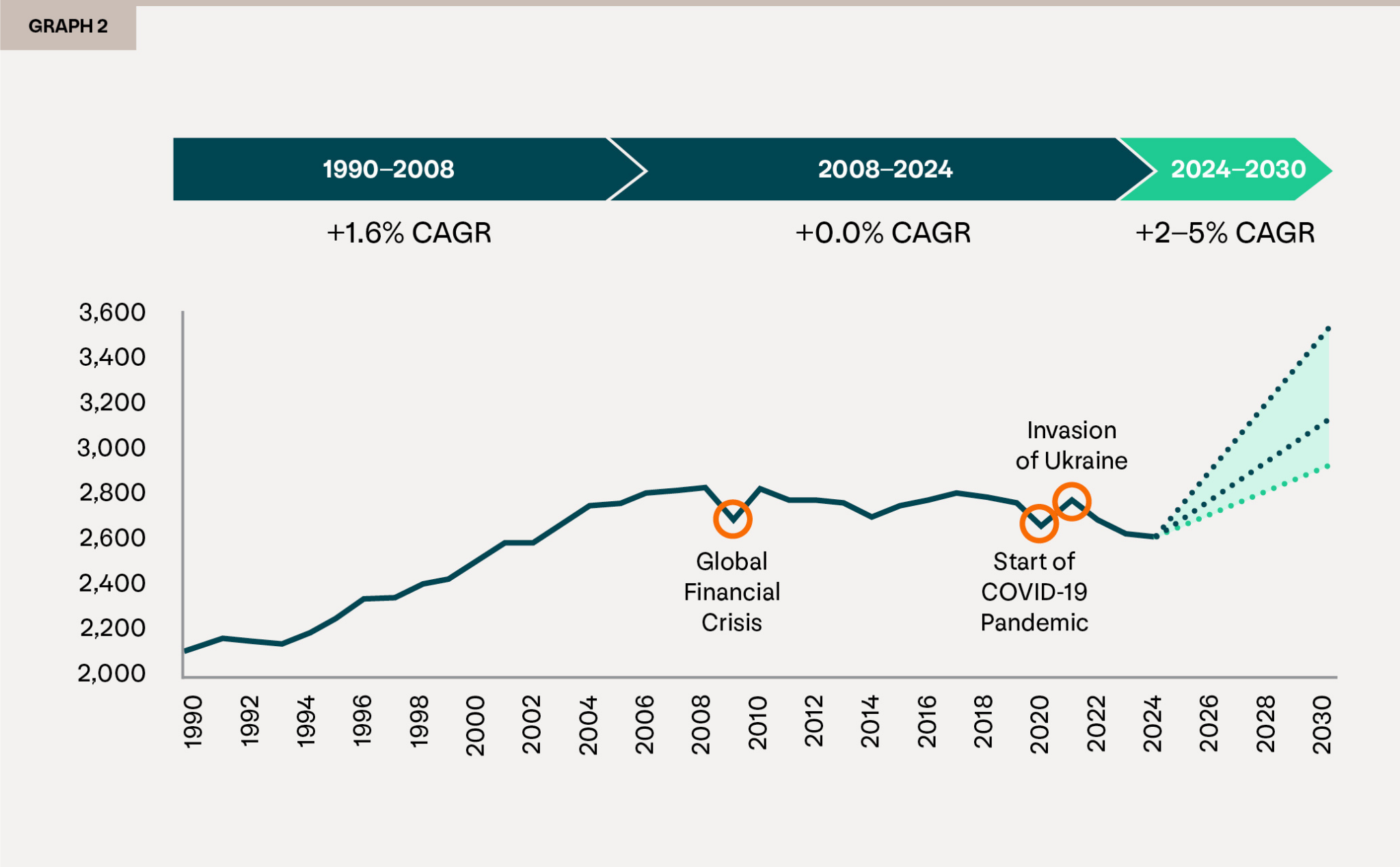
In contrast to the regulatory pressures slowing the US renewables rollout, Europe’s focus on decarbonisation and electrification will require decades of investment in clean energy and grid capacity. EU electricity output, essentially flat for more than a decade, is now forecast to grow at 2% to 5% annually through 2030.
Graph 2: Electricity demand picking up as countries move to electrification
Source: IFM Investors, Eurostat
The European Union’s AccelerateEU initiative and binding requirements for zero-emission buildings by 2050 further reinforce long-term demand for electrification, clean power, grid capacity and energy-efficient infrastructure. These requirements also account for some of the demand increases for which suppliers will have to provide in the immediate term.
Additionally, while the pipeline for potential data centres is more significant in the US, European developments will remain vital for the continent’s growth prospects, and will place further upward pressure on energy demand. Consideration should be given to any data centre developer’s ability to secure both the required energy and equipment in advance. Not all proposed data centre developments are likely to meet their intended construction schedules – or begin construction at all – and investors should carefully consider their risk appetite before exploring the sector. Strong counterparties and secured access to energy should be key considerations for any future builds.
This shows up as a preference for strategic locations with secured power access and strong counterparties. The resulting transactions include a €550 million, seven-year facility that IFM helped finance for a hyperscale data centre platform across Frankfurt, London and Amsterdam. Fully leased to top-tier cloud tenants, it is backed by institutional sponsors DigitalBridge and La Caisse.6
In other parts of the digital sector, we expect fibre growth to continue – aided in part by the need for greater rural connectivity and growing competition between legacy and new fibre providers expanding their networks. Investors will have noted that TalkTalk, one of the UK’s largest providers, recently entered administration. This highlights the market’s challenges, with borrowing costs rising and competition for customers placing downward pressure on prices.
Overall, infrastructure debt enters 2027 in a strong position when compared with the broader credit market.
Even as geopolitical shocks from the war in Iran have pushed energy prices higher and stoked inflation concerns, infrastructure debt spreads have stayed comparatively tight. This is despite some areas of the US private credit market showing rising loan defaults and investor withdrawals, with an increase in CDS activity. We believe that contracted cashflows, the backing of real assets and sustained institutional demand continue to be strong bulwarks against volatility.
[1] This case study was selected to illustrate our experience in structuring scaled, contracted solar platform transactions, and not based on its investment performance or financial outcome.
[2] Marton Kasnyik (2026), Goldman Sees Hyperscaler AI Capex Rising 50% to $1.2 Trillion
[3] MUFG (2025), AI Chart Weekly: Financing the AI Supercycle
[4] Caleb Mutua (2026), Oracle Notice to Weigh on Data Center Debt, Morgan Stanley Says
[5] Vasundhara Sawalka (2026), Oracle's Credit Risk Nears an 18-Year High: Can AI Backlog Save Stock?
[6] This transaction was selected to illustrate our digital infrastructure financing capabilities and our focus on projects with secured power access and strong counterparties. It was not chosen based on its investment performance or financial returns.

Rich Randall
Rich is responsible for the creation and management of IFM Investors’ debt investments strategies and portfolios, and for the debt investments team globally. He also heads IFM Investors’ North American debt investment business. Based in New York, Rich has more than 20 years of experience in originating, analysing, structuring and arranging debt facilities for large infrastructure projects.

Private Markets Macro Outlook 2027: AI, energy and a less predictable world
Much of what happens in 2027 will come down to two things: how fast AI investment keeps growing, and how often energy supply is disrupted. Neither is easy to forecast, which makes resilience in portfolio construction more important than any single call.