Infrastructure equity outlook 2027: Asset class to national priority

Key takeaways
- A sharper focus on sovereign resilience is expanding infrastructure investment opportunities in 2027. As governments reassess defence, energy and supply chain security, they may increasingly look to private infrastructure management expertise to support greater infrastructure expenditure in these areas.
- AI will remain a dominant infrastructure investment theme, but the gap between investment demand and bankable opportunities is likely to widen. Access to reliable power, sustainable commercial arrangements and social licence will increasingly differentiate successful data centres.
- Energy security and decarbonisation are converging as policy priorities. We see a focus on onshore wind, utility-scale solar and batteries, underpinned by digital infrastructure, as an effective way to capture exposure to structural growth trends.
For much of the past two decades, infrastructure investment has been shaped by globalisation, efficiency and the energy transition. In 2027, a more fragmented geopolitical environment, the accelerating demands of artificial intelligence and renewed concerns over energy security are reshaping investment priorities.
We expect long-term megatrends around electrification, digital infrastructure and renewables to remain dominant investment themes in the coming year. In addition, a re-examination of sovereign resilience is broadening the opportunity set for infrastructure investments. Defence, critical infrastructure and energy supply chains are joining the list of priorities for 2027 and beyond.
Geopolitical fragmentation, tariff shocks, reshoring and rising defence spending are pushing governments and long-term capital providers to treat certain infrastructure assets not just as an investment class but as a core national capability. Energy, ports, defence and digital networks are at the centre of this trend.1
In short, governments are shifting from a just-in-time model to a just-in-case one. This involves building excess capacity into key systems and focusing more closely on reliable trade partners and alliances for essential imports and support.
This has wide-ranging implications for infrastructure. A just-in-case logic applies directly to liquid fuel supplies and digital connectivity, impacting two growth sectors. Many countries are looking to tap local supplies while introducing export controls or stockpiling raw materials. This change in mindset impacts all supply chains, with stockpiling increasing prices in the short term and altering the flow of goods through major ports.
Defence: The emerging mobilisation of private capital
In a more competitive world, national security is emerging as a key driver of infrastructure spending in 2027 and beyond. In the area of defence alone, McKinsey estimates that at least US$2 trillion needs to be spent on defence-related infrastructure by 2040.2 Increasing defence expenditure is creating an opportunity for governments to reconsider how nationally significant infrastructure is financed, developed and maintained.
While institutional investors today play a limited role in defence infrastructure, the wider sector is opening up to private capital.
The UK, for example, is actively studying ways to engage institutional investors as it scales up defence spending.3 Similarly, as part of 2026’s National Defence Strategy, Australia estimated that it would seek A$15 billion in private capital over the next decade. The funding would help with construction and maintenance of infrastructure, with a third of that expected by the end of the decade.4
With long-term sustainability considerations in mind, potential infrastructure investment opportunities are best suited to infrastructure that supports defensive capabilities, rather than munitions or other offensive capabilities.
Graph 1: NATO members are increasing their defence spending, actual and forecast spending as a percentage of GDP
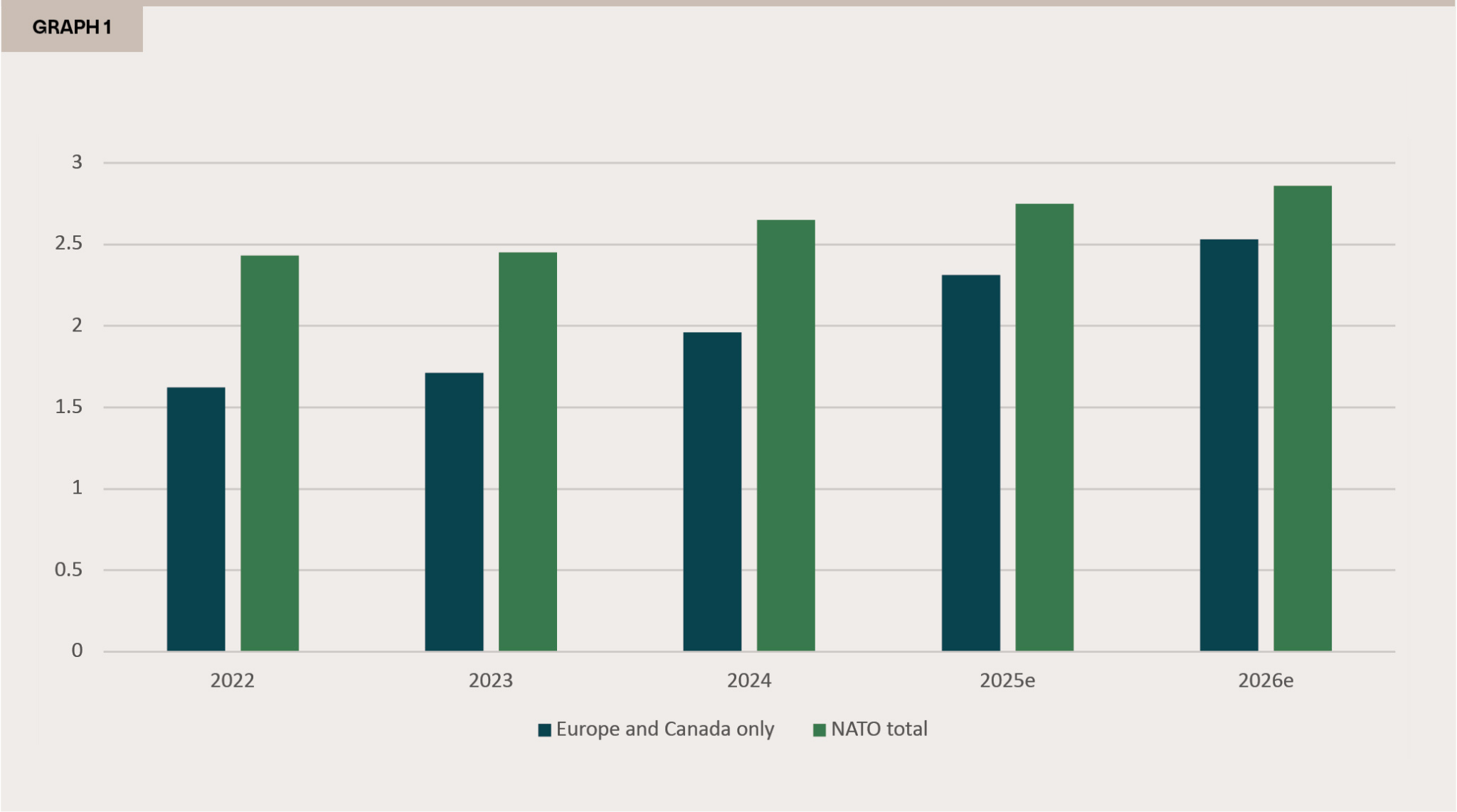
Source: NATO
As the numbers demonstrate, the opportunities are measured in terms of percentage of GDP – a significant opportunity. Infrastructure with dual-use capabilities, such as airfield runways, ports and strategic refinery infrastructure, offers potential access points. This will translate into direct opportunities in both standalone infrastructure and for dual-use transport, logistics, ports and seaports. For its part, IFM Investors has decades of experience in this emerging sector, including the Australian Defence Force’s Joint Operations Command and Darwin Airport, where the runway is shared with the Royal Australian Air Force Base Darwin.
AI infrastructure: Structural growth demands greater investment discipline
If sovereign resilience is about protecting existing infrastructure, AI is about building an entirely new category of it. However, the scale of projected investment should not be confused with the certainty of investment returns.
As the sector matures, we expect a widening distinction between projects underpinned by sustainable commercial arrangements and businesses dependent on continued exponential growth forecasts. Access to reliable power, development capabilities, creditworthy customers and long-term contractual protections will increasingly determine which projects can translate structural demand into attractive infrastructure investments. In the near term, BloombergNEF estimates that the 14 largest investors in the sector – including Microsoft, Amazon, Google and Meta – will spend US$3.3 trillion on data centres through to 2029.5
Graph 2: Forecast global data centre capex in US$trn, 2026-2050
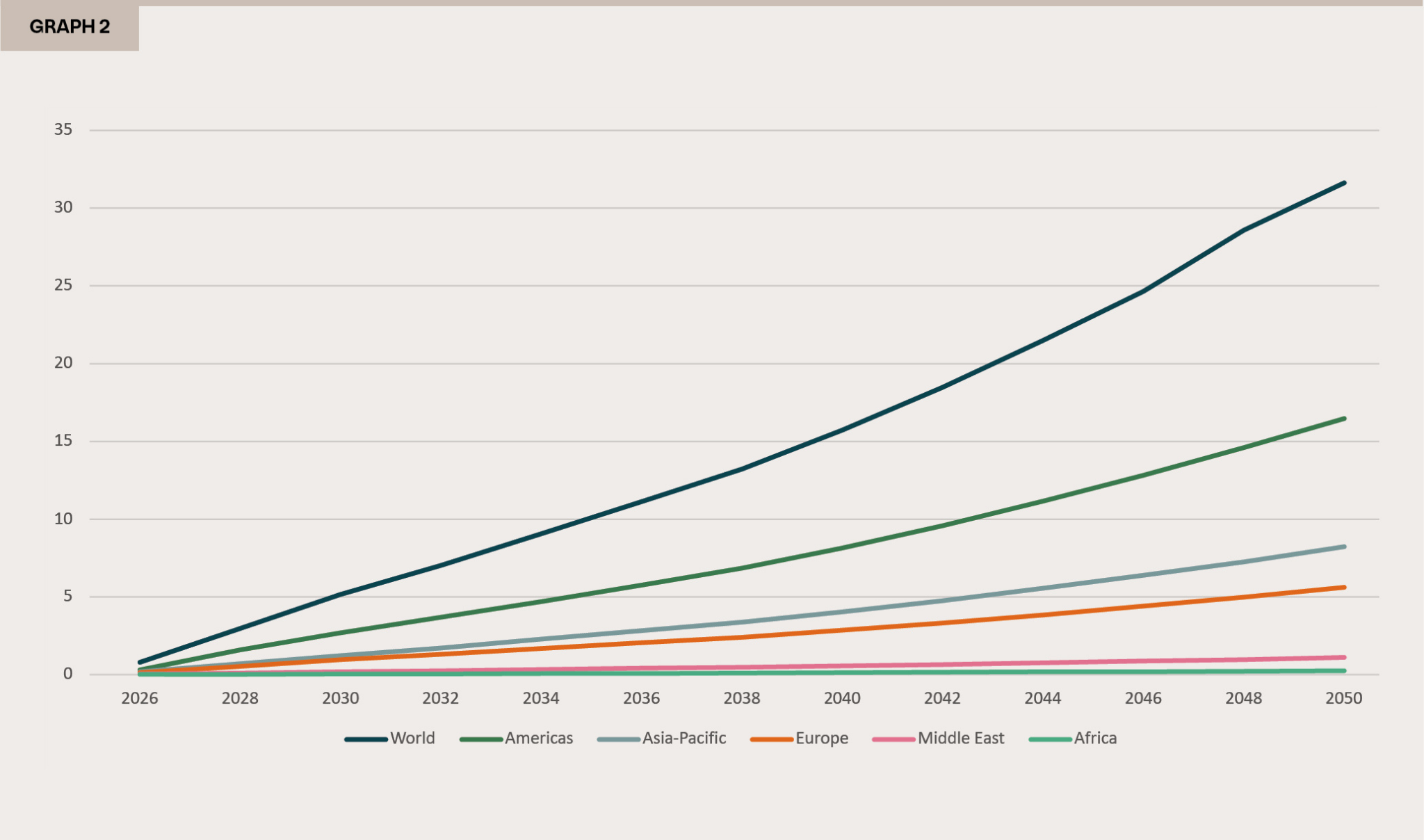
Source: PwC’s Global Data Centre Outlook 2026–50; forecast modelling by Oxford Economics for report’s central scenario
Power availability is emerging as a critical determinant of development feasibility. As AI workloads become increasingly energy-intensive, the ability to secure reliable electricity at competitive prices, together with timely grid connections, is becoming a key differentiator between projects.
The scale of the capacity expansion needed calls for investment in generation, storage and transmission infrastructure. The International Energy Agency’s base case sees data centre electricity use doubling to 945 TWh by 2030. In the US, which is leading the growth of data centres globally, the US Energy Information Administration predicted that the 2026 build-out would need to include a record 86 GW of planned capacity additions, consisting of solar (43.4 GW), wind (11.8 GW), storage (24.3 GW), and natural gas (6.3 GW).6
Graph 3: Data centre electricity consumption in TWh by region, International Energy Agency Base Case, 2020-2030
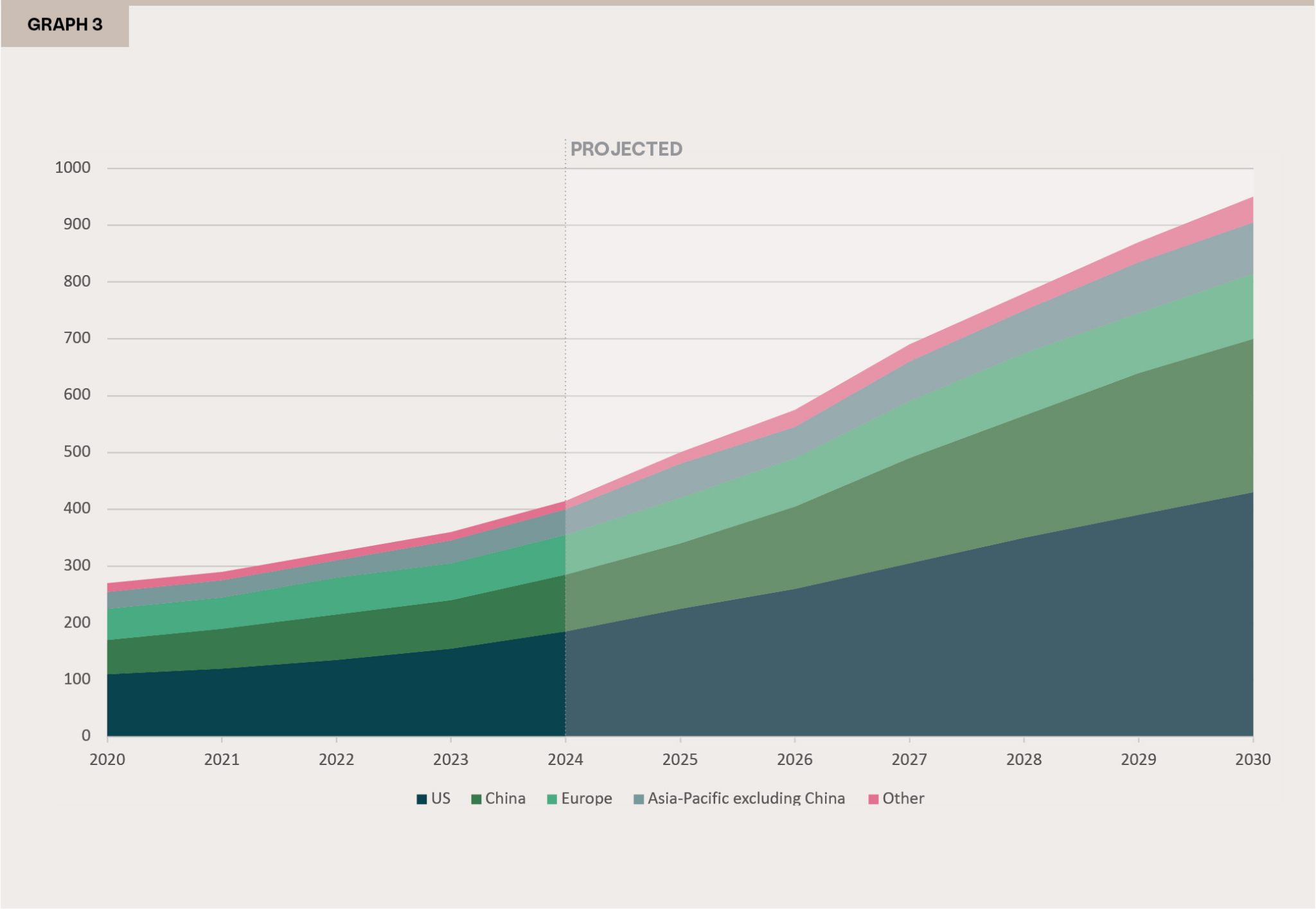
Source: International Energy Agency
Periods of rapid industry expansion inevitably raise questions about the sustainability of growth. The extraordinary pace of AI investment has intensified debate around the commercial returns generated by underlying customers, substantial capital requirements and the potential emergence of an investment bubble.
We believe investors can navigate these risks by focusing on project quality. In data centres, three elements make up the bankability trifecta: a long-term contract with a creditworthy end-customer; a fixed-price and schedule-certain construction plan; and strong access to global capital markets – given the multi-billion-dollar cost of individual projects.
We are mindful of other potential brakes on the AI cycle, including growing social licence challenges associated with power, water and proximity to communities. These pressures are not confined to the US and Europe, with Australia also facing increased scrutiny of where and how facilities are developed. Policy measures supporting additional electricity supply funded by data centre operators may help address power constraints. However, appropriate site selection and community engagement remain critical to earning community acceptance.
The monetisation of AI investments in a rising interest rate environment is also uncertain – although strong earnings in the US technology sector have dampened some concerns.
Looking ahead, sovereign resilience provides an additional structural driver of digital infrastructure demand. Governments are increasingly focused on securing domestic computing capacity, protecting sensitive data and reducing strategic dependencies on foreign infrastructure providers.
While AI will continue to create significant infrastructure investment opportunities, we expect a widening distinction between projects capable of delivering sustainable long-term returns and those reliant on continued exponential growth. Disciplined underwriting, responsible development and active asset management will be critical to capturing this opportunity.
Tracking the fallout from higher prices
Supply-side shocks and geopolitical disruption mean inflation is likely to remain a concern in 2027.
International Monetary Fund (IMF) projections call for modest growth and more frequent inflation shocks. Global growth in 2027 is pegged at around 3.4%, with advanced economies languishing at 1.8%. Global headline inflation is projected to spike before partially retreating toward 4.1% – still well above the pre-pandemic norm that most major central banks are targeting.7
Infrastructure is unusually well positioned within this environment, provided assets carry genuine pricing power.
Regulatory building-block models and contracts with built-in annual price escalation mean core infrastructure is well insulated from inflation exposure and better placed than businesses in more competitive markets to pass costs through.
Higher prices, however, also pose risks for infrastructure. A spike in jet fuel prices, for example, can lead to lower airport landing fees if airlines cut capacity. Similarly, toll roads are exposed to a drop in petrol vehicle usage. These effects are often temporary and depend on each asset’s demand profile and pricing power.
Negative effects are likely to be felt most keenly in developing economies where consumers have less capacity to afford the higher input costs. Food security is also likely to rise up the agenda if farmers are unable to afford or source the diesel, fertiliser and other petroleum-based products needed for crop production.
If sovereign resilience is about protecting existing infrastructure, AI is about building an entirely new category of it. However, the scale of projected investment should not be confused with the certainty of investment returns.
Electrification accelerates as resilience takes priority
We are now seeing evidence that the Middle Eastern conflict’s impact on global energy markets is accelerating a structural shift to electrification. Sales of electric vehicles (EVs) overtook petrol car sales in Australia for the first time in August 2026, with similar trends noted in Europe.8
The energy crisis is also changing the terms of the transition debate. We expect 2027 to bring less emphasis on decarbonisation for its own sake and more on energy security and resilience. Projects that make energy systems more reliable tend to win support across the political spectrum, while those that deliver lower emissions at a higher cost or with lower reliability face a harder pathway.
In Australia, where the strong uptake of rooftop solar means wholesale prices can slip into negative territory, standalone solar is less compelling for institutional investors. Solar power paired with battery storage, however, is a different proposition, as the combination allows power to be dispatched when renewables are not generating.
In Europe, too, the rapid build-out of solar generation in markets such as Spain has hurt pricing and limited appetite for new projects. Energy transition infrastructure remains a focus, but opportunities vary across markets and technologies. We see growth in transmission, onshore wind and battery storage, but less attractive returns in offshore wind, where auction prices do not always reflect the long development timelines and risks involved.
Low-carbon liquid fuels follow the same logic. As drop-in replacements for aviation fuel and diesel, they require no new pipelines or storage, and the UK and EU have led on policy support. For investors, it is no longer enough for energy to be renewable; it must also be resilient.
While inflation and geopolitical uncertainty will remain important considerations in 2027, the outlook for infrastructure is also being reshaped by powerful structural forces. Sovereign resilience, accelerating demand for AI and digital infrastructure, and the convergence of energy security and decarbonisation are creating new opportunities for long-term institutional capital.
As infrastructure adapts to a more fragmented and uncertain world, we believe successful investment will increasingly depend on disciplined asset selection, resilient revenue models and the ability to navigate regulatory, technological and operational complexity. Contracted or regulated cash flows and genuine pricing power can provide protection against inflation and market volatility, while active asset management and operational expertise will be critical to maintaining essential services and protecting long-term value.
[1] Luba Nikulina (2026), Infrastructure: the times they are a-changin’, IFM Investors
[2] McKinsey & Company (2025), The infrastructure moment: Investing in the expanding foundations of modern society, p. 2
[3] UK government (2026), Unlocking private capital to drive UK defence as an engine of growth
[4] Australian government (2026), 2026 National Defence Strategy, p. 86
[5] Bloomberg (2026) estimate captures Alibaba Cloud, Amazon, CoreWeave, Digital Realty, Equinix, GDS Holdings, Google, IREN, Meta, Microsoft, Nebius, NTT Global Data Centres, Oracle and Tencent
[6] US Energy Information Administration (2026), New U.S. electric generating capacity expected to reach a record high in 2026
[7] International Monetary Fund (2026), World Economic Outlook: Resilience Under Strain, Urgent Choices, p. 10
[8] Department of Climate Change, Energy, the Environment and Water (2026), EV sales overtake petrol cars for the first time

Kyle Mangini
Kyle is responsible for implementing IFM’s infrastructure investment strategy and has ultimate investment responsibility for IFM's global infrastructure strategies.

Private Markets Macro Outlook 2027: AI, energy and a less predictable world
Much of what happens in 2027 will come down to two things: how fast AI investment keeps growing, and how often energy supply is disrupted. Neither is easy to forecast, which makes resilience in portfolio construction more important than any single call.