
Building portfolios for multiple futures: A 2027 outlook through the lens of uncertainty

Key takeaways
- Some of the most attractive opportunities in private markets with be the assets sit at key bottlenecks within the system and address the intersection of multiple structural changes.
- Becoming increasingly agnostic to labels and understanding the characteristics of assets, sectors and economies that create positive and negative exposures to structural shifts should lead to more robust portfolios.
- The assets most likely to hold up consistently across plausible futures in 2027 are those that are essential to the economy and society, have explicit inflation linkage/pass-through and are conservatively leveraged.
For most of the three decades before the pandemic, portfolio construction often rested on three assumptions. The equity risk premium was a reliable engine of long-term returns. Diversifying across asset classes made portfolios more robust. And bond and equity returns were uncorrelated or negatively correlated.
Those assumptions held in a relatively benign environment of low, stable inflation. But in the background, four structural shifts were building: deglobalisation, digitisation, decarbonisation and demographics. Their economic and market impacts are becoming more evident.
Recent events show how quickly these shifts can become real-world constraints. The war in the Middle East that began in February 2026 was followed by what the International Energy Agency calls the largest supply disruption in the history of the oil market. That has raised the importance of energy security, and with it the role of the energy grid. The grid now sits at the centre of three shifts at once: decarbonisation needs it to connect new, clean power sources; digitisation to power data centres, and deglobalisation to replace imported fuels with local alternatives. The pressure is already showing. More than 2,500 GW of renewable, storage and large-load projects are waiting in grid connection queues worldwide1 while data centre electricity demand rose 17% in 2025 – a taste of the doubling of demand expected by 2030.2
Each of the four shifts needs physical assets to be built, and they increasingly compete for the same equipment, grid capacity, skilled labour and public balance sheets. Private capital can scale quickly. Equipment, grid capacity and skilled labour cannot. That competition risks making supply shocks more frequent, which pushes inflation higher and makes it more volatile. In those conditions, equities may struggle at the same time that bonds fall. This undermines the assumptions many portfolios were built on.
How these shifts play out will shape the economy for years to come. With public balance sheets stretched, more of the investment they require will need to come from private capital. For private market investors, who commit capital for many years at a time, that makes the shifts central to investment decisions. The aim is to build portfolios that can hold up across several possible futures.
Digitisation, deglobalisation and national resilience, and decarbonisation cannot proceed without essential supporting network, storage or power supply assets.
A framework for thinking about structural shifts
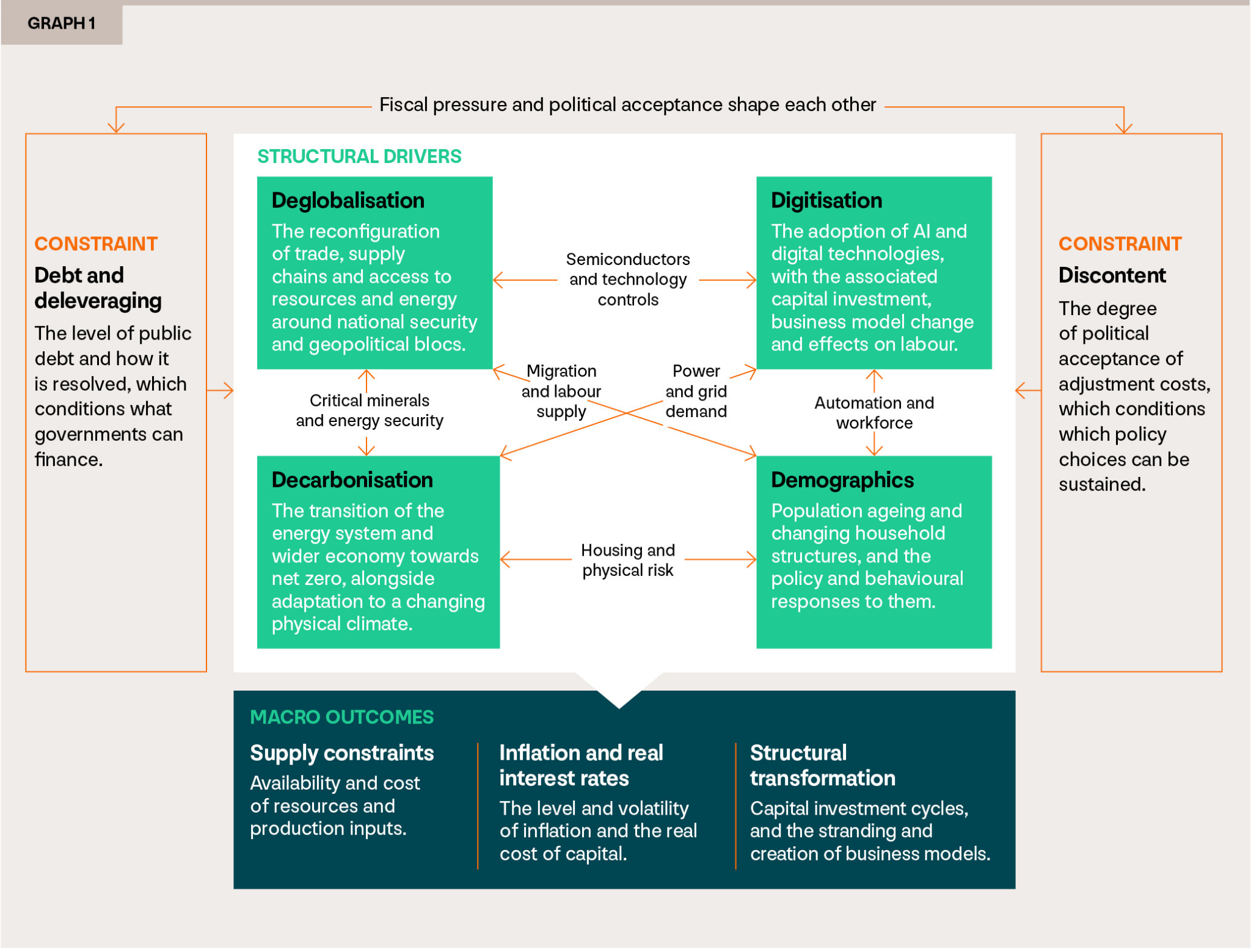
The key structural shifts that will drive long-term outcomes and some of the important interconnections between them are set out in Graph 1.
Graph 1: The key structural shifts shaping long-term outcomes
Source: IFM Investors. Structural framework, not a forecast.
The investment implications of the four main structural drivers – deglobalisation, digitisation, decarbonisation and demographics – reach portfolios in one of two ways. Bottom up, they will reshape demand, create new essential assets and/or business models, strand others and widen dispersion within asset classes. Top down, they can change the regime itself, for example which constraints bind and how often – as well as how inflation and real rates behave.
Bottlenecks and intersections present bottom-up opportunities in 2027
When thinking about bottom-up investment opportunities, it is important to consider the various constraints that determine what combinations of the structural shifts are feasible.
Supply constraints
Fiscal capacity
Social cohesion
Combining these with the interconnected nature of these structural shifts suggests that some of the most attractive opportunities in private markets in 2027 will be the scarce and/or essential assets that sit at the key bottlenecks within the system. In particular, these opportunities will address the intersection of multiple structural changes.
Another important implication of this is that attractive opportunities often sit next to a structural shift rather than being highly dependent on picking winners. Digitisation, deglobalisation and national resilience, and decarbonisation cannot proceed without essential supporting network, storage or power supply assets. This, however, needs to be overlaid with an awareness of the extent to which regulated/allowed returns may be constrained by the level of adjustment costs that are socially acceptable.
Top-down exposures can complement traditional asset class labels
From a top-down perspective, structural shifts challenge traditional asset allocation and institutional portfolio construction processes for two reasons, suggesting instead that investors should adopt a more holistic view.
First, the four structural shifts set out previously can be mapped on to the various sectors of the economic system. Demographics will drive consumer sectors and social/health services. Digitisation will spur investment in technology and communications, and decarbonisation in energy and utilities. And deglobalisation will fuel growth in trade and materials. Investors should not assume that the differential returns driven by structural shifts will continue to flow to conventional asset classes and the labels that underpin strategic asset allocation approaches to investing. Instead, becoming increasingly agnostic to labels and understanding the characteristics of assets, sectors and economies that will create positive and negative exposures to structural shifts should lead to more robust portfolios.
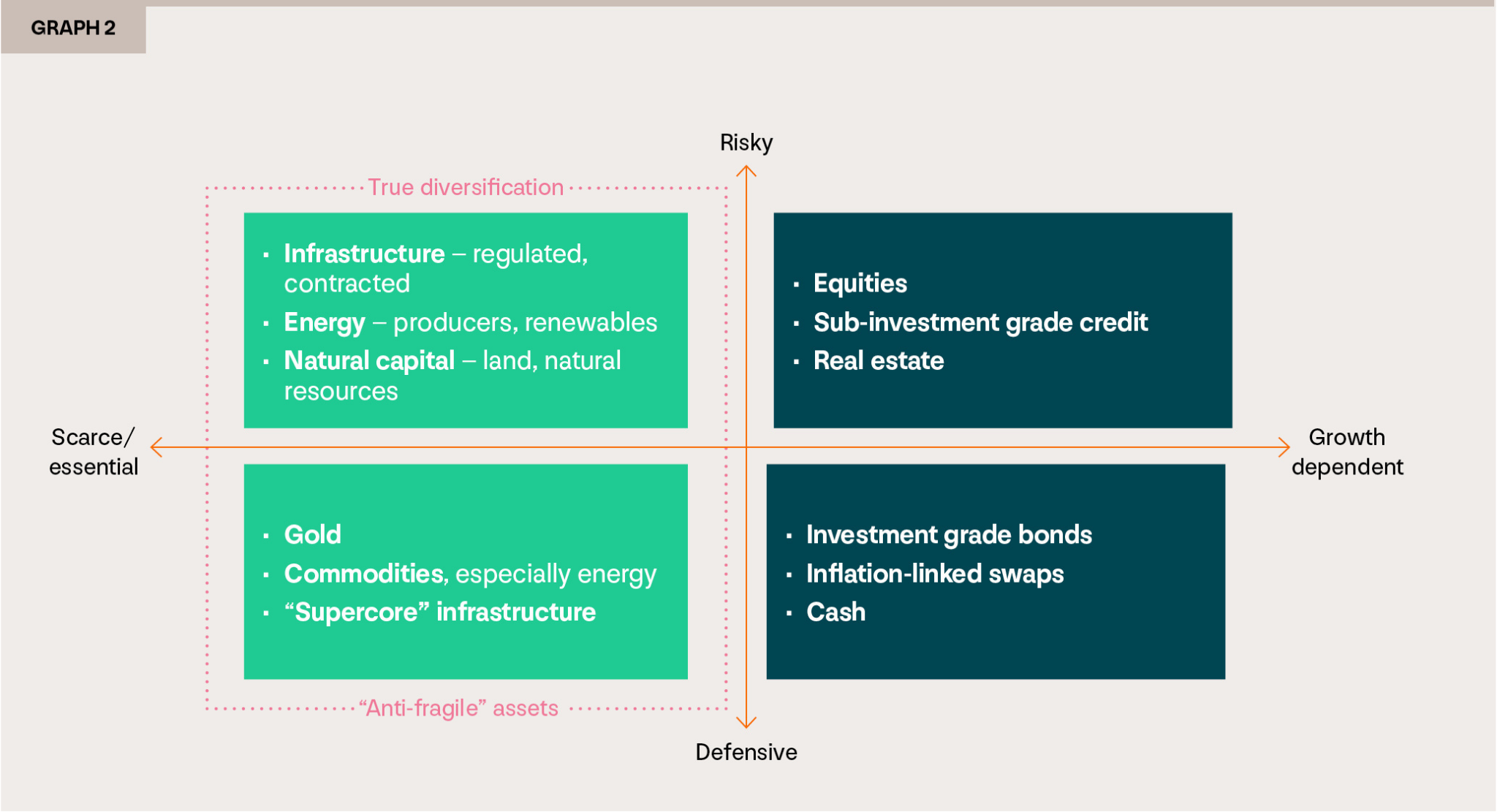
Second, as noted earlier, deglobalisation, digitisation, decarbonisation and demographics all need physical investment, and all compete for the same limited investment, equipment and labour. Competition for scarce inputs increases the frequency of supply shocks and therefore inflation volatility and structural inflation levels. These in turn create the exact conditions that undermine and even break traditional portfolio construction. In such scenarios, investors could see equities deliver poor returns at the same time that bond and equity returns are positively correlated. This suggests that scarce and essential assets, for example regulated and contracted infrastructure, energy, land and natural resources, should be emphasised in terms of their diversifying and defensive characteristics. An alternative way of classifying asset classes through this lens is illustrated in Graph 2.
Graph 2: Alternative classification of asset classes
Source: IFM Investors
Monitoring change to understand plausible futures
Future pathways for the deglobalisation, decarbonisation and digitisation themes have evolved significantly in recent years. The evolution points to the challenge in predicting the global economy’s end-state in 10, 20 and 30 years. Outcomes depend on how each of the factors interacts with economic performance and the demands these changes place on society. Investors will need to continuously monitor developments to understand which plausible futures are becoming more or less likely to occur, how the changes impact the scenarios they are monitoring and how shifts change which assets and portfolios are likely to be more robust going forward.
Reflecting the challenges associated with scarcity, grid investment, expected to approach US$550 billion in 20263, must contend with labour and equipment shortages, and construction delays caused by overwhelmed permitting systems. Similarly, governments and local communities remain at odds in many countries over how enthusiastically and tightly to embrace proposed data centres, casting doubt over AI growth ambitions without the desired capacity.
The need to monitor developments continuously should not be confused with the need to adjust portfolios frequently. From a private markets perspective, the key is to use insights on the likely future state of the world to inform commitment pacing, support underwriting activities and identify assets and strategies that are likely to be robust to a range of different futures. The divergent and rapidly changing nature of long-term outcomes also suggests that flexibility and structural liquidity are likely to be increasingly attractive features of private market solutions now and in the future.
Table 1 sets out four plausible futures/regimes, the likely macro outcomes under these, and a set of signposts that could be used for real-time monitoring. These are neither forecasts nor exhaustive and no probabilities are attached.
Table 1: Four illustrative plausible futures (not forecasts)4
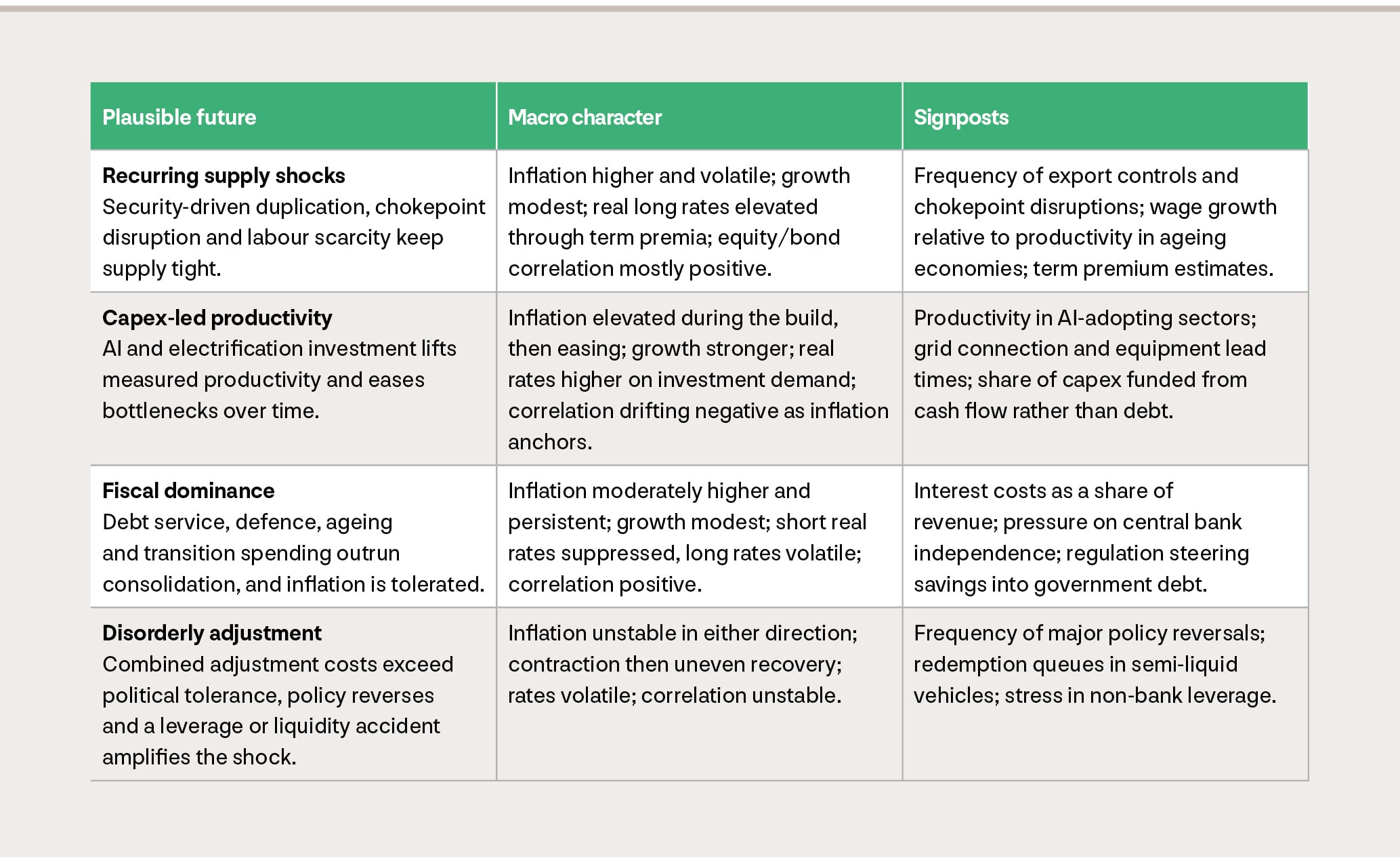
Looking across the four plausible futures set out in Table 1, the assets most likely to hold up consistently share the same traits: assets that are essential to the economy and society, possess an explicit inflation linkage/pass-through and are conservatively leveraged. The equity/bond correlation turns negative in only one plausible future, and only there does inflation eventually anchor. Although in that environment conventional equity-heavy portfolios will likely outperform portfolios designed with robustness in mind, the case for robustness does not require high inflation to be the most likely outcome, only that the range of outcomes is wider and lumpier than conventional portfolios were built for.
Implications for private markets
In 2027, we believe investors should consider how to change both their mindset and practices when identifying opportunities and risks in private markets in light of major structural shifts.
Bottom-up considerations suggest that some of the most attractive opportunities sit at bottlenecks in the economic and social systems where supply constraints bite and/or where multiple structural shifts intersect. Top-down considerations imply that structural shifts are likely to create conditions that make traditional asset class labels less useful for understanding how structural shifts will impact portfolio returns. The same situation will also fundamentally change which assets are likely to be most useful for improving portfolio robustness.
The plausible futures arising from the major structural shifts imply highly differentiated economic outcomes. These perspectives can be supported by developing a set of scenarios or plausible futures that capture the combined impact of different evolutions of the key structural shifts and a set of signposts for these that can be monitored in real time.
The assets most likely to hold up consistently across these plausible futures are those that are essential to the economy and society, have explicit inflation linkage/pass-through and are conservatively leveraged. From a product structuring perspective, elevated uncertainty over long-term outcomes increases the value of portfolio flexibility and therefore structural liquidity.
Explore Private Markets Macro Outlook 2027

Private Markets Macro Outlook 2027: AI, energy and a less predictable world

2027 global economic outlook: Economic resilience amid structural change


Infrastructure equity outlook 2027: Asset class to national priority


Infrastructure debt outlook 2027: AI hyperscalers set to extend debt market dominance


Diversified credit outlook 2027: Patience pays in a higher-rate world



Australian real estate outlook 2027: Near-term caution, long-term opportunity

[1] International Energy Agency (2026), Electricity 2026: Analysis and forecast to 2030
[2] International Energy Agency (2026), Key Questions on Energy and AI
[3] International Energy Agency (2026), World Energy Investment 2026
[4] Plausible future scenarios presented are for illustrative purposes only. Plausible futures are based on certain assumptions that may not materialise and other information that may prove inaccurate. These assumptions generally involve considering macroeconomic characteristics, long-run economic conditions, among other criteria. There is no guarantee that the scenarios presented will materialise.

Jeff Chee
Jeff is responsible for establishing and leading IFM’s global investment research capability, ensuring research remains central to the organisation’s long-term, client-aligned investment approach.