Key takeaways
-
Mid-market infrastructure can offer attractive and growing opportunities for global investors seeking diversification and higher returns, while retaining the defensive characteristics of infrastructure.
-
Mid-market infrastructure investments exhibit greater operational complexity or are in earlier stages of lifecycle. These dynamics present more opportunities for near term value creation through active asset management.
-
They could also provide better downside protection and enhanced diversification for institutional investors seeking higher returns without losing the defensive characteristics of core infrastructure.
Private infrastructure fundraising surpassed the high watermark years of 2021-22 and reached nearly US$300 billion in 20251 – a record milestone reflecting robust institutional investor confidence and increasing allocations to infrastructure as an asset class. We believe that private infrastructure has become an integral part of institutional investors’ portfolios, offering steady demand profile, inflation hedge, sustainable growth, and low correlation to traditional asset classes.
Large-cap infrastructure has attracted increased institutional capital, however mid-market infrastructure can also offer attractive and growing opportunities for global investors seeking diversification and higher returns, while retaining the defensive characteristics of infrastructure investments. Preqin’s fund search data indicates that investor intentions are shifting further toward smaller commitments,2 highlighting increased interest in mid-market strategies.
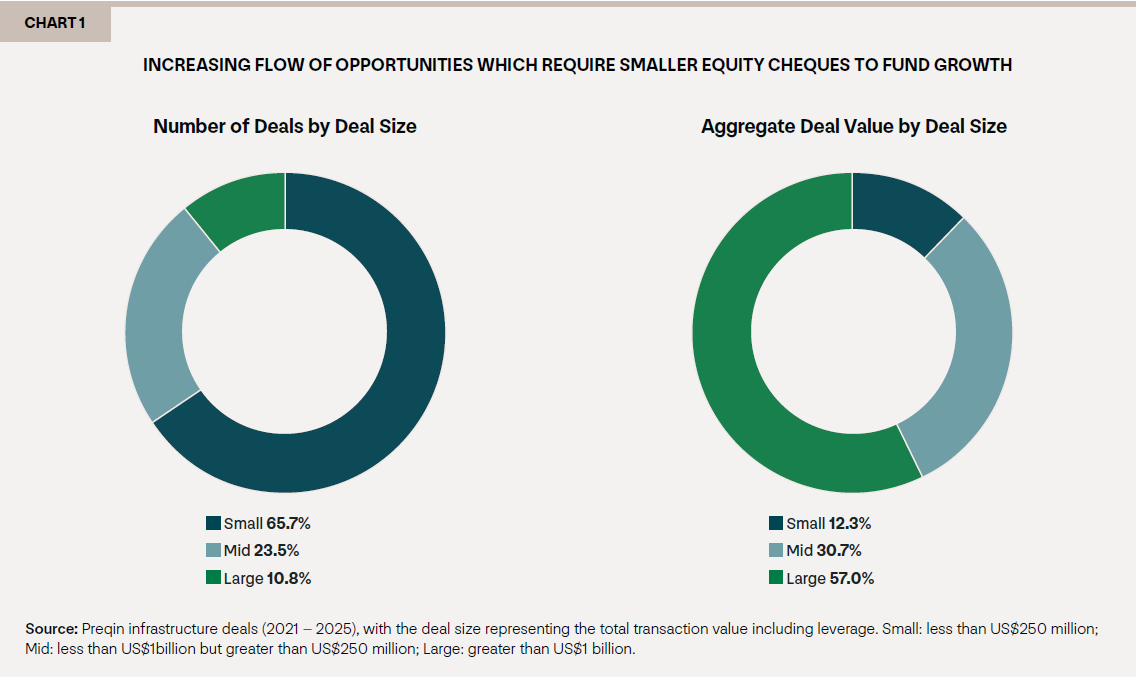
Well-aligned opportunity set
Greater near term value creation levers
In comparison with large-cap, many mid-market infrastructure investments exhibit greater operational complexity or are in earlier stages of lifecycle. These dynamics present more opportunities for near term value creation through active asset management. We believe mid-market companies also typically have more potential to grow and optimise operations, with the prospect for multiple expansion at exit upon achieving scale (see Chart 2).
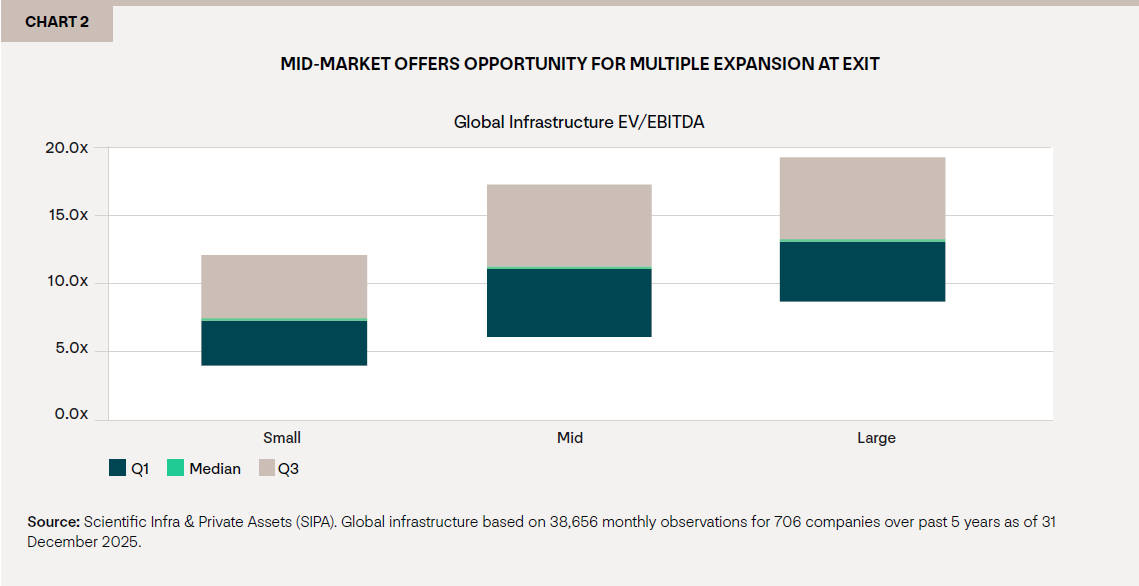
Value creation in infrastructure can be achieved through multiple pathways, often accompanied by risk. Even though the mid-market is generally perceived as a higher risk segment, we have been able to access it with a better risk/return balance given the IFM footprint, ecosystem, and existing know how.
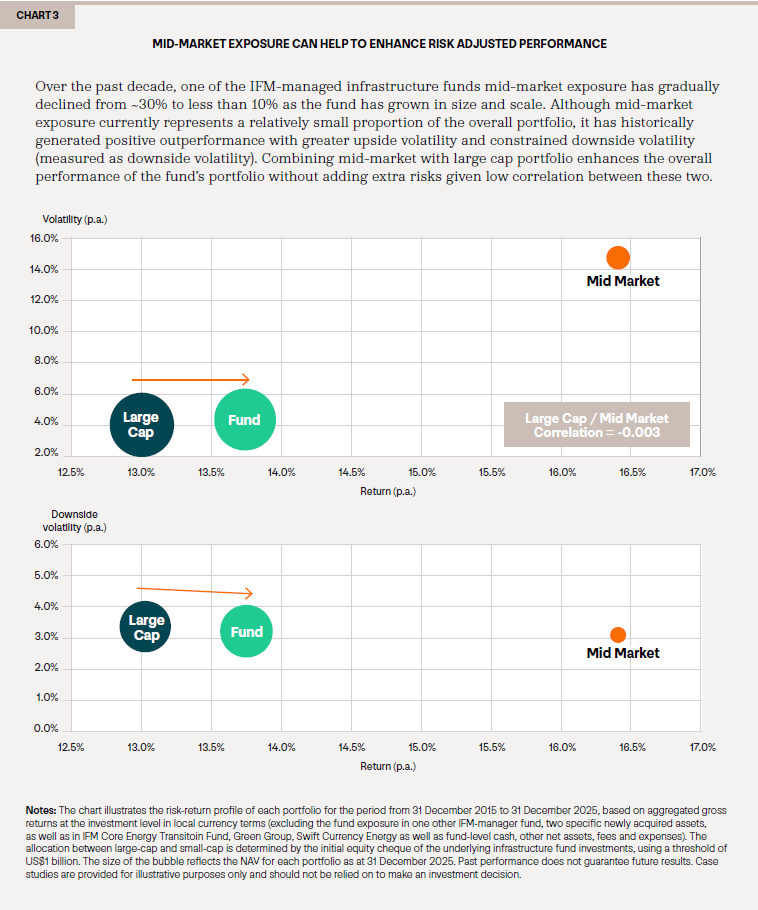
Enhanced exit optionality
Exit optionality is broader for mid-market infrastructure relative to large cap, due to a wider range of potential buyers and strategic pathways such as infrastructure funds, institutional infrastructure investors, strategic industry players and public equity markets. We believe IFM is well placed to leverage its global network of investment partners, strategic partners, senior advisors and portfolio company connections to identify suitable buyers to help drive potential upside on exit. Further, as one of the largest investors in super core, core and core-plus infrastructure, IFM understands the characteristics that potential buyers will be looking for and how to position these businesses for exit.
Strategic implications for investors - role in portfolio diversification
We believe there is a growing investor appetite for infrastructure strategies that offer higher return potential while maintaining the critical characteristics of the asset class. IFM’s Private Markets 700 research3 found that investors are increasingly moving up the risk curve, with 64% of respondents targeting high yielding sub strategies such as value add and opportunistic infrastructure. Chart 4 illustrates that generally mid-market infrastructure has consistently demonstrated higher risk-adjusted-performance and better downside hedge relative to the broader infrastructure market across multiple time horizons. These findings indicate that mid-market infrastructure can offer a more attractive risk-return profile with stronger capital preservation, which we believe makes it a compelling option for long-term infrastructure investment portfolios.
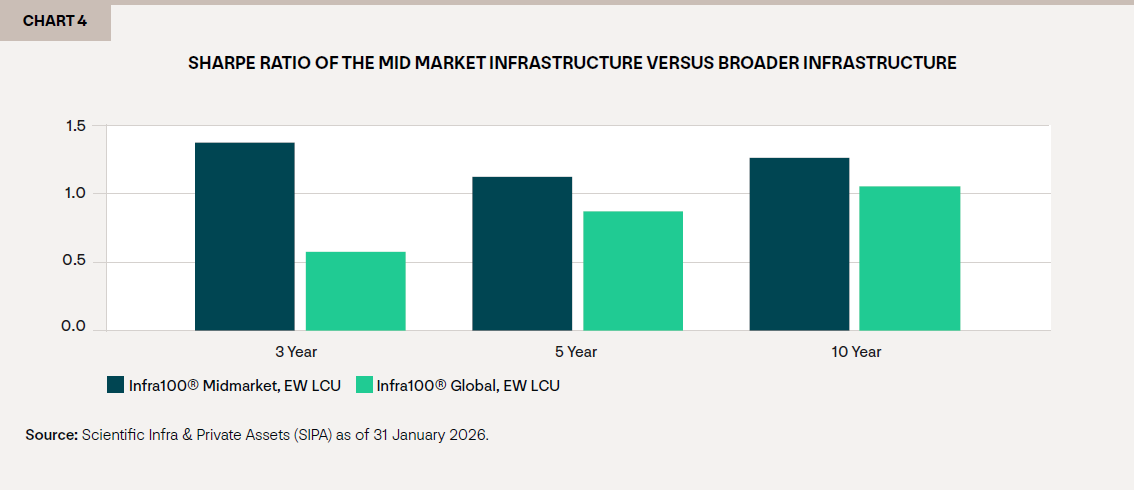
We believe there is a growing investor appetite for infrastructure strategies that offer higher return potential while maintaining the critical characteristics of the asset class.
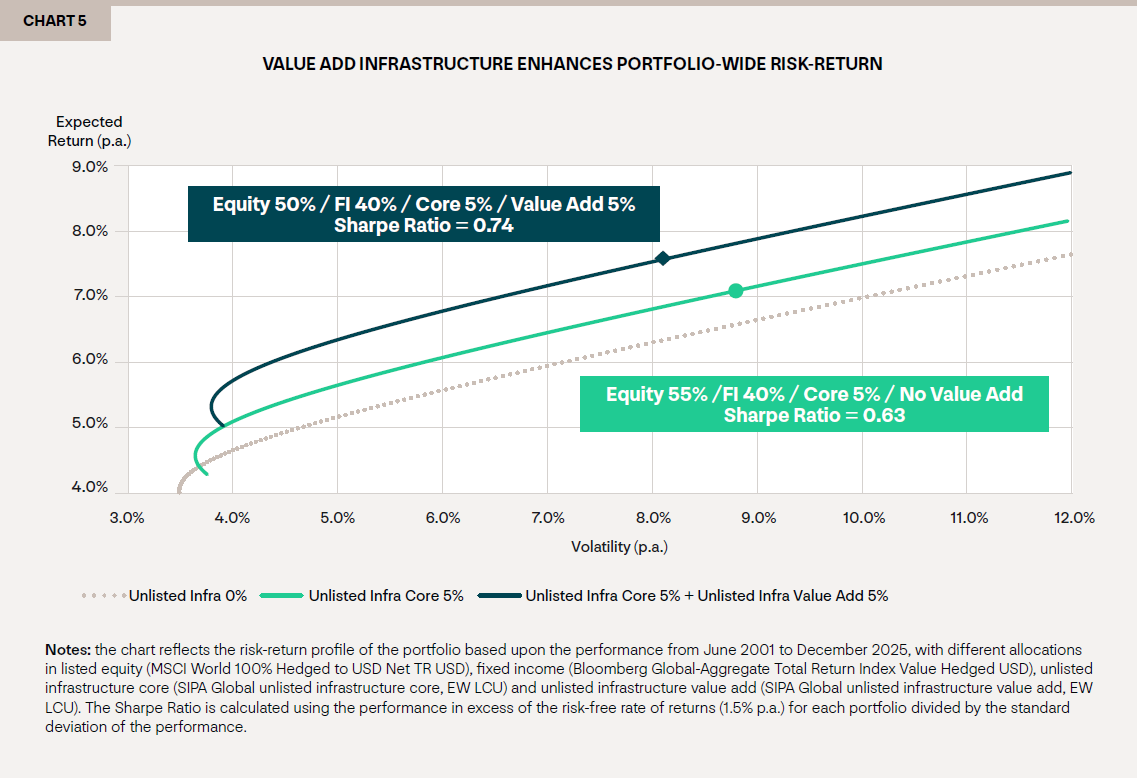
Mid-market also provides access to a broader set of infrastructure strategies, extending beyond core into other infrastructure sub strategies and adjacencies. We believe these strategies complement traditional core infrastructure, enabling investors to construct portfolios that aim to balance defensive characteristics with growth potential. The analysis shown in Chart 5 indicates that incorporating unlisted core infrastructure into a traditional equity/fixed income portfolio can shift the efficient frontier upward and to the left, enhancing returns while reducing overall risk. Furthermore, adding an additional allocation to unlisted value add infrastructure can further enhance the portfolio’s risk adjusted returns, reinforcing the benefits of diversification within the infrastructure asset class.
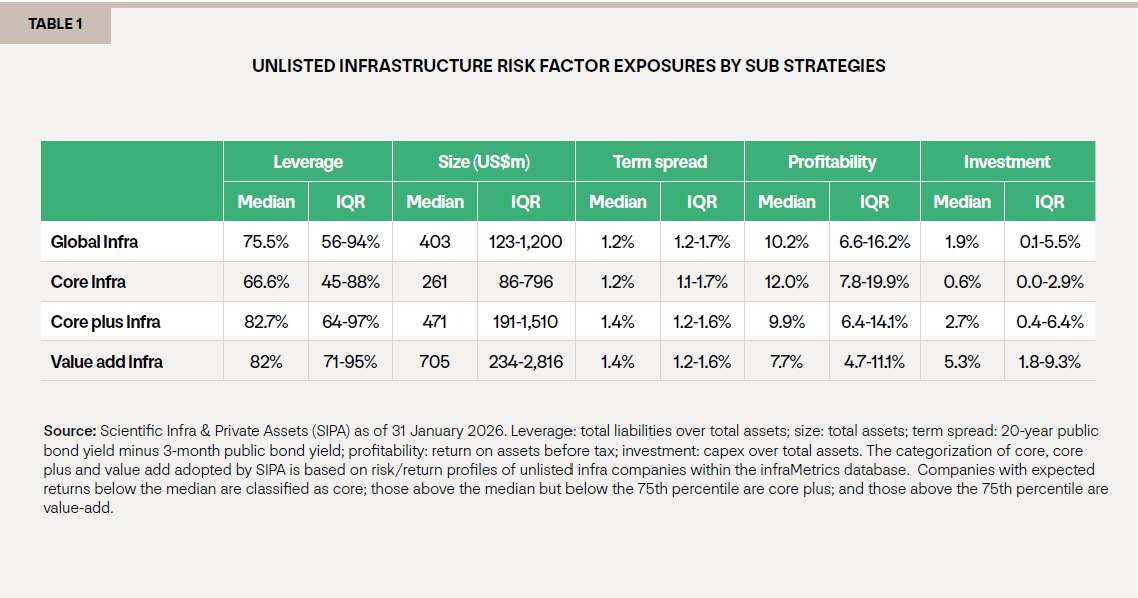
While infrastructure sub strategies - such as core, core plus, and value add - share certain common characteristics, their distinct value drivers offer complementary exposures that can potentially enhance portfolio diversification. For example, core infrastructure tends to have lower leverage but also lower investment factor, measured as capex over total assets. Core plus and value add infrastructure generally shows lower immediate profitability, but increased ability to generate higher returns through value creation initiatives.
Mid-market strategies also enable access to emerging infrastructure sub-sectors that typically begin at a relatively smaller scale but rely heavily on active near-term value creation levers, including technological upgrades, operational optimisation, and strategic repositioning. These opportunities may be attractive for investors seeking differentiated sources of alpha within their infrastructure allocations. By targeting these niche segments, mid-market strategies enable investors to complement traditional core infrastructure holdings with assets that combine defensive characteristics and higher return potential.
From our observations, heightened uncertainty amid elevated geopolitical risks and widening divergence in the growth outlook across major economies currently characterise the global economic landscape. In this context, our mid-market infrastructure strategy, focused on asset centricity with positive infrastructure adjacency and supported by a clear path to implement value creation initiatives, naturally lends itself to potentially resilient performance through cycles. The projected acceleration of infrastructure investments, with global assets under management expected to approach US$3 trillion by 2030,4 further underscores the relevance of this resilience. Collectively, we believe these dynamics position mid-market infrastructure as a strategically attractive component of institutional portfolios, balancing defensive characteristics with growth potential in an era of heightened macroeconomic volatility. More importantly, we apply an established infrastructure mindset to our investments, which is critical given the distinct operational and regulatory complexities of infrastructure assets that require a fundamentally different model from conventional private equity.5
For full details, including all disclaimers applicable to the data contained herein, please refer to the complete article.
[1] Source: Infrastructure Investor Fundraising Report Full Year 2025
[2] Source: Preqin Global Report Infrastructure in 2026
[3] Source: IFM Investors Private Markets 700 Report
[4] Source: Preqin Private Markets in 2030
[5] Investments in infrastructure are subject to various risks including regulatory risk and market risk, which are outlined in further detail on the “Important Disclosures” page. Prior to making an investment in any infrastructure strategy, investors should refer to the offering documents for a complete discussion of risks.
Meet the authors

Abbie Sui
Abbie is a senior member of the Infrastructure Portfolio Management Team, responsible for a broad set of portfolio construction, risk management and fund analysis outcomes across all of IFM Investors’ infrastructure products as well as asset management of Adelaide Airport.

Aaron McGovern
Aaron is responsible for the origination of infrastructure investments and ongoing management of assets. Aaron has worked on transactions in the Americas, Europe and Australia in the transport, energy and utilities sectors. Aaron is currently a board member of Aleatica and Impala Terminals.
Related articles

Envisaging and enabling cities of the future



Private credit under pressure, but opportunities still exist





Where investment decisions can fall short – and why