Key takeaways
While closed-ended vehicles may be appropriate for value-add strategies, we believe energy transition opportunities within core infrastructure are best suited to open-ended funds as they allow:
- Value creation opportunities to be captured across the full energy transition asset lifecycle
- Investing with less technology and execution risk
- Better long-term outcomes from harnessing the power of compounding
- Greater visibility into underlying assets and reduced blind pool risk
- More investor control over liquidity
The global energy transition represents a significant investment opportunity, requiring substantial, long-term capital to support a lower-carbon, increasingly electrified economy.
The global energy transition represents a significant investment opportunity, requiring substantial, long-term capital to support a lower-carbon, increasingly electrified economy. Capturing an opportunity of this scale requires an investment approach aligned with the long-term, evolving nature of infrastructure and the structural forces driving it, from digitalisation and energy security to the electrification of transport and industry. In our view, these characteristics are well-suited to an open-ended core infrastructure investment strategy.
Capturing value across the full asset lifecycle
Fully capturing the value of the energy transition will require patient capital as markets, industries and societies transition at their own pace and according to their specific needs and objectives. This means that energy infrastructure assets can evolve, expand and modernise over decades, making open-ended core infrastructure a potential fit for long-term investors.
Unlike closed-ended structures, where time is a constraint that can limit an investor’s strategic options, open-ended funds can benefit from value creation beyond the initial build-out phase. This includes repowering, where upgrading existing assets can increase capacity and extend asset life with comparatively lower execution risk (read more here). This approach changes infrastructure from a static asset class into one where value may be increasingly created through ongoing optimisation, expansion and reinvestment over time.
From our point of view, this long-term perspective is becoming even more important as power demand accelerates, driven by the electrification of the economy and the rapid growth of AI and digital infrastructure. With data center electricity consumption projected to more than double by 20301 the need for reliable and scalable energy infrastructure is expected to continue growing.
In this environment, attractive value creation opportunities can potentially emerge years after an asset is first developed through expansion, repowering and operational improvements. Although closed-ended funds may participate in these opportunities, finite fund lives may require assets to be sold before their full potential is realised. An open-ended core strategy allows investors to stay invested where the long-term investment case remains relevant. This can help enable participation in asset evolution over time and allow capital allocation decisions to be driven by investment merit rather than fund maturity constraints.
Continuous advances in renewable generation, battery storage, grid infrastructure and digital technologies are reshaping the energy transition. Investors must consider not only how assets perform today, but how they may need to evolve to remain competitive over the decades ahead.
Many of the risks and opportunities associated with technological change emerge well beyond a typical fund exit horizon. As a result, these considerations may not be as fulsomely considered as they should be by investment strategies focused on realising value in the near term. This can leave investors with suboptimal outcomes if the risks eventuate while not being appropriately priced into investment cases.
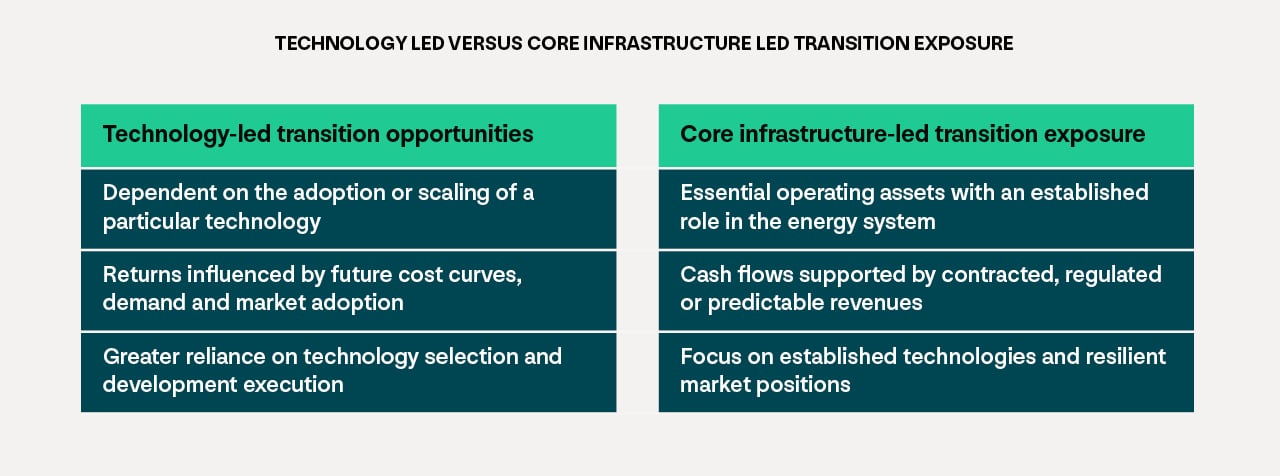
Open-ended funds need to price in technology risks because taking a long-term view requires assessing how assets will perform in a range of different scenarios including how technology changes. Accordingly, core strategies are more likely to focus on essential operating assets with established technologies, resilient market positions and contracted, regulated or otherwise predictable cash flows.
Driving outcomes through continuous investment and reinvestment
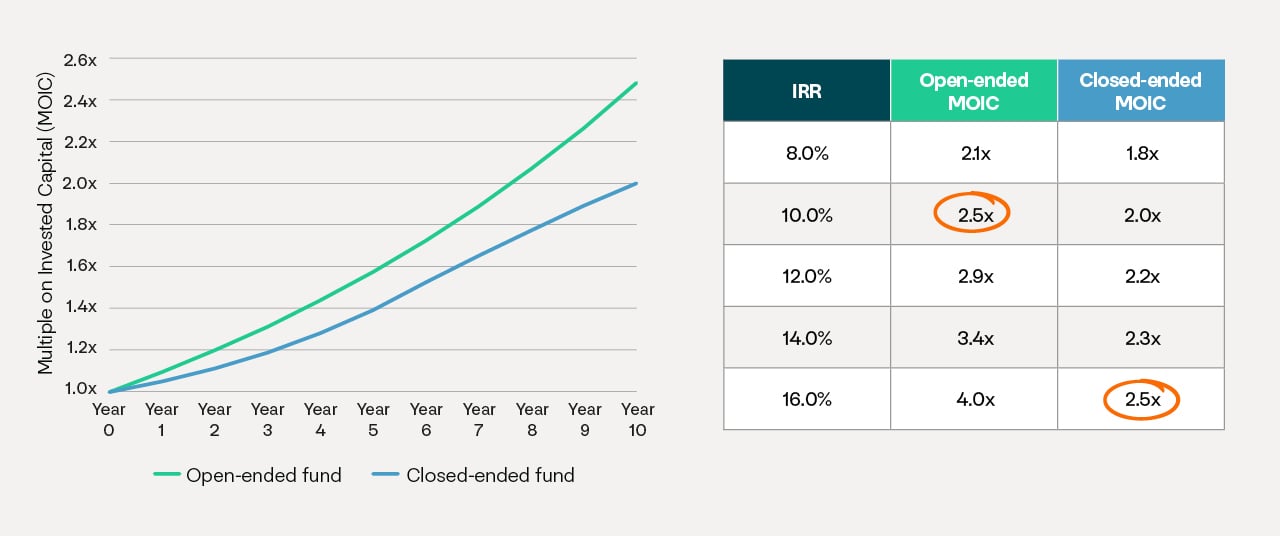
For long-duration assets such as energy infrastructure, investor outcomes are driven more by staying invested rather than focusing on short-term returns. Open-ended core strategies typically reflect this long-term orientation, enabling capital to remain continuously invested. This allows investors to potentially benefit from the power of compounding and avoid cash drag and reinvestment gaps that can occur when capital is returned early.
Over the long-term, an open-ended core strategy is expected to achieve a comparable money multiple while remaining focused on lower-risk infrastructure assets. A closed-ended strategy, however, may need to generate higher asset-level returns through investments further up the risk curve to deliver the same outcome. For this reason, money multiple can provide greater context for long-term investment success compared to focusing purely on IRR. The figure below shows that this is because it can capture the full benefit of sustained ownership, reinvestment and compounding over the life of the investment.
MOIC over time: Comparing outcomes across fund structures
Providing greater visibility at entry while reducing blind pool risk
Open-ended core infrastructure funds generally provide investors with greater visibility into the assets they are investing in, reducing the uncertainty associated with blind pool investing. The result is a clearer understanding of the underlying drivers of risk and return, which can be particularly valuable in a sector undergoing significant change.
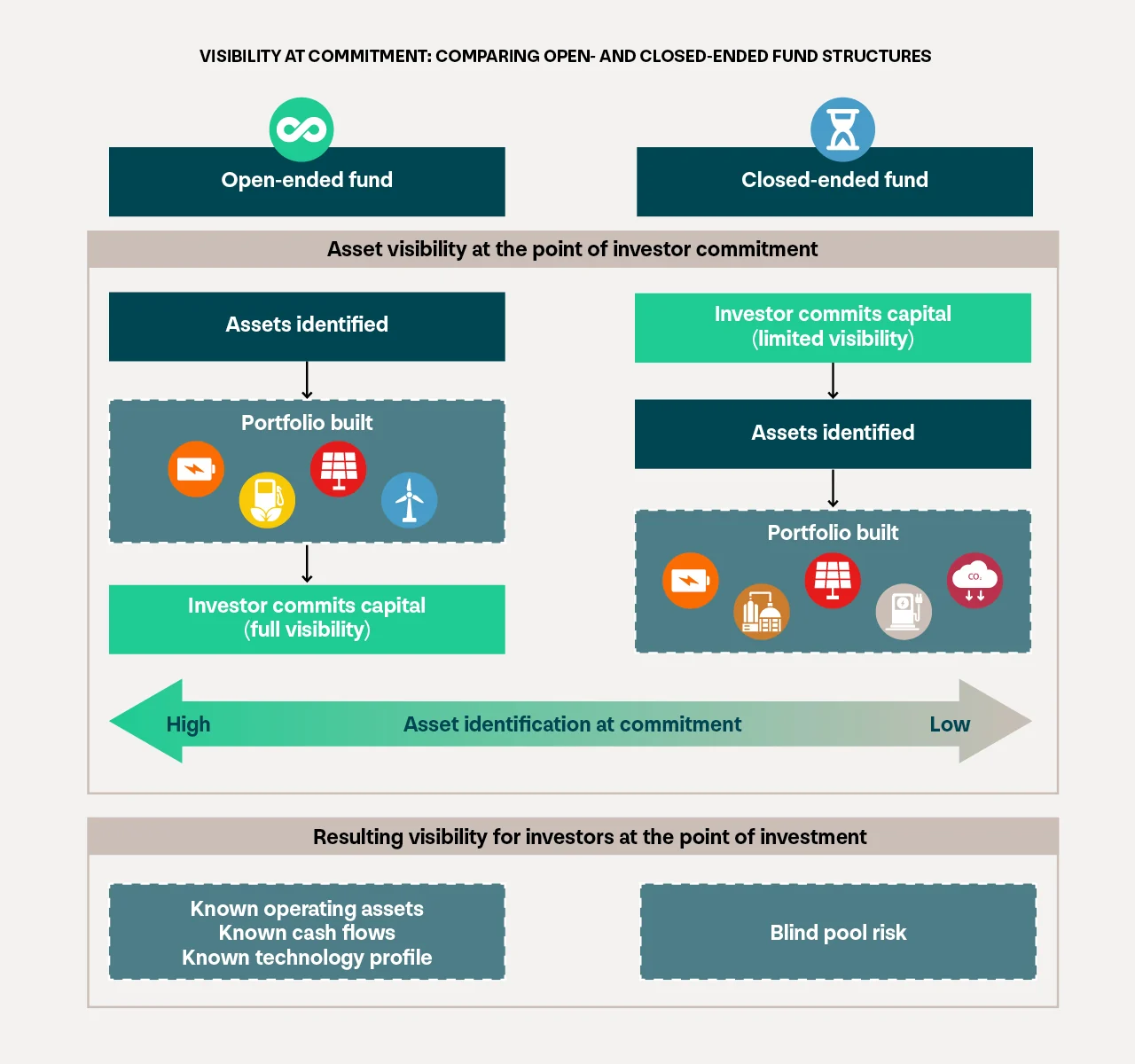
Source: IFM analysis
Liquidity has become an increasingly important consideration in private markets, with constrained exit activity and extended holding periods limiting investor flexibility in recent years. Open-ended core infrastructure funds address this challenge through structured redemption mechanisms that provide periodic liquidity, reducing the need to rely on asset sales or secondary market transactions to access capital.
As a result, investors can maintain exposure to core infrastructure assets as long as the investment case remains relevant, while retaining the flexibility to access liquidity when needed. Rather than selling assets to meet fund timelines, investment decisions can be driven by long-term value creation and market conditions. We believe this structure is better suited for the energy transition, where core mature operating assets and recurring cash flows can help support periodic investor liquidity within a broader liquidity framework.
Open-ended structures can also provide a regular cash yield from mature operating assets. This enables investors to choose between receiving distributions as income or reinvesting them to compound returns, depending on their portfolio objectives and liquidity needs. This flexibility allows investors to tailor their exposure to infrastructure around their own cash flow requirements.
From our perspective, diversified portfolios and a broad, stable investor base support robust liquidity frameworks. For investors seeking exposure to the energy transition, this approach can help provide access to critical infrastructure assets while retaining greater flexibility over how and when capital is deployed, reinvested or returned.

Neil Doherty
Neil joined IFM in 2008 and is on the Executive Team for our low carbon infrastructure assets. Neil is on the Board of Directors of Nala Renewables and Swift Current Energy driving key energy transition initiatives, whilst continuing to be responsible for the origination and execution of new transactions.

Marigold Look
Marigold is responsible for managing IFM Investors’ low carbon infrastructure assets. At IFM, Marigold has been involved with various investments across our global infrastructure portfolios, including Colonial Pipeline (US), Pacific Hydro, Port of Brisbane, NSW Ports, NT Airports, Brisbane Airport and Adelaide Airport.

Richard Li
Richard Li is a Senior Associate in Infrastructure at IFM Investors, involved in infrastructure origination, transactions, and asset management, with a primary focus on Energy Transition.

James Moriarty
James Moriarty is a Product Specialist in the Global Client Solutions Team at IFM Investors, focused on infrastructure equity and institutional client solutions.
Related articles

Higher leverage, lower presales: The changing risk in development finance



Manchesterism in action: the rise and rise of Manchester Airports Group



Three reasons infrastructure debt complements corporate direct lending