Beyond the runway: How airports manage through rising jet fuel prices

Key takeaways
- Fuel volatility shaping airline economics. Energy markets have reacted to the Iran conflict, with jet fuel prices volatile and expected to remain elevated in the near-term, shaping airline economics more than supply constraints.
- System stability amid pricing pressures. Airports are experiencing some impact, such as lower load factors on certain routes, but overall performance remains stable, with these effects typically temporary.
- Airports offer uncorrelated portfolio exposure. Airports remain a differentiated component of infrastructure portfolios, particularly where larger, more diversified assets are supported by strong fundamental value drivers.
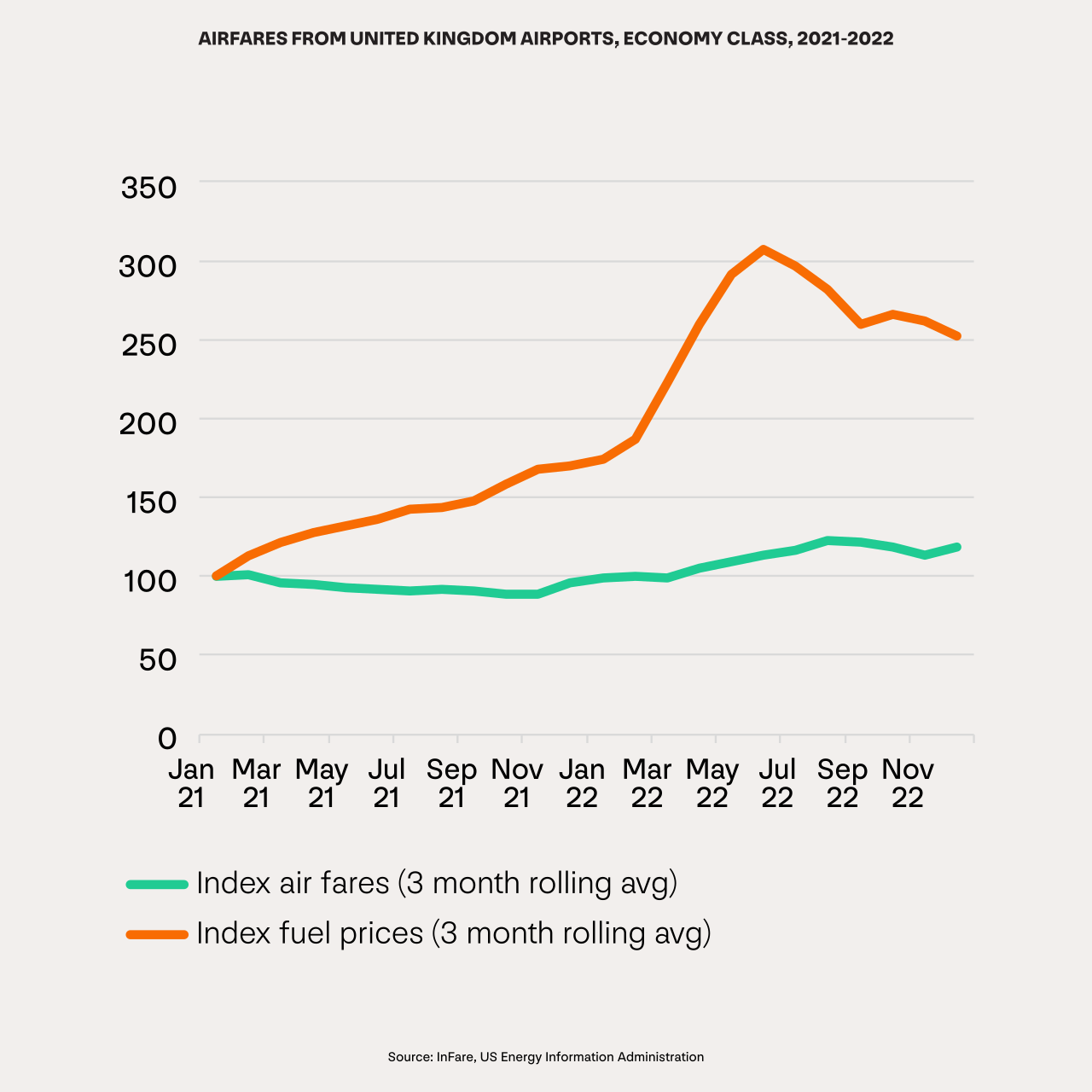
While fuel prices can move sharply, fare increases tend to be more measured, with airlines balancing cost recovery against demand sensitivity.
Putting fuel market risks into perspective
Amid renewed geopolitical tensions in the Middle East, energy markets remain volatile. Jet fuel is more expensive, airlines are starting to face increased costs, and clients are asking what it means for airport assets. While a potential path to peace may emerge, this does not change the fundamentals of airport operations.
Airports are designed to operate through pricing and demand cycles. Earlier concerns around fuel shortages have not materialized, with supply chains adjusting through fuel stockpiles, alternative routing and operational flexibility. While near-term passenger volumes can ebb and flow on specific routes depending on airline behavior, the underlying infrastructure asset remains resilient, supported by diversified revenue streams that extend well beyond passenger traffic.
Pricing pressure is shaping airline behavior, not airport operations
There is understandable attention surrounding the Strait of Hormuz and the risks of further disruption. At this stage, fuel remains available but prices are elevated as markets price in geopolitical risk and the possibility of future supply pressure. Higher jet fuel prices have prompted refiners to implement “jetmaxing”, which adjusts processes to produce more jet fuel, helping to support supply and moderate price increases.
If elevated prices persist, airlines will likely raise fares as hedging protections unwind. The impact is typically a modest softening in demand as passengers become more selective.
Airport operations, however, should continue largely unchanged. Airports remain fully operational, with runways active and connectivity intact.
Airport assets absorb near-term pressure through diversified income
Airports are not passive recipients of airline activity. They are active, diversified operating platforms with multiple income streams.
Beyond volume-linked aeronautical revenues (which reflect passenger movements), airports also generate contracted revenues from property assets, as well as fixed components of retail rentals and logistics, providing a meaningful buffer against passenger volume fluctuations.
Diversification also plays out within volume linked revenues. According to the International Air Transport Association (IATA), recent Middle East disruption saw a 3.4% year-on-year decline in global passenger demand. Meanwhile, air cargo demand grew 4% year-on-year, supported by strong trade activity, particularly across Asia.
These trends highlight how different parts of the system respond under pressure. Passenger volumes may soften on individual routes, but traffic quickly redistributes across the network. The temporary reduction in Middle East carrier capacity demonstrates this in practice, with European short haul routes remaining largely unaffected, while long-haul flights rerouted via Asia, potentially strengthening the role of alternative hub airports.
At the asset level, the impact is measured. While these disruptions are not immaterial, we believe they are manageable, and importantly, remain cyclical rather than structural.
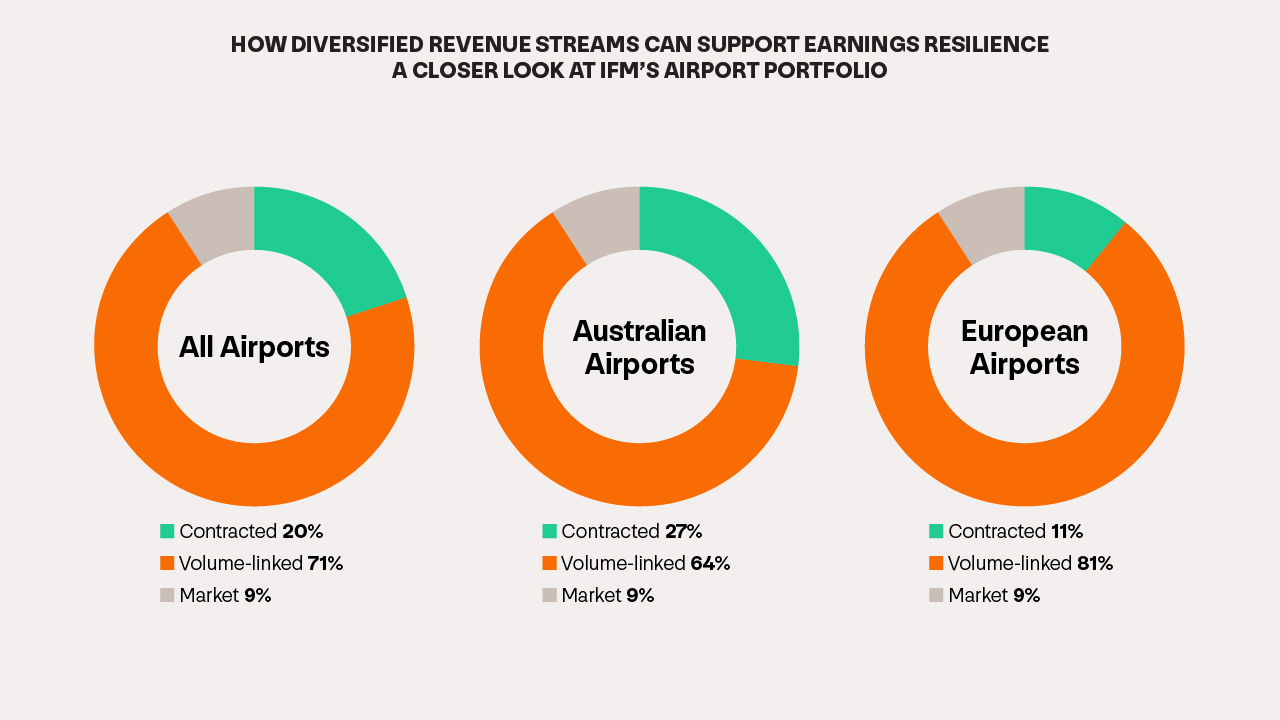
Over time, airports can deliver resilient, uncorrelated returns
Historically, airports have operated through a range of disruptions, from economic downturns and geopolitical shocks to the COVID-19 pandemic. In each case, the pattern is consistent: volumes adjust, then recover; revenues rebase, then grow; demand returns. The current environment sits well below those historical extremes.
There are also clear regional differences, particularly between Australian and European markets. Larger airports, with a contracted revenue base and well established, high-frequency routes, continue to demonstrate resilience. By contrast, smaller airports are inherently more exposed and are reliant on individual routes and carriers, and therefore more sensitive to localized demand shifts.
Resilience plays out differently across markets
Europe: Diversification across routes and carriers
Australia: Demand anchored by geography and contracted income
Case Study: How airports have adapted to past energy shocks
In early 2022, the conflict in Ukraine drove a sharp increase in global energy prices, with oil rising above $100 per barrel. This created an immediate cost shock for airlines.
Higher fuel costs fed through to moderately higher ticket prices, putting pressure on passenger demand. Low-cost and leisure segments, traditionally considered price sensitive, performed strongly during this period as individuals prioritized travel over other discretionary spending. Some customers, however, postponed booking decisions until closer to departure, reducing forward visibility for airlines
and airports and introducing greater short term uncertainty around demand.
This highlights a key dynamic: while fuel prices can move sharply, fare increases tend to be more measured, with airlines balancing cost recovery against demand sensitivity.
Passenger behavior adjusted in the near term, but this did not translate into a sustained decline in demand.
Passenger volumes recovered quickly, supported by underlying demand, network flexibility and capacity discipline. Across IFM’s airport portfolio, assets continued to deliver growth, underpinned by diversified airline partnerships and active asset management.
Rising fuel costs, steady fares
Source: InFare, US Energy Information Administration
Passenger demand rebounds as pricing pressures ease
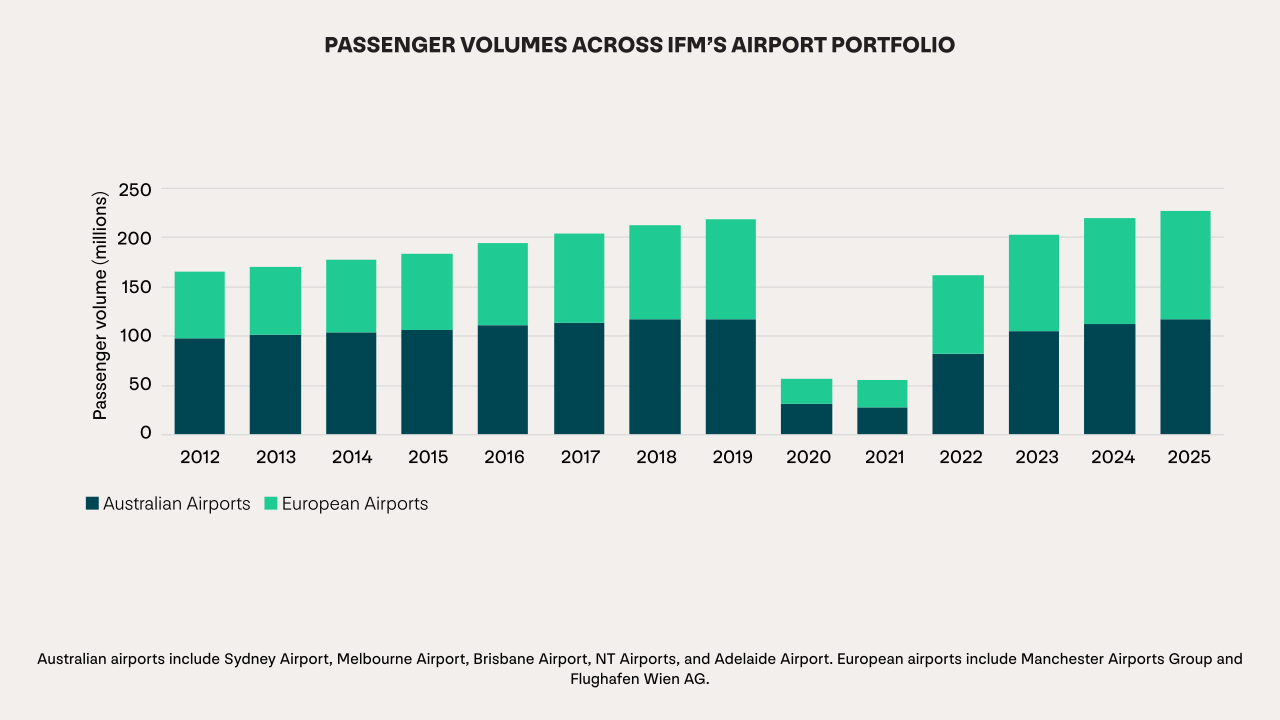
Australian airports include Sydney Airport, Melbourne Airport, Brisbane Airport, NT Airports, and Adelaide Airport. European airports include Manchester Airports Group and Flughafen Wien AG.
Case studies are provided for illustrative purposes only and should not be relied on to make an investment decision.
Conclusion
Volatility is a cycle, not a structural shift Macroeconomic and geopolitical volatility are likely to persist. Energy prices may stay elevated, and passenger demand may adjust at the margin, particularly if conflict-driven inflation weighs on discretionary travel.
But pricing pressure on airlines doesn’t translate to structural change for airport assets.
Across the portfolio, diversified revenue streams have helped support stability. Over time, strong demand and disciplined capacity management should continue to support growth. This is a period of adjustment, not dislocation. Airports remain essential, diversified assets, with fundamentals intact and volatility historically proving temporary.
Looking further ahead, the industry is also evolving. While still some way from scale, sustainable aviation fuels could help strengthen fuel supply resilience and reduce exposure to traditional energy price volatility over time.

Maximilian Fieguth
Max leads a team of Asset Management professionals responsible for implementing value creation opportunities across the IFM infrastructure portfolio, delivering global best practice initiatives, and supporting the execution of infrastructure transactions.

Ashwin Mathur
Ashwin Mathur heads up the Infrastructure Portfolio Management team at IFM Investors and is responsible for IFM’s Infrastructure portfolio construction framework.

Abbie Sui
Abbie is a senior member of the Infrastructure Portfolio Management Team, responsible for a broad set of portfolio construction, risk management and fund analysis outcomes across all of IFM Investors’ infrastructure products as well as asset management of Adelaide Airport.

Drummond Clark
Drummond is a Vice President in IFM Investors’ Infrastructure team, based in London. He is responsible for the origination, execution and asset management of infrastructure investments across Europe.
Related articles

PM700 investors display growing hunger for infrastructure assets

Adding value through active management and capital reinvestment

The infrastructure growth engine: Creating tomorrow’s core infrastructure today